Choosing the 2026 best Wpc Decking Material requires more than comparing colors, prices, and surface textures. Global buyers need evidence about climate performance, manufacturing consistency, installation requirements, and long-term maintenance. A deck beside a sunny Mediterranean pool faces different risks from one exposed to northern frost, coastal salt, or tropical rain.
Performance comes first.
This guide examines core materials, including wood fibers, recycled polymers, additives, and protective surface layers. It also considers water absorption, thermal movement, slip resistance, color stability, fire classification, and fastener compatibility. Independent test reports can support these claims, but buyers should verify current ASTM, EN, ISO, or local requirements before placing an order. Standards and building rules differ between markets.
Real projects reveal practical details. Dark boards may become hot under direct sunlight. Hollow profiles can reduce weight, yet they may require careful joist spacing. Brushed textures can improve underfoot grip, but dirt may collect inside deeper grooves. A low-maintenance promise sounds attractive. It does not mean maintenance-free. Regular cleaning, correct drainage, and suitable installation remain important.
Samples can mislead.
A small showroom board cannot show seasonal expansion, fading, or moisture behavior. Buyers should request production samples, technical datasheets, warranty terms, and independent test results. Supplier experience also matters, especially when containers cross climates and installation teams use different methods. No material performs perfectly everywhere. Even this evaluation has limits. The strongest choice is the product whose verified properties match the project’s climate, traffic, budget, and compliance needs.
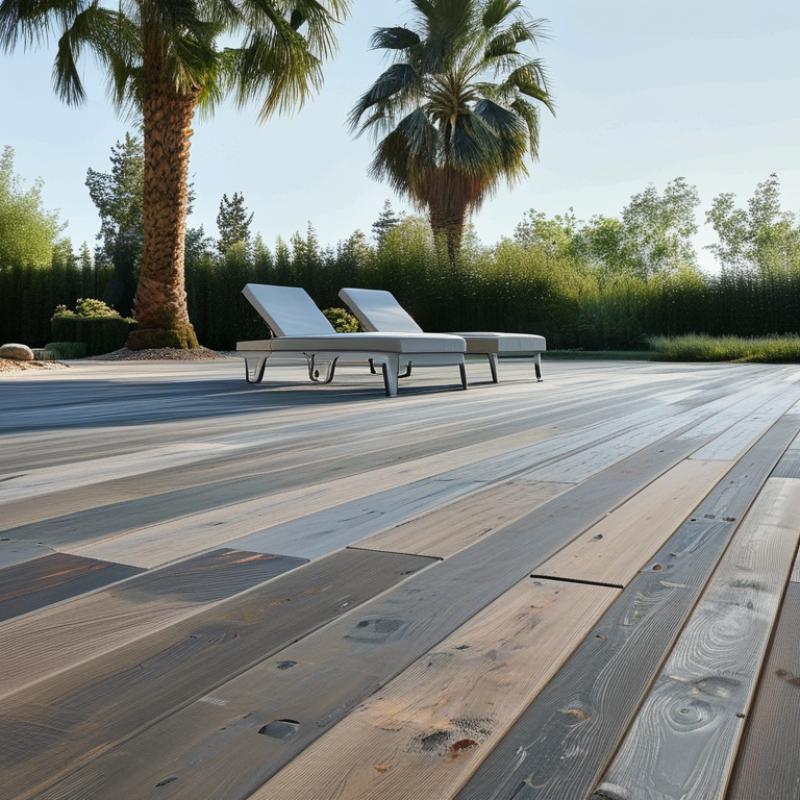
WPC decking combines wood fibers, thermoplastic resin, and performance additives. Wood content commonly ranges from 30% to 70%, but formulas differ widely. The exact balance matters. Recycled polymers can lower environmental impact, yet inconsistent feedstock may create color variation or uneven melting. Mineral fillers improve stiffness, although excessive filler can make boards brittle. In practical inspections, a dense, well-mixed profile feels stable underfoot and exposes fewer fibers after cutting.
WPC decking usually appears in hollow, solid, capped, and uncapped types. Hollow boards reduce weight and transport costs, but they need careful joist spacing and sealed ends. Solid boards handle impact better and support more reliable edge fastening, though they are heavier. Capped boards include a protective polymer layer that improves resistance to stains, moisture, and fading. It is not invulnerable. Uncapped boards may cost less, but they can absorb more moisture and require stricter drainage design. Brushed, embossed, and matte surfaces also change traction and visual depth.
Performance depends on more than resin content. Buyers should check water absorption, slip resistance when wet, UV aging, thermal expansion, and bending strength. Independent test reports are more useful than attractive samples. Dark boards can become very hot in direct sun. Expansion gaps, airflow, and substructure drainage remain essential. One detail is easy to miss: a strong board can still fail when installers ignore movement. Some specifications look precise, but site conditions rarely behave perfectly.
Evaluating WPC decking starts with climate, not appearance. In tropical regions, intense UV exposure can fade surfaces and increase heat. Check accelerated weathering results, color retention, and surface temperature data. Heavy rainfall also demands low water absorption and effective drainage beneath each board.
Cold climates create another challenge. Repeated freezing and thawing can expose weak cores, loose fasteners, or poor expansion planning. Leave movement gaps according to verified installation guidance. Coastal buyers should examine salt-air resistance and corrosion protection for clips and screws. A strong board still needs a suitable substructure.
Tips: Request independent test reports for slip resistance, water absorption, UV aging, thermal expansion, and fire performance. Compare results under similar test conditions. Ask whether the warranty covers your climate zone. Do not rely on attractive samples alone. I once underestimated afternoon heat on exposed decks; darker colors became uncomfortable quickly. That detail deserves more attention. Inspect ventilation, joist spacing, and drainage plans before ordering. A material can be technically sound yet unsuitable for a poorly designed installation.
2026 Best WPC Decking Material for Global Buyers?
A reliable WPC decking material must meet recognized performance standards, not just look like natural wood. ASTM D7032 and EN 15534 can help assess strength, weathering, and dimensional stability. However, these standards do not replace local building requirements. Buyers should request current test reports from accredited laboratories. Check bending performance, slip resistance, water absorption, UV exposure, and fire behavior. A wet board near a pool can reveal weaknesses quickly.
Safety depends on more than the board itself. Joist spacing, fasteners, drainage, ventilation, and installation quality all affect long-term performance. Some products pass laboratory tests but perform poorly after careless installation. This is a practical limitation worth admitting. Requirements also vary between climates. Hot coastal regions, freezing areas, and high-traffic spaces need different evaluations. Confirm the product’s intended use before placing a large order.
Tips: Ask for batch-specific reports, not general brochures. Review an Environmental Product Declaration when available. It should follow ISO 14025 principles and show lifecycle impacts. Recycled-content claims need clear evidence, while FSC certification generally applies to certified wood content, not the entire WPC product. Check maintenance instructions, warranty conditions, and disposal guidance. Independent documentation is more useful than impressive marketing language.
2026 Best WPC Decking Material for Global Buyers?
For global buyers, WPC decking cost is more than the board price. Freight, import duties, local labor, and joist preparation can change the final budget sharply. Zonda’s 2024 Cost vs. Value Report recorded an average U.S. composite deck project cost of about $24,206, with a 68.2% resale-value return. Regional pricing still varies widely. Treat that figure as a reference, not a quotation.
Lifespan depends on formulation, drainage, sunlight, and installation quality. The National Association of Home Builders estimates composite decking can last around 20 years, while many wood decks average about 15 years. Better WPC profiles may perform longer, but a 25-year claim is not a guarantee. I would request test results for water absorption, slip resistance, UV exposure, and freeze-thaw performance. ASTM D7032 provides a useful performance framework for composite deck boards and guardrails.
Maintenance is usually simpler than timber. Regular sweeping and seasonal washing can prevent dirt films and trapped moisture. Some surfaces still stain, fade, or become slippery under dense shade. Installation needs care. Many systems use joists spaced near 400 millimeters, but the technical sheet must control. Hidden clips, expansion gaps, ventilation, and correct screw selection affect movement and noise. The ICC building-code framework also requires attention to structural loading and guard safety. Small errors matter. A cheaper board can become expensive when installers improvise.
WPC decking generally offers a balanced combination of service life, low maintenance, and moderate installed cost. The comparison uses typical international market ranges for residential projects and excludes unusual site conditions, structural repairs, taxes, and regional labor premiums.
| Material | Typical Installed Cost | Expected Service Life | Maintenance | Installation Requirement |
|---|---|---|---|---|
| WPC decking | USD 50–150/m² | 25–30 years | Periodic cleaning; usually no staining | Ventilated substructure and expansion gaps |
| Pressure-treated softwood | USD 40–120/m² | 10–20 years | Regular sealing or staining | Standard joists, drainage, and corrosion-resistant fasteners |
| PVC decking | USD 60–160/m² | 25–30 years | Periodic cleaning; no routine staining | Ventilation, thermal-movement gaps, and suitable clips |
| Natural hardwood | USD 80–200/m² | 20–40 years | Periodic oiling and surface maintenance | Careful detailing, ventilation, and high-quality fasteners |
Selecting the best WPC decking supplier for an international project requires more than comparing catalog prices. Material consistency, export experience, and technical support often determine the real project cost.
Grand View Research reported that the global wood-plastic composites market was valued at over USD 7 billion in 2023, with construction among its major applications. MarketsandMarkets also projects continued growth through 2028, supported by demand for weather-resistant building materials. These figures show strong market momentum, but growth does not guarantee quality. Buyers should request test reports for slip resistance, water absorption, flexural strength, and color stability. Standards such as ASTM D7031 and EN 15534 can help compare products across regions.
A reliable supplier should provide traceable batch information, clear tolerances, and installation guidance adapted to local climates. Check whether the factory controls board density, surface adhesion, and moisture protection during production. For large projects, inspect packaging details closely: reinforced corners, moisture barriers, pallet stability, and readable labels can prevent costly damage at the port. Verify lead times using recent shipment records, not only a sales promise. Independent laboratory testing adds confidence, especially when project specifications differ between countries.
„Thanks to the LUVIR technology, the solder resist process could be switched directly from the previously used mask exposure to direct exposure. As an outstanding digital solution on the market, this technology has been able to demonstrate fast process times and superior quality on our certified conventional ink in production. This allowed us to fully digitize the solder mask process at low cost – without process or ink adjustments. An excellent benefit to our production in Rot am See.“
Ralf Göhringer (Head of Production WE Rot am See)
I would definitely recommend the Limata machine and team for a future company purchase
Michael Greenaway
Compunetics Inc.
“The Limata ldi has been amazing!! Best thing we did was buy this machine”
Richard Brady
GM
Circuitlabs
“Since 2019, we have been running the Limata X1000 LDI system (including LUVIR for solder mask imaging) in daily production as an addition to our current process with film. The machine was capable of properly exposing Taiyo PSR-4000 BN (DI) solder mask types on normal to high-copper boards using a new and unique direct imaging process. The machine operating interface is very user friendly which allowed for a quick technical training curve. The pre-registration processing reduced several seconds of production time at every print. Limata support and service staff is incomparable. They supported our team every step of the way at basically any time of the day or night, with literally, an immediate response time, customizing the software interface to best fit our Operations and needs.
We have exposed more than 8,000 prints since end of October, on various solder mask colors and some resist film panels. Limata, has proven to be very capable and innovative. They are a strong contender in the industry.
We have very much enjoyed this project, and working with the team!
Thank you Limata for the continued support and being a part of our growth.”
Bill Sezate
Vice President, GM
Summit Interconnect
As a replacement to our current contact exposure process with film, the LIMATA X2000 system including LUVIR-Technology was capable of properly exposing non-LDI solder mask types using a direct imaging process. The machine offers cutting edge software with a very intuitive operating interface which allowed for quick technician training curve. The dual drawer system combined with pre-registration processing reduced several seconds of production time at every machine cycle. Limata support and service staff is world class. They added software patches to keep production running at shortest possible response times, customized the software interface to best fit our in-house Operations system, and even wrote a step-by-step machine processing manual. As a result of the project, we have exposed more than 16,000 times on various product types and solder mask brands/colors. Limata, in a very short timeframe as a company, has definitely shown they are truly innovative and will be challenging the industry of direct imaging for the top spot.
Kevin Beattie
Process Engineer
TTM Technologies
Forest Grove Division
