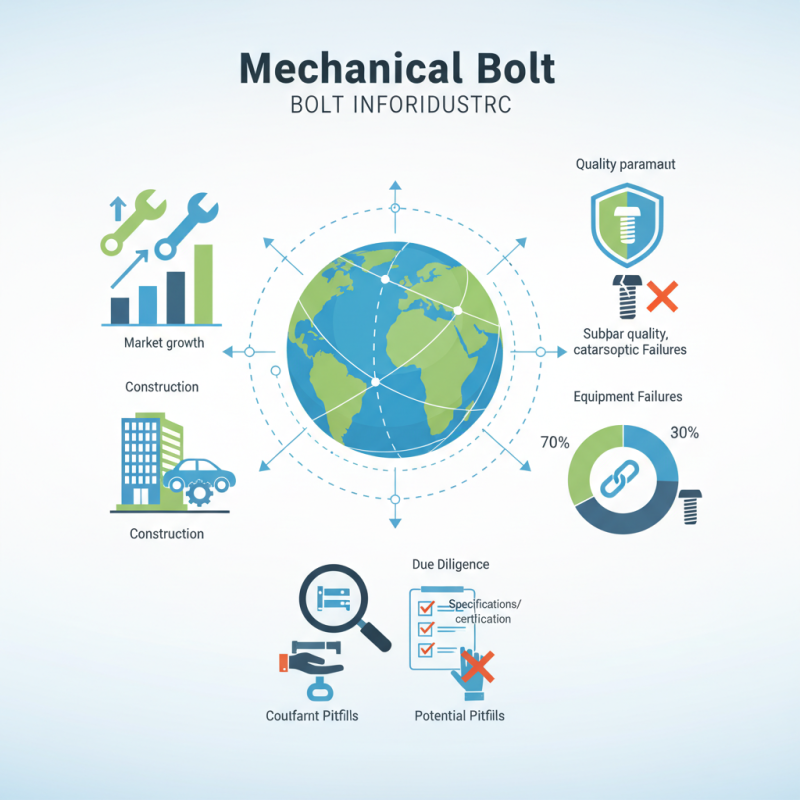
The Mechanical Bolt industry is witnessing significant growth, driven by expanding sectors such as construction and automotive. The global mechanical fasteners market, valued at over $90 billion in 2021, is expected to surpass $120 billion by 2026, according to industry reports. Mechanical bolts, crucial for structural integrity, are in high demand due to their essential role in various applications.
Quality is paramount when sourcing mechanical bolts. A subpar bolt can lead to catastrophic failures, posing safety risks and financial losses. Recent statistics indicate that 70% of equipment failures in industrial settings can be traced back to fastener issues. This highlights the need for reliable suppliers who adhere to stringent manufacturing standards and control measures.
While the market offers numerous options, not all suppliers guarantee the same reliability and performance. Due diligence in selecting the right mechanical bolt supplier is essential. Understanding the specifications and certification requirements is vital. Buyers must also be aware of the potential pitfalls in the procurement process, such as counterfeit products. This guide aims to assist global suppliers in making informed decisions, ensuring the quality and safety of their mechanical bolt purchases.
Understanding mechanical bolts is essential for anyone involved in construction, manufacturing, or repair. Mechanical bolts are designed to hold materials together securely. They come in various types, each tailored for specific applications and environments.
Common types include:
When selecting mechanical bolts for various applications, several factors come into play. The material of the bolt is crucial. Different materials offer varying levels of strength, corrosion resistance, and temperature tolerance. For instance, stainless steel bolts are robust against rust, while alloy steel can provide greater tensile strength. Assess the environment where the bolts will be used. Extreme conditions can influence bolt performance significantly.
Tip: Always check the material specifications before making a purchase. This can help avoid installation failures later.
The size and thread type of the bolt matter too. Ensure they fit the intended nuts and holes accurately. Mismatched sizes can lead to weak connections. Pay attention to the hardness ratings. Choosing bolts with appropriate hardness can prevent issues like stripping during installation.
Tip: Consider using a torque wrench. It ensures that bolts are tightened to the correct specifications, which can enhance reliability.
An often overlooked factor is the availability of replacements. In high-demand applications, unexpected failures can be costly. Keeping spare bolts on hand can save time and resources. Evaluate suppliers based on their ability to provide consistent quality. Diverse supply options may also lead to fluctuations in reliability.
Tip: Establish a relationship with trustworthy suppliers and ask about lead times. The right supplier can make a difference in maintaining operational efficiency.
When selecting mechanical bolts, understanding the materials is crucial. Steel is a common choice due to its strength. However, bolts made from stainless steel offer corrosion resistance. This feature is beneficial in environments exposed to moisture.
Other materials like titanium are lightweight and durable. They are ideal for applications where weight reduction matters. Aluminum bolts can also be used for non-structural applications, providing sufficient strength with less weight. Each material has its advantages and limitations.
It’s essential to consider the environment where these bolts will be used. Environmental factors can affect bolt performance. Misjudging these can lead to failures. Evaluating the specific requirements of your project is necessary. In turn, this ensures reliable and efficient outcomes. Understanding the properties and applications will enhance your choices when buying bolts.
The global mechanical bolt market is growing steadily, with projections indicating a compound annual growth rate (CAGR) of around 5% through 2026. This growth is driven by the rising demand from various sectors, including automotive and aerospace. Suppliers are evolving to meet these needs, focusing on quality and innovation.
When sourcing mechanical bolts, it is essential to consider the reliability of suppliers. Industry reports highlight that over 70% of mechanical failures stem from inadequate fastening solutions. Choosing suppliers who prioritize quality assurance can mitigate these risks. It's crucial to assess their manufacturing standards and certifications. Efficiency in production processes can also play a significant role in the overall performance of the bolts.
Market analysis shows a preference for new materials, like high-strength steel and advanced alloys. These materials enhance durability and reduce wear, making them appealing to various industries. However, not all suppliers adapt quickly to these changes. Companies must remain vigilant, ensuring they partner with suppliers who can offer modern solutions without compromising on quality. Investing time in researching suppliers will lead to better outcomes in projects.
This chart displays the projected market demand for different categories of mechanical bolts by 2026. The categories include high-strength bolts, standard bolts, and specialized bolts, illustrating their expected market share.
The landscape of mechanical bolt technology is evolving rapidly. Innovations are reshaping how bolts are designed, manufactured, and distributed. Suppliers must stay informed about these changes. Smart manufacturing and automation are becoming more prevalent in production. This shift enhances efficiency but necessitates new skill sets.
Sustainability is another significant trend. Eco-friendly materials are gaining traction in the manufacturing process. The challenge remains in balancing cost with sustainability. Increased demand for ethical sourcing means suppliers need to adapt quickly. The market is responding to consumer preferences for sustainable products.
Supply chains are more interconnected than ever. Real-time data analytics facilitate better decision-making. However, this complexity can lead to vulnerabilities. Disruptions in one region can impact global availability. Suppliers should focus on building resilience to mitigate risks associated with these trends.
„Thanks to the LUVIR technology, the solder resist process could be switched directly from the previously used mask exposure to direct exposure. As an outstanding digital solution on the market, this technology has been able to demonstrate fast process times and superior quality on our certified conventional ink in production. This allowed us to fully digitize the solder mask process at low cost – without process or ink adjustments. An excellent benefit to our production in Rot am See.“
Ralf Göhringer (Head of Production WE Rot am See)
I would definitely recommend the Limata machine and team for a future company purchase
Michael Greenaway
Compunetics Inc.
“The Limata ldi has been amazing!! Best thing we did was buy this machine”
Richard Brady
GM
Circuitlabs
“Since 2019, we have been running the Limata X1000 LDI system (including LUVIR for solder mask imaging) in daily production as an addition to our current process with film. The machine was capable of properly exposing Taiyo PSR-4000 BN (DI) solder mask types on normal to high-copper boards using a new and unique direct imaging process. The machine operating interface is very user friendly which allowed for a quick technical training curve. The pre-registration processing reduced several seconds of production time at every print. Limata support and service staff is incomparable. They supported our team every step of the way at basically any time of the day or night, with literally, an immediate response time, customizing the software interface to best fit our Operations and needs.
We have exposed more than 8,000 prints since end of October, on various solder mask colors and some resist film panels. Limata, has proven to be very capable and innovative. They are a strong contender in the industry.
We have very much enjoyed this project, and working with the team!
Thank you Limata for the continued support and being a part of our growth.”
Bill Sezate
Vice President, GM
Summit Interconnect
As a replacement to our current contact exposure process with film, the LIMATA X2000 system including LUVIR-Technology was capable of properly exposing non-LDI solder mask types using a direct imaging process. The machine offers cutting edge software with a very intuitive operating interface which allowed for quick technician training curve. The dual drawer system combined with pre-registration processing reduced several seconds of production time at every machine cycle. Limata support and service staff is world class. They added software patches to keep production running at shortest possible response times, customized the software interface to best fit our in-house Operations system, and even wrote a step-by-step machine processing manual. As a result of the project, we have exposed more than 16,000 times on various product types and solder mask brands/colors. Limata, in a very short timeframe as a company, has definitely shown they are truly innovative and will be challenging the industry of direct imaging for the top spot.
Kevin Beattie
Process Engineer
TTM Technologies
Forest Grove Division
