Choosing a Led Phototherapy Mask can feel simple until product pages start listing wavelengths, irradiance, treatment times, and skin benefits. For global buyers, those details matter more than polished packaging. A mask should fit comfortably, sit securely across the face, and provide clear instructions for use. Buyers should also check its wavelength specifications, eye-safety guidance, warranty, and customer support in their market.
Photomedicine researcher Dr. Michael R. Hamblin describes photobiomodulation as “the use of light to stimulate, heal, regenerate, and protect tissue.” That principle is useful, but it is not a promise that every mask will produce the same result. Evidence and device specifications vary. Be cautious with dramatic claims.
This guide compares five LED masks through practical questions: What light does each device use? How long is a session? Is the fit workable for different face shapes? Are care instructions and limitations easy to find? These checks help buyers compare products across regions without treating marketing language as clinical proof. Small details count. A stiff strap can turn a promising routine into an unused device. The comparison is not perfect; product availability and support can change by country. Still, a careful shortlist can help global buyers make a more informed choice.
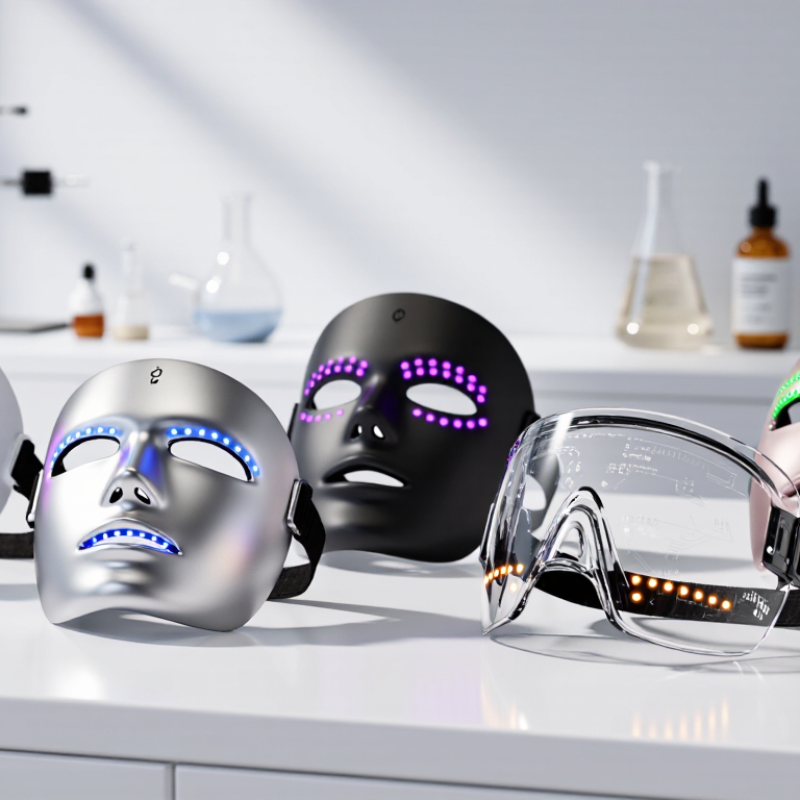
Global buyers need more than a polished product photo when comparing LED phototherapy masks. The five leading options usually include flexible silicone masks, rigid full-face masks, red-light devices, red-and near-infrared designs, and professional-style models. Each format serves a different purchasing priority. Flexible silicone improves facial contact. Rigid shells can feel more stable. Near-infrared light may reach deeper tissue, but marketing claims often exceed the available evidence.
Start with measurable specifications. Check the stated wavelengths, irradiance, treatment time, and LED coverage. A credible supplier should provide test reports, user instructions, eye-protection guidance, and clear safety warnings. Look for independent quality documentation rather than vague terms such as “medical grade.” Battery capacity matters during travel. Charging compatibility matters across regions. Confirm plug type, operating voltage, warranty length, spare parts, and return conditions before ordering.
Fit is easy to underestimate. A mask that presses against the nose may discourage regular use. A loose edge can leave uneven exposure. I would compare weight, strap adjustment, cleaning method, and heat around the eyes. Skin sensitivity also deserves attention; redness or discomfort should not be ignored. Results vary, and a longer session is not automatically better. Some purchasing decisions remain imperfect because irradiance measurements may use different testing methods. Buyers should request raw data where possible, then compare like with like.
5 Best LED Phototherapy Masks for Global Buyers
Blue light, usually 415–470 nm, targets acne-related bacteria near the skin surface. Clinical reviews report the strongest acne evidence around 415 nm, especially when combined with red light. However, results vary with acne severity, treatment frequency, and device output. Clear skin is not guaranteed.
Red light, commonly 630–660 nm, penetrates deeper and may support inflammation control and collagen-related skin repair. A 2023 review in Photodermatology, Photoimmunology & Photomedicine identified red-light protocols as promising, but noted inconsistent dosing between studies. Near-infrared light, typically 830–850 nm, reaches deeper tissue. World Association for Photobiomodulation Therapy guidance commonly places therapeutic near-infrared use within this broader range.
Check irradiance, treatment time, and wavelength accuracy. Wavelength labels alone are not enough. A mask emitting 660 nm at weak intensity may underperform. One delivering excessive energy may irritate sensitive skin. The IEC 62471 safety framework evaluates photobiological risk, including eye exposure, but it does not prove cosmetic effectiveness. That distinction matters.
Look closely at the numbers. Personally, I would compare independent testing, eye protection, heat buildup, and published dose data before choosing one. More LEDs do not automatically mean better treatment.
5 Best LED Phototherapy Masks for Global Buyers
Treatment quality depends on dose, not brightness alone. Irradiance shows how much optical power reaches each square centimeter, measured in mW/cm². Fluence shows the total energy delivered, measured in J/cm². These values help buyers compare masks more accurately across different markets and designs.
The basic calculation is simple: fluence equals irradiance multiplied by treatment time. A mask delivering 30 mW/cm² for 600 seconds provides about 18 J/cm². However, the result changes when the mask sits farther from the skin. Curved surfaces can also create uneven exposure around the nose, cheeks, and jaw. A neat number can still mislead.
Ask for test data measured at the actual skin distance. Check the wavelength range, tested area, session duration, and measurement method. Independent laboratory reports are more useful than vague terms such as “high power.” Look for clear safety instructions, eye protection guidance, and electrical compliance documents suitable for your region. Requirements may differ between countries.
Do not chase the highest irradiance. More energy is not automatically better. Follow the stated schedule and watch for persistent redness, discomfort, or unusual sensitivity. People using photosensitizing medicines should seek professional advice before treatment. No meter reading is perfect. Even small placement changes can affect the dose, so repeatable positioning matters during every session.
Compare irradiance and calculated fluence across five generic treatment profiles. Fluence is calculated as: irradiance (mW/cm²) × treatment time (seconds) ÷ 1,000.
The values represent generic reference configurations rather than branded product measurements. Buyers should confirm measured irradiance, treatment distance, wavelength range, and recommended exposure time before comparing devices.
When comparing LED phototherapy masks, safety should stand beside wavelength, comfort, and treatment results. IEC 62471 assesses photobiological risks from optical radiation, including potential harm to the eyes and skin. Ask for the applicable risk group, test conditions, measurement distance, and exposure limits. A vague “eye-safe” claim is not enough. It may hide important details.
IEC 60601 addresses the safety of medical electrical equipment, but its relevance depends on the product’s intended use and market claims. A beauty device may not require the same assessment as a regulated medical device. Buyers should request electrical safety reports, leakage-current results, insulation details, and risk-management documentation. Check whether the tested model matches the supplied model. Small design changes can matter. I have seen compliance files that looked convincing, yet lacked clear traceability.
Tips: Request original laboratory reports, not only certificates. Confirm the laboratory’s competence and report date. Review user instructions for eye protection, treatment duration, skin warnings, and charging safety. Inspect the mask for sharp edges, heat buildup, loose wiring, or uneven light output. Ask how the manufacturer controls production consistency. Standards support safer decisions, but they do not replace independent technical review. A certificate alone can still leave questions.
5 Best LED Phototherapy Masks for Global Buyers
Rank the Five Masks by Fit, Coverage, Power, Warranty, and Market Availability
Rank 1: The best overall mask should sit close to the face without pressing the nose. Its flexible shell should cover the forehead, cheeks, jawline, and chin evenly. Look for published irradiance data, not vague “high power” claims. A two-year warranty and regional voltage support strengthen its global value. Rank 2: A lightweight silicone design may win for comfort and fit. It should include adjustable straps and shielded eye areas. However, softer materials can leave small gaps near the temples. Coverage matters. Check product images carefully.
Rank 3: A rigid mask can provide stronger, more consistent positioning. It may deliver excellent red and near-infrared coverage across the central face. Still, weight becomes noticeable after ten minutes. That trade-off matters. Rank 4: A compact mask suits buyers who travel frequently. Its lower power may require longer sessions, and its coverage can stop short of the jawline. Confirm the warranty process before purchase. Rank 5: The most affordable option may offer acceptable light distribution, but limited market availability creates problems. Replacement parts, chargers, and customer support may vary by country.
For global buyers, compare independent measurements, return terms, and seller reliability. Product specifications sometimes look incomplete. That deserves caution. My ranking would change when newer testing reveals better eye protection, wider coverage, or clearer warranty service. Comfort also deserves more weight than many comparison charts give it.
„Thanks to the LUVIR technology, the solder resist process could be switched directly from the previously used mask exposure to direct exposure. As an outstanding digital solution on the market, this technology has been able to demonstrate fast process times and superior quality on our certified conventional ink in production. This allowed us to fully digitize the solder mask process at low cost – without process or ink adjustments. An excellent benefit to our production in Rot am See.“
Ralf Göhringer (Head of Production WE Rot am See)
I would definitely recommend the Limata machine and team for a future company purchase
Michael Greenaway
Compunetics Inc.
“The Limata ldi has been amazing!! Best thing we did was buy this machine”
Richard Brady
GM
Circuitlabs
“Since 2019, we have been running the Limata X1000 LDI system (including LUVIR for solder mask imaging) in daily production as an addition to our current process with film. The machine was capable of properly exposing Taiyo PSR-4000 BN (DI) solder mask types on normal to high-copper boards using a new and unique direct imaging process. The machine operating interface is very user friendly which allowed for a quick technical training curve. The pre-registration processing reduced several seconds of production time at every print. Limata support and service staff is incomparable. They supported our team every step of the way at basically any time of the day or night, with literally, an immediate response time, customizing the software interface to best fit our Operations and needs.
We have exposed more than 8,000 prints since end of October, on various solder mask colors and some resist film panels. Limata, has proven to be very capable and innovative. They are a strong contender in the industry.
We have very much enjoyed this project, and working with the team!
Thank you Limata for the continued support and being a part of our growth.”
Bill Sezate
Vice President, GM
Summit Interconnect
As a replacement to our current contact exposure process with film, the LIMATA X2000 system including LUVIR-Technology was capable of properly exposing non-LDI solder mask types using a direct imaging process. The machine offers cutting edge software with a very intuitive operating interface which allowed for quick technician training curve. The dual drawer system combined with pre-registration processing reduced several seconds of production time at every machine cycle. Limata support and service staff is world class. They added software patches to keep production running at shortest possible response times, customized the software interface to best fit our in-house Operations system, and even wrote a step-by-step machine processing manual. As a result of the project, we have exposed more than 16,000 times on various product types and solder mask brands/colors. Limata, in a very short timeframe as a company, has definitely shown they are truly innovative and will be challenging the industry of direct imaging for the top spot.
Kevin Beattie
Process Engineer
TTM Technologies
Forest Grove Division
