The ats 100 automatic transfer switch controller has transformed power management in critical applications. As organizations increasingly depend on reliable energy sources, the need for efficient transfer switches grows. According to the Global Power Management Controller Market Report, the demand for automatic transfer switch controllers is projected to rise significantly, driven by the push for energy resilience and efficiency.
These controllers not only ensure uninterrupted power during outages but also enhance operational efficiency. The ATS 100 Automatic Transfer Switch Controller features advanced monitoring capabilities. This ensures quick response times and minimal downtime. Industry experts highlight that such systems can reduce operational costs by up to 30% when integrated properly.
However, adopting these technologies is not without challenges. Organizations must carefully consider installation complexities and maintenance requirements. Each system brings unique needs that demand thoughtful evaluation. The ATS 100 Automatic Transfer Switch Controller indeed sets the standard for performance, but organizations should reflect on how well they meet their specific requirements.
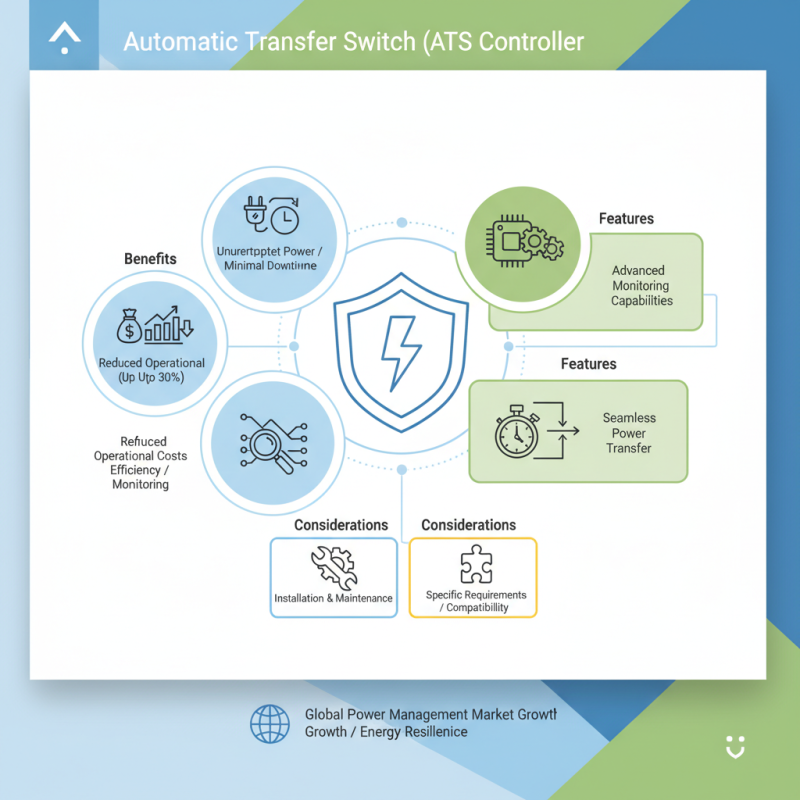
Automatic Transfer Switch (ATS) controllers are essential in modern power systems. They ensure that backup power sources activate quickly during outages. With seamless transitions, these controllers enhance reliability in critical applications. For hospitals, data centers, and manufacturing plants, uninterrupted power is crucial.
These controllers possess user-friendly interfaces. Operators can monitor power statuses and adjust settings easily. Many models feature real-time diagnostics, providing valuable data on system performance. This capability can identify issues before they escalate, aiding maintenance planning. However, reliance on technology can lead to complacency. Regular maintenance checks remain necessary for optimal function.
Integration with remote monitoring is another advantage. Personnel can oversee operations from anywhere, increasing flexibility. However, cybersecurity must be a priority. Vulnerabilities can arise, exposing systems to threats. Thus, while ATS controllers significantly improve resilience, they also require careful management and continual evaluation.
Automatic Transfer Switch (ATS) controllers play a vital role in efficient power management systems. They ensure a seamless transition between primary and backup power sources. This feature is crucial in critical applications like healthcare facilities, data centers, and industrial operations. When the primary power fails, ATS controllers automatically switch to backup power, minimizing downtime and disruptions.
One of the key benefits of ATS controllers is their reliability. They monitor power supply constantly, detecting faults and switching systems as needed. This real-time response is essential in maintaining operational integrity. However, it is worth noting that improper installation or maintenance can lead to failures. Regular checks and updates to the controllers are necessary for optimal performance.
Another significant advantage is the enhanced safety they provide. ATS controllers reduce the risk of human error during power transitions. They automate a complex process that, if done manually, could lead to dangerous situations. Users must understand the technology well to utilize its full benefits. Training staff on ATS operations is crucial for maximizing safety and reliability in power management systems.
| Feature | Description | Benefit |
|---|---|---|
| Seamless Switching | Instantaneous transfer of power sources | Ensures uninterrupted power supply during outages |
| User-friendly Interface | Intuitive controls and displays | Enhanced usability for operators |
| Remote Monitoring | Real-time performance tracking via web or app | Improved management and troubleshooting |
| Manual Override | Option to manually switch power sources | Control during emergencies |
| Integrated Diagnostics | Self-testing and diagnostics features | Early detection of potential issues |
| Compliance with Standards | Meets regulatory requirements for safety | Reduced risks and liabilities |
| Energy Efficiency | Optimizes power usage based on demand | Lower operational costs |
| Flexible Configuration | Customizable settings to fit specific needs | Adaptable to various applications |
When selecting an Automatic Transfer Switch (ATS) controller, consider its operational reliability. The controller should seamlessly switch power between the primary and backup sources. Look for features like a manual override option, which can be crucial during maintenance. Also, a real-time monitoring capability is essential. This allows you to identify issues before they escalate, ensuring an uninterrupted power supply.
Another critical aspect is compatibility with various power sources. The controller should adapt to different generator types, ensuring flexibility. User-friendly interfaces enhance usability, especially during emergencies. A comprehensive alert system for faults is also vital. It should notify users of any irregularities, allowing timely intervention.
You should also reflect on the installation process. Some controllers require complex setups, which can be a hassle. Ensure that the chosen ATS controller is scalable, accommodating future power needs. This foresight can save both time and investments later on. Evaluate each feature carefully, as the wrong choice can lead to operational challenges down the line.
When considering automatic transfer switch (ATS) controllers, understanding their technical specifications is crucial. These controllers ensure seamless power transitions, minimizing outages. The heart of an ATS controller lies in its sensors. These components detect power supply status, activating the switch to a backup system when necessary. It’s fascinating how these sensors function in real-time to provide reliability.
Programming flexibility is another noteworthy feature. Many top ATS controllers allow users to tailor settings to fit their specific needs. This customization can enhance the controller's effectiveness in diverse environments. Features like adjustable delay settings can prevent unnecessary switchovers. However, this flexibility can be overwhelming for some users, requiring careful consideration during setup.
Power capacity ratings are essential too. Controllers come with various load capacities to accommodate different applications. Choosing the right capacity is critical; too low can lead to failures. Not all specifications are clear-cut. Some users may find it difficult to interpret these ratings. Understanding these details can take time, but it pays off in ensuring proper functionality.
Automatic transfer switch (ATS) controllers play a vital role in ensuring power reliability across various sectors. In healthcare, they are crucial for maintaining uninterrupted service. Hospitals rely on ATS controllers to switch to backup generators during outages, ensuring patient safety. Research shows that 80% of hospitals use these devices to protect sensitive equipment.
In industries like data centers, the stakes are even higher. A study revealed that power interruptions can cost businesses up to $1 million per hour. ATS controllers mitigate this risk. They automate the transfer process, allowing for seamless power transitions. The equipment’s efficiency helps avoid equipment damage, ultimately reducing downtime.
Real-world applications extend beyond critical infrastructure. Small businesses also adopt ATS systems for cost-effectiveness. They minimize downtime and maintain customer trust. Yet, not all installations are perfect. Some users report issues with maintenance and system integration. Continuous improvement is necessary to address these challenges and ensure reliability across all applications.
„Thanks to the LUVIR technology, the solder resist process could be switched directly from the previously used mask exposure to direct exposure. As an outstanding digital solution on the market, this technology has been able to demonstrate fast process times and superior quality on our certified conventional ink in production. This allowed us to fully digitize the solder mask process at low cost – without process or ink adjustments. An excellent benefit to our production in Rot am See.“
Ralf Göhringer (Head of Production WE Rot am See)
I would definitely recommend the Limata machine and team for a future company purchase
Michael Greenaway
Compunetics Inc.
“The Limata ldi has been amazing!! Best thing we did was buy this machine”
Richard Brady
GM
Circuitlabs
“Since 2019, we have been running the Limata X1000 LDI system (including LUVIR for solder mask imaging) in daily production as an addition to our current process with film. The machine was capable of properly exposing Taiyo PSR-4000 BN (DI) solder mask types on normal to high-copper boards using a new and unique direct imaging process. The machine operating interface is very user friendly which allowed for a quick technical training curve. The pre-registration processing reduced several seconds of production time at every print. Limata support and service staff is incomparable. They supported our team every step of the way at basically any time of the day or night, with literally, an immediate response time, customizing the software interface to best fit our Operations and needs.
We have exposed more than 8,000 prints since end of October, on various solder mask colors and some resist film panels. Limata, has proven to be very capable and innovative. They are a strong contender in the industry.
We have very much enjoyed this project, and working with the team!
Thank you Limata for the continued support and being a part of our growth.”
Bill Sezate
Vice President, GM
Summit Interconnect
As a replacement to our current contact exposure process with film, the LIMATA X2000 system including LUVIR-Technology was capable of properly exposing non-LDI solder mask types using a direct imaging process. The machine offers cutting edge software with a very intuitive operating interface which allowed for quick technician training curve. The dual drawer system combined with pre-registration processing reduced several seconds of production time at every machine cycle. Limata support and service staff is world class. They added software patches to keep production running at shortest possible response times, customized the software interface to best fit our in-house Operations system, and even wrote a step-by-step machine processing manual. As a result of the project, we have exposed more than 16,000 times on various product types and solder mask brands/colors. Limata, in a very short timeframe as a company, has definitely shown they are truly innovative and will be challenging the industry of direct imaging for the top spot.
Kevin Beattie
Process Engineer
TTM Technologies
Forest Grove Division
