Automation is a key aspect of modern industry. To achieve efficiency, understanding the right Control Components is crucial. These components are the backbone of automated systems. They ensure smooth operations and process optimization.
Control Components can range from sensors to actuators. Each has a specific role in ensuring reliability. For instance, sensors detect changes in the environment. They provide crucial data for decision-making. Actuators, on the other hand, carry out the commands from control systems. They convert energy into motion and are vital for task completion.
Selecting the best Control Components is not straightforward. It requires an understanding of the application. Factors such as response time, accuracy, and durability come into play. Many professionals find this overwhelming. Evaluating options is essential, but it’s also complex. Reflecting on past choices can help in making better decisions for future needs.
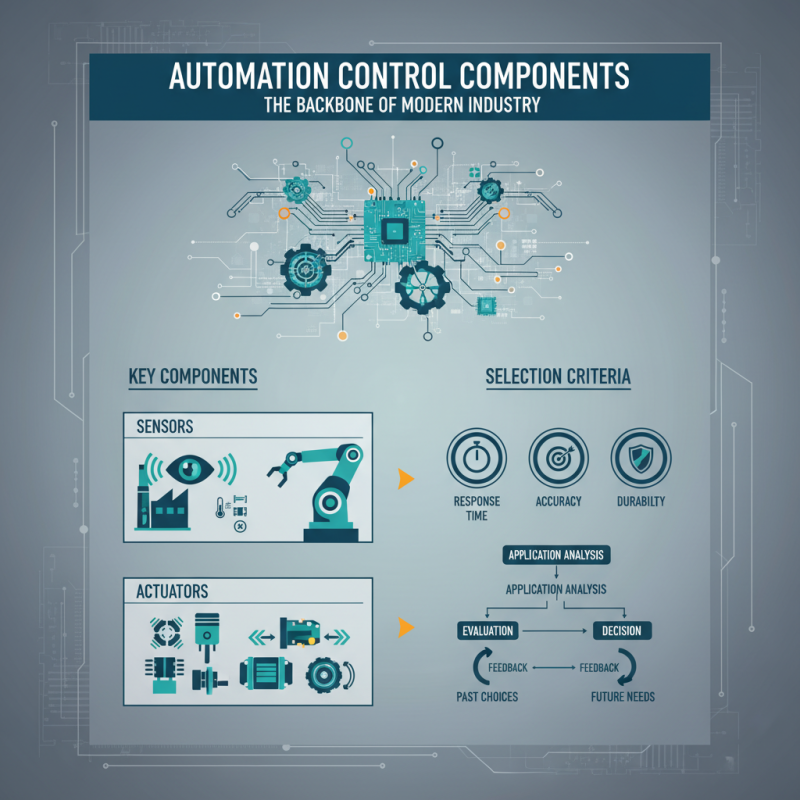
Control components are essential in automation systems. They help regulate processes and ensure efficiency. These components include sensors, actuators, and controllers. Each plays a unique role in the functioning of an automated system. Sensors collect data from the environment. Actuators convert signals into physical actions. Controllers process this information to make decisions.
When choosing control components, it’s important to consider the application. Compatibility is crucial for successful integration. Many components may not work seamlessly together. This can lead to unexpected downtime or failures. Sometimes, the complexity of the system may overwhelm even seasoned professionals.
Implementing an effective automation system requires careful planning. Testing components before full deployment is necessary. This allows for adjustments based on performance. It’s also helpful to gather feedback from the team. Continuous improvement is vital. Automation is not a one-size-fits-all solution. Each environment may present its own set of challenges.
In the realm of automation, control components play a crucial role. Sensors, for example, capture data on various parameters like temperature, pressure, and flow rates. They convert these physical quantities into electrical signals. According to industry reports, the global sensor market is expected to reach $200 billion by 2026. This growth indicates the increasing reliance on sensors for optimal automation strategies.
Another key component is the programmable logic controller (PLC). PLCs are used to automate industrial processes. They provide flexibility and can manage multiple inputs and outputs. Research shows that the PLC market is projected to grow at a CAGR of 6.5% from 2022 to 2028. However, integrating new PLC systems can be complex. Many facilities encounter challenges during implementation.
Actuators, which convert electrical signals into mechanical movement, are also vital. They play a significant role in controlling machinery. Data suggests that the actuator market will expand significantly, driven by increasing automation needs across various sectors. Nevertheless, selecting the right actuator involves consideration of various factors. These may include load capacity, speed requirements, and installation space. The choices can often seem overwhelming.
When selecting control components for automation, several key features are essential. Precision is vital. Components must accurately perform their functions to maintain operational efficiency. Responsiveness also plays a critical role. A system that reacts quickly to changes can greatly enhance productivity. The ability to integrate with existing systems is another feature to consider. This ensures seamless communication and collaboration between different components.
Durability cannot be overlooked. Automation involves significant wear and tear. Components need to withstand demanding environments without frequent failures. Monitoring capabilities are equally important. Real-time data insights allow for proactive maintenance and reduce unexpected breakdowns. Cost is always a concern, yet investing in high-quality components pays off in the long run. It's a balancing act.
One aspect often neglected is the user interface. A complex interface can lead to operator errors. Ensuring components are user-friendly enhances efficiency. Reflecting on these features can help in making more informed decisions. Sometimes, a focus on cost can result in selecting inferior components. Continuous evaluation and adaptation are necessary for success in automation.
In the realm of automation, selecting the right control components is crucial. Several options dominate the landscape, each with distinct advantages. For instance, programmable logic controllers (PLCs) are popular for their flexibility. They allow for easy reprogramming when processes change. Yet, their setup can be complicated, which may lead to errors if not done correctly. Human-machine interfaces (HMIs) offer intuitive control interfaces. However, they can become cluttered with too much information, making them overwhelming for operators.
Next, we have sensors, which are vital for feedback in automated systems. They monitor various parameters, such as temperature and pressure. Although effective, sensors can suffer from accuracy issues. Environmental factors may distort readings, necessitating regular maintenance. Likewise, actuators are integral for executing control commands. They vary from electric motors to pneumatic cylinders. Each type has specific applications, but improper selection can impact performance. Operators must understand the requirements of their systems to make informed decisions.
Automation control is a complex tapestry. Selecting components needs careful consideration and testing. The best solution isn't one-size-fits-all. Each environment presents unique challenges. An effective component for one task might not suit another. The need for ongoing evaluation and adjustment is essential in achieving automation goals.
Automation is rapidly evolving, with emerging technologies reshaping control systems. The integration of artificial intelligence (AI) brings intelligent decision-making capabilities to automation processes. Machine learning helps systems adapt based on historical data, improving efficiency. Flexible control strategies allow industries to streamline operations and respond quickly to changing demands.
Tips: Embrace adaptability in control systems. This approach can help your business stay relevant as new technologies emerge.
Another fascinating trend is the rise of Internet of Things (IoT) devices. These interconnected devices collect data in real-time, enabling better monitoring and control. However, integrating numerous devices poses a challenge. Users must prioritize cybersecurity to protect sensitive information.
Continuous improvement is essential in automation. Regularly assess your control components and processes for potential enhancements. Invest in employee training to ensure everyone understands the latest technologies. By staying engaged with industry trends, you can drive effective automation strategies.
„Thanks to the LUVIR technology, the solder resist process could be switched directly from the previously used mask exposure to direct exposure. As an outstanding digital solution on the market, this technology has been able to demonstrate fast process times and superior quality on our certified conventional ink in production. This allowed us to fully digitize the solder mask process at low cost – without process or ink adjustments. An excellent benefit to our production in Rot am See.“
Ralf Göhringer (Head of Production WE Rot am See)
I would definitely recommend the Limata machine and team for a future company purchase
Michael Greenaway
Compunetics Inc.
“The Limata ldi has been amazing!! Best thing we did was buy this machine”
Richard Brady
GM
Circuitlabs
“Since 2019, we have been running the Limata X1000 LDI system (including LUVIR for solder mask imaging) in daily production as an addition to our current process with film. The machine was capable of properly exposing Taiyo PSR-4000 BN (DI) solder mask types on normal to high-copper boards using a new and unique direct imaging process. The machine operating interface is very user friendly which allowed for a quick technical training curve. The pre-registration processing reduced several seconds of production time at every print. Limata support and service staff is incomparable. They supported our team every step of the way at basically any time of the day or night, with literally, an immediate response time, customizing the software interface to best fit our Operations and needs.
We have exposed more than 8,000 prints since end of October, on various solder mask colors and some resist film panels. Limata, has proven to be very capable and innovative. They are a strong contender in the industry.
We have very much enjoyed this project, and working with the team!
Thank you Limata for the continued support and being a part of our growth.”
Bill Sezate
Vice President, GM
Summit Interconnect
As a replacement to our current contact exposure process with film, the LIMATA X2000 system including LUVIR-Technology was capable of properly exposing non-LDI solder mask types using a direct imaging process. The machine offers cutting edge software with a very intuitive operating interface which allowed for quick technician training curve. The dual drawer system combined with pre-registration processing reduced several seconds of production time at every machine cycle. Limata support and service staff is world class. They added software patches to keep production running at shortest possible response times, customized the software interface to best fit our in-house Operations system, and even wrote a step-by-step machine processing manual. As a result of the project, we have exposed more than 16,000 times on various product types and solder mask brands/colors. Limata, in a very short timeframe as a company, has definitely shown they are truly innovative and will be challenging the industry of direct imaging for the top spot.
Kevin Beattie
Process Engineer
TTM Technologies
Forest Grove Division
