Choosing a reliable Flex Neon Strip manufacturer is more complex than comparing prices or browsing attractive product photos. Global buyers must examine brightness, color consistency, bending radius, waterproofing, heat control, voltage stability, and installation support. A strip may look excellent in a showroom, yet fail outdoors after repeated temperature changes. That uncomfortable possibility deserves attention.
Lighting engineer James R. Benya, PE, offers a useful reminder: “Evaluate the whole lighting system, not the LED alone.” His point applies directly to Flex Neon Strip sourcing. The silicone jacket, LED density, PCB design, power supply, connectors, and control system all influence the final result. One weak component can reduce service life.
This guide introduces ten manufacturers serving international buyers. Each company should be considered through practical evidence, not marketing language. We look at product customization, waterproof ratings, color options, cut marks, minimum order quantities, sample policies, certifications, warranties, and export experience. Documentation matters. So does the manufacturer’s response when something goes wrong.
Some suppliers may appear highly capable but provide limited technical data. Others may offer strong engineering but slower communication. There is no perfect ranking. That is worth admitting.
Buyers should request samples before placing volume orders. Test them in the intended environment. Bend them carefully. Check brightness at the same voltage. Inspect joints, end caps, and adhesive performance. A dependable supplier should explain limitations clearly, not promise everything. The following manufacturers offer different strengths, and this comparison helps buyers choose according to project needs, risk tolerance, and long-term performance expectations.
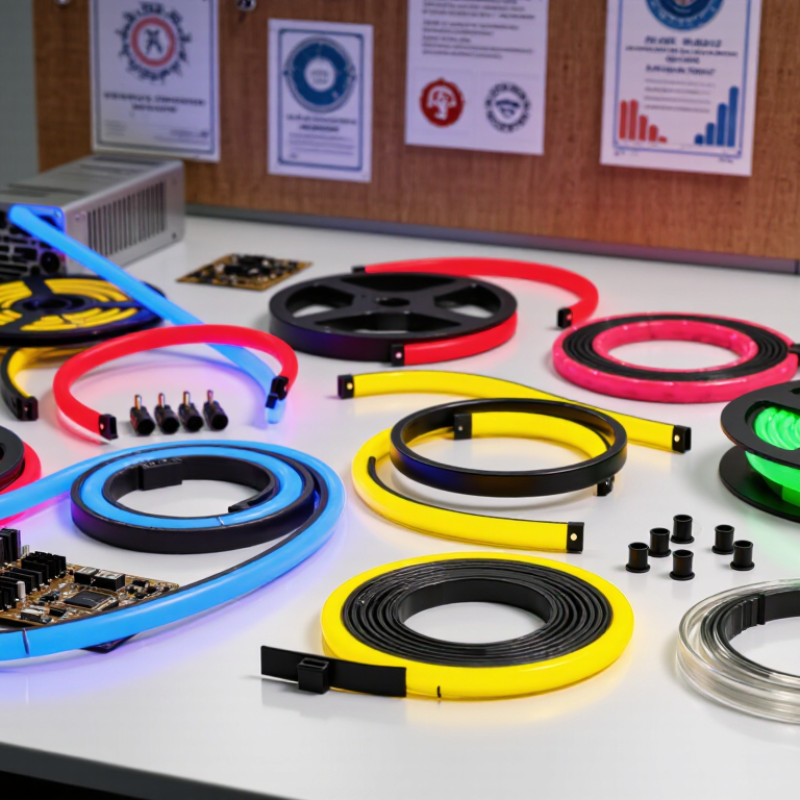
10 Best Flex Neon Strip Manufacturers for Global Buyers?
When comparing flex neon strip manufacturers, start with the electrical benchmark: 12–24 VDC operation. Lower voltage suits compact signage and short runs. Higher voltage can reduce current and visible brightness loss over longer lengths. Ask for voltage-drop data at the intended cut length, not only a showroom sample.
IP67 protection should mean more than a label. The strip needs sealed construction against dust and temporary water immersion. Check whether connectors, end caps, and power-entry points share the same rating. In practical testing, a small gap near an end cap can defeat otherwise strong protection. That detail is easy to miss. Request test reports and production inspection records from each shortlisted supplier.
A 50,000-hour lifespan is usually a conditional estimate, not a promise for every installation. Confirm the test temperature, duty cycle, LED loading, and brightness setting. Heat matters. Aluminum channels, proper spacing, and suitable power supplies help preserve color consistency and lumen output. I would also inspect sample bends, cut marks, and silicone recovery after repeated handling. Some products look excellent for one week, then show uneven light near tight curves. That finding should not be ignored. A reliable manufacturer explains limitations clearly, offers traceable batch information, and supports replacement procedures when field performance falls short.
Choosing among the 10 best flex neon strip manufacturers requires evidence beyond attractive samples. CRI 80+ suits general commercial lighting, while CRI 90+ better preserves skin tones, food colors, and artwork. However, higher CRI can reduce efficacy. Ask for photometric reports showing lumens, wattage, CCT, R9, and TM-30 results. CRI alone is incomplete.
The “90+ LEDs/m” figure describes diode density, not color quality. Confirm the actual count per meter, cut-point spacing, and brightness uniformity. A dense strip usually creates smoother neon lines and fewer dark spots around tight bends. The U.S. Department of Energy’s 2023 Solid-State Lighting R&D Opportunities report identifies efficacy and thermal control as continuing LED priorities. Check whether the supplier provides LM-80 data and TM-21 projections for the LED package. These documents reveal lumen maintenance under tested temperatures.
Warranty claims need equal scrutiny. Request the coverage period, rated operating hours, allowable ambient temperature, bending limits, and replacement procedure. A five-year warranty sounds strong, but vague exclusions weaken it. Ask for batch-level failure records, burn-in results, and IP test evidence when outdoor installation is planned. IEC 60598-1 and relevant ingress-protection testing provide useful reference points. The IEA’s Energy Efficiency 2023 report estimates lighting consumes roughly 15% of global electricity, so efficiency deserves serious attention. Still, I would not select the most efficient strip automatically. Poor thermal design can shorten its real service life. Some datasheets remain surprisingly optimistic.
The chart compares three specification tiers using measurable criteria commonly used by global buyers: color rendering index (CRI), LED density, and warranty duration. The assessment score is normalized against CRI 95, 180 LEDs/m, and a five-year warranty. Reference values are specification benchmarks rather than company or brand claims.
A comparison of ten leading flex neon strip manufacturers should begin with verified certifications, not polished catalogs. Buyers should check current UL or ETL listings, CE documentation, RoHS declarations, and IEC test reports. These documents should match the exact product series, voltage, and installation environment. A certificate for one profile may not cover every color or diffuser.
Production output also separates capable suppliers from resellers. Strong manufacturers often operate several extrusion lines, aging-test benches, and automated cutting stations. Monthly capacity may range from 50,000 to 500,000 meters, but the number alone proves little. Ask for recent production records, line utilization, and average lead times. A factory producing 300,000 meters monthly may still struggle with small custom orders.
Details matter. Inspect samples for even brightness, clean end caps, stable adhesive, and consistent silicone thickness. Request IP65 or IP67 test evidence when outdoor use is planned. Review thermal testing at full power, especially for long runs near 24 volts. One supplier may offer impressive output but weak batch traceability. Another may hold excellent certifications while lacking flexible scheduling. That trade-off deserves attention. I would also compare warranty terms, replacement procedures, and audit access. Some claims sound reliable until the documents carry expired dates or unrelated factory addresses. Independent inspection is slower, yet it can reveal uneven color temperature, loose solder joints, or packaging damage before shipment.
For global buyers, selecting a flex neon strip manufacturer requires more than comparing unit prices. MOQ affects inventory risk, especially when testing a new market or color range. Ask whether the MOQ applies per model, color, voltage, or total order. A flexible supplier may offer mixed designs within one production run. That can reduce waste.
Lead time should include sample approval, production, inspection, and export preparation. Request a written schedule with separate dates. Bend radius also needs a measurable value, not vague claims such as “highly flexible.” Ask for the minimum inner and outer radius, then test a sample around your planned sign shape. A strip that bends beautifully on a bench may show dark spots after installation. That detail is easy to miss.
Customization can include silicone hardness, pixel spacing, cable exits, waterproofing, color temperature, and packaging. Confirm drawings, tolerances, and test reports before paying for tooling. Documentation supports reliable purchasing and downstream compliance. Still, specifications can change during production, so retain approved samples. A small gap here can become a costly remake.
10 Best Flex Neon Strip Manufacturers for Global Buyers?
Pricing, Compliance, and Application Fit for Selecting the Best Supplier
A low unit price rarely represents the real project cost. Compare the complete landed price, including controllers, aluminum channels, connectors, testing, freight, and replacement stock. A 5-meter reel may look economical, but unsuitable voltage or weak thermal control can increase installation labor. The International Energy Agency reports that lighting uses approximately 15% of global electricity. Efficient LED selection therefore affects operating budgets, not only purchase prices.
Request measurable evidence before approving a supplier. Useful documents include IEC 60598 test reports, IEC 60529 IP ratings, RoHS declarations, EMC results, and photobiological safety assessments under IEC 62471. For outdoor façades, verify IP67 sealing, UV-resistant silicone, drainage design, and a stated bending radius. For hospitality interiors, check color consistency, CRI, dimming behavior, and the visible dot effect through the diffuser. Details matter.
The U.S. Department of Energy commonly associates quality LED products with lifetimes of 25,000 to 50,000 hours, but heat can reduce performance sharply. Ask for LM-80 and TM-21 data where applicable, plus a thermal test under actual installation conditions. I would also test a production sample for 500 hours. That is not perfect. It is still better than trusting glossy photographs. A supplier’s strongest evidence is repeatable testing, clear warranty limits, traceable batches, and fast technical support across the target market.
„Thanks to the LUVIR technology, the solder resist process could be switched directly from the previously used mask exposure to direct exposure. As an outstanding digital solution on the market, this technology has been able to demonstrate fast process times and superior quality on our certified conventional ink in production. This allowed us to fully digitize the solder mask process at low cost – without process or ink adjustments. An excellent benefit to our production in Rot am See.“
Ralf Göhringer (Head of Production WE Rot am See)
I would definitely recommend the Limata machine and team for a future company purchase
Michael Greenaway
Compunetics Inc.
“The Limata ldi has been amazing!! Best thing we did was buy this machine”
Richard Brady
GM
Circuitlabs
“Since 2019, we have been running the Limata X1000 LDI system (including LUVIR for solder mask imaging) in daily production as an addition to our current process with film. The machine was capable of properly exposing Taiyo PSR-4000 BN (DI) solder mask types on normal to high-copper boards using a new and unique direct imaging process. The machine operating interface is very user friendly which allowed for a quick technical training curve. The pre-registration processing reduced several seconds of production time at every print. Limata support and service staff is incomparable. They supported our team every step of the way at basically any time of the day or night, with literally, an immediate response time, customizing the software interface to best fit our Operations and needs.
We have exposed more than 8,000 prints since end of October, on various solder mask colors and some resist film panels. Limata, has proven to be very capable and innovative. They are a strong contender in the industry.
We have very much enjoyed this project, and working with the team!
Thank you Limata for the continued support and being a part of our growth.”
Bill Sezate
Vice President, GM
Summit Interconnect
As a replacement to our current contact exposure process with film, the LIMATA X2000 system including LUVIR-Technology was capable of properly exposing non-LDI solder mask types using a direct imaging process. The machine offers cutting edge software with a very intuitive operating interface which allowed for quick technician training curve. The dual drawer system combined with pre-registration processing reduced several seconds of production time at every machine cycle. Limata support and service staff is world class. They added software patches to keep production running at shortest possible response times, customized the software interface to best fit our in-house Operations system, and even wrote a step-by-step machine processing manual. As a result of the project, we have exposed more than 16,000 times on various product types and solder mask brands/colors. Limata, in a very short timeframe as a company, has definitely shown they are truly innovative and will be challenging the industry of direct imaging for the top spot.
Kevin Beattie
Process Engineer
TTM Technologies
Forest Grove Division
