Choosing the best All-Aluminum Interior Doors is not simply a matter of selecting the brightest finish. The right door must balance strength, appearance, privacy, sound control, and daily comfort. A slim aluminum frame may look elegant, yet poor hardware can create rattling, uneven gaps, or difficult closing after months of use. Small details matter.
Architect Ludwig Mies van der Rohe’s famous principle, “Less is more,” offers a useful design guide for this subject. His words were not written specifically for interior doors, but they fit aluminum design remarkably well. A clean profile, concealed hinges, and a carefully matched handle can create a quiet, architectural appearance. Still, minimalism should not hide weak construction.
Experienced installers often inspect the wall opening before recommending a door system. They check floor levels, frame depth, hinge capacity, and the door’s weight. This practical step prevents expensive adjustments later. Finish quality also deserves attention. Powder coating should feel even, without pinholes or rough edges. In humid rooms, corrosion resistance becomes more important than visual appeal alone.
There is no universal “best” type of All-Aluminum Interior Doors. A glass-panel model may suit a home office, while a solid-core aluminum door can provide better privacy for a bedroom. Sliding doors save space, but hinged doors usually offer stronger sealing and simpler maintenance. The honest answer depends on the room, budget, climate, and installation quality. Even attractive systems can disappoint when these factors are ignored.
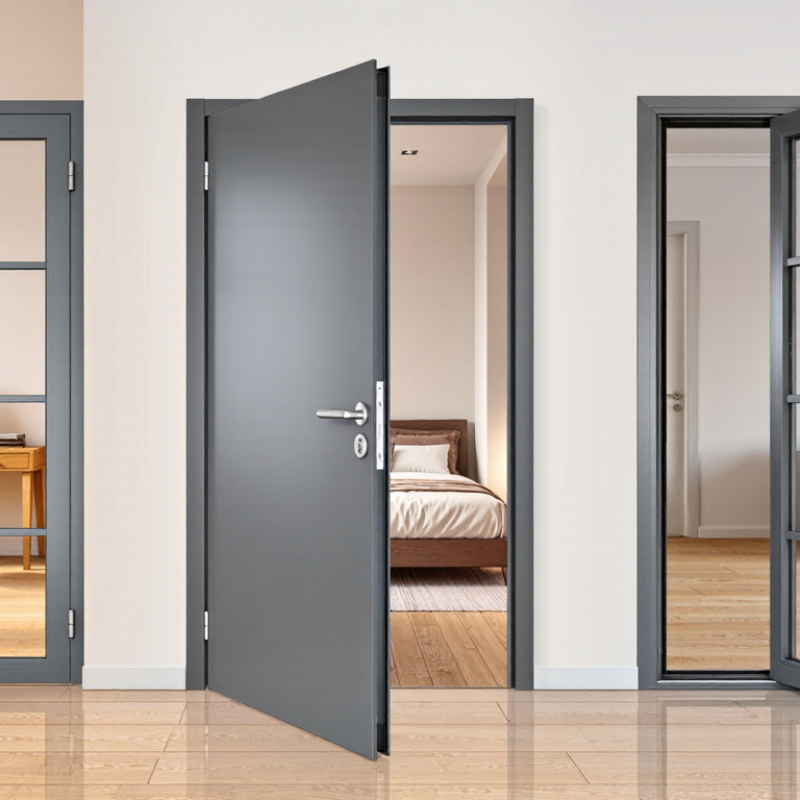
What Is the Best Type of All Aluminum Interior Doors?
Types of all-aluminum interior doors suit different rooms, layouts, and privacy needs. Hinged doors remain practical for bedrooms, offices, and bathrooms. They provide a firm seal and simple maintenance. Sliding doors save floor space in compact apartments. Their rollers need regular cleaning, especially near kitchens. Pocket doors disappear into the wall, but repairs can become difficult after installation.
Folding doors work well for wide openings between living areas. Pivot doors create a strong architectural feature, although they require careful weight calculation. A narrow aluminum frame can increase visible glass and natural light. It can also transmit more sound unless the panel uses laminated glass or acoustic seals. The National Fenestration Rating Council emphasizes tested air, water, and structural performance for door assemblies, even when interior applications face lower exposure.
Material choice also deserves attention. The International Aluminium Institute reports that recycled aluminum uses about 5% of the energy required for primary aluminum production. That supports lower-impact specifications when recycled content is verified. Grand View Research’s 2024 market analysis identifies renovation and space-saving systems as important demand drivers. Still, market growth does not prove every system performs equally. In my experience, sliding doors often look efficient, but weak hardware creates alignment problems. Check panel weight, track design, acoustic targets, and replacement access before selecting the best type.
The best type of all-aluminum interior door depends on where it will be installed. For bedrooms, offices, and bathrooms, a lightweight aluminum frame with a rigid aluminum door leaf offers a practical balance. Look for corrosion-resistant alloy, consistent wall thickness, and clean welded or mechanically joined corners. A powder-coated or anodized surface can resist scratches, moisture, and daily fingerprints. Thin metal may look elegant, but it can flex or sound hollow. That is worth checking in person.
Structural details affect long-term performance more than decoration. Reinforced hinge zones prevent sagging, especially on wide doors with glass panels. Adjustable hinges help correct alignment after installation. A concealed perimeter seal can reduce light gaps and soften closing noise. For privacy rooms, choose laminated or frosted glass with a properly supported frame. Hardware should match the door’s weight. This detail is often underestimated.
Tips: Tap the door leaf and inspect its edges. Ask for alloy information, coating specifications, hinge-load data, and installation tolerances. Measure the opening twice. A small mistake becomes obvious every day. Avoid choosing the thinnest profile only because it costs less. In my experience, a slightly heavier construction feels more stable, although it may require stronger hinges and a more careful installation. Performance depends on the complete door system, not aluminum alone.
Comparison of Door Styles and Their Uses
The best aluminum interior door depends on room function, available space, and privacy needs. In recent interior fit-outs, hinged doors remain the most dependable choice. They provide a firm seal, simple hardware, and predictable daily movement. A slim framed glass panel can brighten a hallway while separating a home office. Clear glass suits shared spaces, but frosted glass offers better privacy in bathrooms and bedrooms.
Sliding doors work well where floor space is limited. They can divide a kitchen, study, or wardrobe without needing a swing area. However, the track collects dust and requires careful cleaning. Pocket sliding systems look especially neat, yet repairs may become difficult after wall finishing.
Folding doors suit wide openings, such as dining areas or meeting rooms. Their multiple panels open quickly, although the joints may reduce acoustic control.
Pivot doors create a strong architectural feature for entrances to lounges or private offices. They need accurate alignment and enough clearance around the opening. Solid aluminum panels offer greater privacy and stronger visual separation. They can also feel heavier in a small room.
Door performance depends on frame depth, hinges, seals, glass thickness, and installation quality. A beautiful style can still fail when the floor is uneven. I once underestimated this detail during a renovation, and the door began rubbing after seasonal movement. Careful site measurement matters more than appearance alone.
Choosing the best aluminum interior door starts with the room, not the finish. Measure the opening, wall thickness, and swing direction carefully. A slim aluminum frame suits modern rooms and narrow corridors. However, frame strength matters more in busy areas. Look for powder-coated surfaces, adjustable hinges, and replaceable seals. These details reduce scratches, rattling, and early maintenance.
Glass selection needs equal attention. Clear glass adds light, while frosted or fluted glass improves privacy. For bedrooms and bathrooms, laminated safety glass is a sensible choice. Door weight also affects daily comfort. Oversized glass panels can look impressive, but weak hardware may sag over time. The Aluminum Association reports that recycling aluminum uses about 5% of the energy required for primary production. Therefore, recycled-content frames can support a more responsible specification. Still, recycled content alone does not guarantee better performance.
Tips: Ask for tested acoustic and hardware data, not vague “premium” claims. Check whether the door meets relevant ASTM or local safety requirements. For sound control, inspect the complete assembly, including seals and the wall. A beautiful door can perform poorly beside a hollow partition. Choose a thermal-break frame only when temperature differences or condensation are real concerns. Interior doors rarely need maximum insulation. That money may be better spent on stronger hinges. I have seen specifications focus too heavily on appearance. That mistake is easy to repeat. Compare samples under daylight, test the latch by hand, and confirm replacement-part availability before ordering.
How to Choose the Best Aluminum Interior Door
This comparison uses a practical 1–5 rating scale based on typical design characteristics. Solid-panel aluminum doors generally provide the highest privacy and sound control, glass-panel doors maximize daylight, and louvered doors provide the best natural ventilation. The best choice depends on whether privacy, light, airflow, or easy maintenance is your main priority.
For most interior applications, the best all-aluminum door combines a powder-coated frame with a solid-core or acoustic panel. The right choice depends on the room’s demands. Bathrooms need sealed edges and corrosion-resistant hardware. Offices may benefit from acoustic infill and compression seals. A lightweight hollow panel looks modern, but it can sound tinny and dent easily. It is not always the cheapest choice.
Installation strongly affects long-term performance. Measure the opening at several points before ordering. The frame must sit plumb, level, and square. Even a small alignment error can cause rubbing, uneven gaps, or latch failure. Use compatible fasteners, especially where aluminum meets steel. Protect the finished surface during construction. A careless drill mark may become a permanent visual defect. Leave enough clearance for the selected hinges and floor finish.
Maintenance is simple, but consistency matters. Clean the frame with mild soap, clean water, and a soft cloth. Avoid abrasive pads and strong solvents. Inspect hinges, handles, seals, and latches every few months. Tighten loose hardware before movement becomes damage. Remove dust from sliding tracks promptly. Powder coating usually remains stable indoors, although deep scratches still need attention. A perfect door does not exist. Good installation and modest care often matter more than an expensive specification.
„Thanks to the LUVIR technology, the solder resist process could be switched directly from the previously used mask exposure to direct exposure. As an outstanding digital solution on the market, this technology has been able to demonstrate fast process times and superior quality on our certified conventional ink in production. This allowed us to fully digitize the solder mask process at low cost – without process or ink adjustments. An excellent benefit to our production in Rot am See.“
Ralf Göhringer (Head of Production WE Rot am See)
I would definitely recommend the Limata machine and team for a future company purchase
Michael Greenaway
Compunetics Inc.
“The Limata ldi has been amazing!! Best thing we did was buy this machine”
Richard Brady
GM
Circuitlabs
“Since 2019, we have been running the Limata X1000 LDI system (including LUVIR for solder mask imaging) in daily production as an addition to our current process with film. The machine was capable of properly exposing Taiyo PSR-4000 BN (DI) solder mask types on normal to high-copper boards using a new and unique direct imaging process. The machine operating interface is very user friendly which allowed for a quick technical training curve. The pre-registration processing reduced several seconds of production time at every print. Limata support and service staff is incomparable. They supported our team every step of the way at basically any time of the day or night, with literally, an immediate response time, customizing the software interface to best fit our Operations and needs.
We have exposed more than 8,000 prints since end of October, on various solder mask colors and some resist film panels. Limata, has proven to be very capable and innovative. They are a strong contender in the industry.
We have very much enjoyed this project, and working with the team!
Thank you Limata for the continued support and being a part of our growth.”
Bill Sezate
Vice President, GM
Summit Interconnect
As a replacement to our current contact exposure process with film, the LIMATA X2000 system including LUVIR-Technology was capable of properly exposing non-LDI solder mask types using a direct imaging process. The machine offers cutting edge software with a very intuitive operating interface which allowed for quick technician training curve. The dual drawer system combined with pre-registration processing reduced several seconds of production time at every machine cycle. Limata support and service staff is world class. They added software patches to keep production running at shortest possible response times, customized the software interface to best fit our in-house Operations system, and even wrote a step-by-step machine processing manual. As a result of the project, we have exposed more than 16,000 times on various product types and solder mask brands/colors. Limata, in a very short timeframe as a company, has definitely shown they are truly innovative and will be challenging the industry of direct imaging for the top spot.
Kevin Beattie
Process Engineer
TTM Technologies
Forest Grove Division