The global glass market is expanding, creating stronger demand for dependable architectural hardware. Grand View Research estimates that the market could reach about USD 226 billion by 2030. This growth supports new opportunities for every Glass Shelf Brackets Supplier serving retail, hospitality, and residential projects.
A bracket is small, but its responsibilities are not. It must support the glass, protect its edges, and maintain a clean visual line. Technical choices include load capacity, fixing depth, screw quality, corrosion resistance, and compatibility with tempered glass. According to the Glass and Glazing Federation, correct specification and installation remain essential for safe glazing performance. That guidance matters when a shelf carries bottles, ceramics, or display products above customers’ heads.
Hardware consultant Peter Date offers a practical reminder: “A shelf is only as reliable as its weakest fixing.” The sentence sounds simple. It deserves attention.
Experienced suppliers usually provide load testing, material certificates, installation drawings, and sample verification. Stainless steel and zinc-alloy fittings may look similar, yet their performance can differ sharply in humid environments. A polished finish also cannot hide poor thread engagement or uneven wall anchoring.
China remains a major manufacturing base for glass hardware, combining machining capacity with flexible customization. However, low price alone is not proof of reliability. Buyers should examine production experience, quality-control records, packaging protection, and after-sales response. Even careful sourcing can miss a detail. That is why this guide evaluates China’s leading suppliers through evidence, technical capability, and practical project experience.
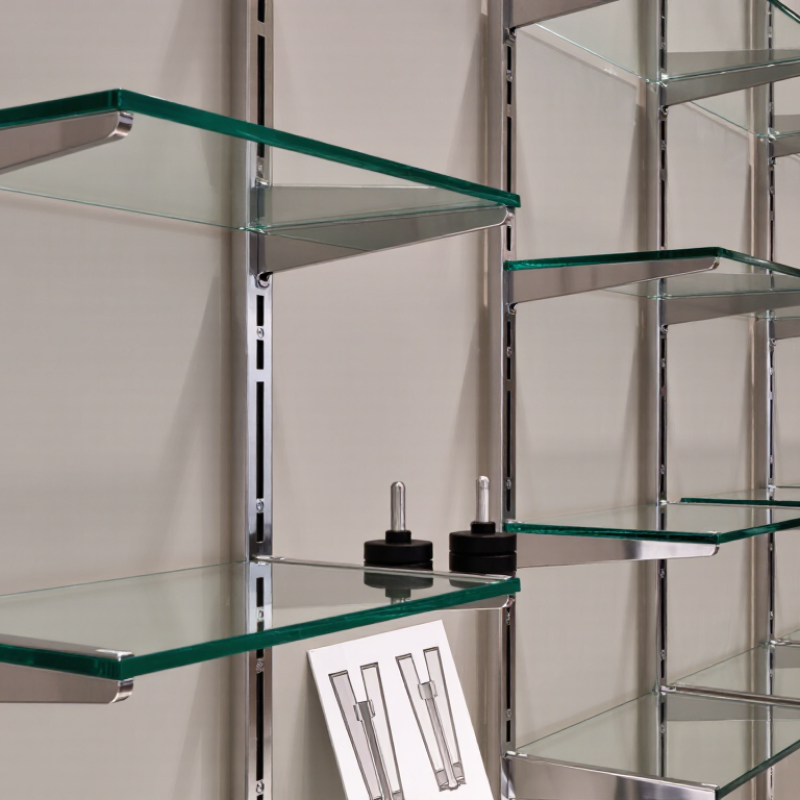
Glass shelf brackets are commonly designed for 6–12 mm glass, but that range is not universal. A 6 mm panel may sit securely in a bracket with a correctly sized gasket, while 12 mm glass needs a wider channel and suitable clamping depth. Check the manufacturer’s load rating and glass-thickness range before specifying hardware. The National Glass Association’s glazing guidance emphasizes matching glazing components to the glass and installation conditions; bracket fit should be verified against the actual panel, not guessed from appearance.
Small details matter. A thin rubber liner helps prevent glass-to-metal contact, while an uneven wall can twist the shelf and concentrate stress near an edge. For a long shelf carrying heavy objects, use enough support points and follow the bracket maker’s stated load limits. Glass thickness alone does not determine safe capacity; shelf span, glass type, fixing method, and load distribution all matter. One practical check: test the fit with a sample offcut before installation. It can save rework.
Tips: Measure the glass with calipers, including any coating or edge finish that affects seating. Confirm whether the bracket is intended for 6, 8, 10, or 12 mm glass. Do not force a panel into a tight channel. A snug fit is useful; pressure at the edge is not. When specifications are unclear, ask the supplier for a written compatibility range and installation instructions.
| Bracket type | Typical glass compatibility | Common mounting method | Typical applications | Selection notes |
|---|---|---|---|---|
| Adjustable glass clamp bracket | Often designed for approximately 6–12 mm glass; verify the specified adjustment range. | Screw-fixed to a wall or cabinet; padded jaws grip the glass edge. | Display shelves, bathroom storage, and retail fixtures. | Check pad material, clamp opening, and the bracket’s stated load rating. |
| Fixed-size glass clamp | Usually made for a specific thickness, such as 6, 8, 10, or 12 mm. | Screw-fixed clamp with a fitted insert or cushioning pad. | Cabinet shelving, shop displays, and glass partitions with shelves. | Match the actual glass thickness to the product specification; do not force glass into an undersized clamp. |
| Side-mount glass shelf support | Commonly available for glass around 6–10 mm; some designs accommodate thicker panels. | Fastened to a vertical wall or cabinet side, supporting the shelf edge. | Recessed cabinets, bookcases, and built-in display units. | Use a matched pair or the number specified for the shelf size and expected load. |
| Glass shelf pin with retaining pad | Typically suited to shelf edges within a model-specific range, often around 5–8 mm. | Pin fits a pre-drilled cabinet hole; a pad or clip helps retain the glass. | Adjustable cabinet shelves and lightweight display storage. | Confirm pin diameter, hole spacing, shelf thickness, and retention design. |
| Under-shelf glass support | Varies by design; many models are specified for glass in the 6–12 mm range. | Mounted beneath the shelf, usually with a padded contact surface. | Wall-mounted display shelves and furniture installations. | Check the support footprint, fixing substrate, and load limits for the complete installation. |
| Glass-to-wall standoff support | Often offered for 8–12 mm glass; compatibility depends on the clamp or through-fixing design. | Anchored to the wall, with the glass held by a clamp or specified fixing system. | Decorative shelves and contemporary retail or interior displays. | Confirm whether the glass requires holes; drilled glass must be ordered and processed accordingly. |
Compatibility ranges are typical examples, not universal standards. Always verify the bracket manufacturer’s specified glass-thickness range, load rating, fixing requirements, and installation instructions. Avoid direct metal-to-glass contact, and do not drill or cut tempered glass after tempering.
For glass shelf brackets, stainless steel grade matters most where moisture and cleaning habits vary. Grade 304 contains chromium and nickel, offering dependable corrosion resistance for many indoor bathrooms, kitchens, and retail displays. It is often a practical choice for dry rooms and controlled interiors. A damp cloth is enough.
Grade 316 includes molybdenum, which improves resistance to chlorides found in coastal air, pool areas, and some cleaning products. For a shelf near a seaside window, that added resistance can help reduce tea-colored stains around screw heads. It does not make the steel corrosion-proof; standing saltwater and neglected deposits can still cause problems. Small details matter.
Finish also affects upkeep. Brushed surfaces can hide fingerprints better than mirror-polished ones, though scratches may show differently under strong light. Buyers should confirm the stated steel grade through material documentation, rather than relying on appearance alone.
Check welds, edges, and fastener material too. A 316 bracket paired with lower-grade screws may still develop visible rust. I have seen specifications focus on the bracket body while overlooking the screws. That is easy to miss.
Neither grade determines safe shelf capacity by itself; glass thickness, bracket spacing, wall anchors, and installation quality all need to match the intended load.
For global buyers, glass shelf brackets are only as dependable as the glass and quality controls behind them. EN 12150-1 specifies requirements for thermally toughened soda-lime silicate safety glass, including fragmentation and flatness. It does not certify a bracket or prove that every glass panel suits every fitting. Check glass thickness, hole position, edge finish, and the bracket’s stated load capacity together. A clean, polished edge matters. So does correct installation.
Quality management provides another useful check. ISO’s 2022 Survey recorded 1,265,216 valid ISO 9001 certificates worldwide, showing the standard’s broad use across industries. Certification indicates a documented quality management system; it is not a guarantee that each shipment is flawless. Ask suppliers how they inspect dimensions, coatings, fasteners, and packaging, and whether batch records are available. In practical checks, a bracket may look sturdy while uneven contact creates pressure on the glass. That detail is easy to overlook, and specifications alone may not reveal it. Evaluate samples and installation guidance before approving a large order.
ISO 9001 edition publication years provide context for quality management. EN 12150-1:2015 covers thermally toughened soda lime silicate safety glass; ISO 9001:2015 specifies requirements for quality management systems. The chart shows standard publication history, not product test results or supplier certifications.
A bracket’s load rating is only meaningful when the full installation is considered. Check the supplier’s stated capacity, recommended glass thickness, bracket spacing, and fixing method before selecting hardware. A rating from a controlled test may not reflect a wall with weak plaster or loose anchors. The wall matters.
For a typical installation, mark bracket positions with a level, then confirm they support the shelf near its intended load points. Use fixings suited to the wall material, and follow the specified tightening method. Over-tightening can stress glass; under-tightening may let it shift. Do not assume every glass edge or finish handles pressure equally well.
Testing should match real use. Apply weight gradually and evenly, then inspect for movement, slipping, cracked glass, or loose screws. Keep people clear while checking. Repeat after installation and after any change in load. A simple test is useful, but it cannot replace documented capacity data or a qualified assessment for demanding applications. I would also record the glass thickness and fixing details; these are easy to overlook later.
For global buyers, a glass shelf bracket is a small part with little room for guesswork. Ask China suppliers for drawings that specify glass thickness, hole positions, finish, and load rating. Request test records for the bracket-and-fixing combination, not just the metal component. A polished sample may look right, yet wall anchors can perform differently across substrates. This detail is easy to overlook.
Compliance should be checked against the destination market and the project’s use conditions. Review material declarations, inspection records, and any applicable test reports; confirm that report models match the quoted product. UNCTAD’s Review of Maritime Transport 2024 notes that over 80% of world merchandise trade by volume moves by sea. That makes export readiness practical, not cosmetic: confirm carton protection, moisture control, packing lists, and shipping marks before production. One more check. Ask the supplier to photograph packed cartons and verify dimensions against the booking plan.
Tips: Send a marked-up shelf drawing and a physical glass sample where possible. Get written approval for the finish and load-test method. I would still allow time for one revision; specifications rarely arrive perfect on the first pass.
„Thanks to the LUVIR technology, the solder resist process could be switched directly from the previously used mask exposure to direct exposure. As an outstanding digital solution on the market, this technology has been able to demonstrate fast process times and superior quality on our certified conventional ink in production. This allowed us to fully digitize the solder mask process at low cost – without process or ink adjustments. An excellent benefit to our production in Rot am See.“
Ralf Göhringer (Head of Production WE Rot am See)
I would definitely recommend the Limata machine and team for a future company purchase
Michael Greenaway
Compunetics Inc.
“The Limata ldi has been amazing!! Best thing we did was buy this machine”
Richard Brady
GM
Circuitlabs
“Since 2019, we have been running the Limata X1000 LDI system (including LUVIR for solder mask imaging) in daily production as an addition to our current process with film. The machine was capable of properly exposing Taiyo PSR-4000 BN (DI) solder mask types on normal to high-copper boards using a new and unique direct imaging process. The machine operating interface is very user friendly which allowed for a quick technical training curve. The pre-registration processing reduced several seconds of production time at every print. Limata support and service staff is incomparable. They supported our team every step of the way at basically any time of the day or night, with literally, an immediate response time, customizing the software interface to best fit our Operations and needs.
We have exposed more than 8,000 prints since end of October, on various solder mask colors and some resist film panels. Limata, has proven to be very capable and innovative. They are a strong contender in the industry.
We have very much enjoyed this project, and working with the team!
Thank you Limata for the continued support and being a part of our growth.”
Bill Sezate
Vice President, GM
Summit Interconnect
As a replacement to our current contact exposure process with film, the LIMATA X2000 system including LUVIR-Technology was capable of properly exposing non-LDI solder mask types using a direct imaging process. The machine offers cutting edge software with a very intuitive operating interface which allowed for quick technician training curve. The dual drawer system combined with pre-registration processing reduced several seconds of production time at every machine cycle. Limata support and service staff is world class. They added software patches to keep production running at shortest possible response times, customized the software interface to best fit our in-house Operations system, and even wrote a step-by-step machine processing manual. As a result of the project, we have exposed more than 16,000 times on various product types and solder mask brands/colors. Limata, in a very short timeframe as a company, has definitely shown they are truly innovative and will be challenging the industry of direct imaging for the top spot.
Kevin Beattie
Process Engineer
TTM Technologies
Forest Grove Division
