China has become a major source of professional wellness and photobiomodulation equipment. Among its growing product categories, the Red Light Therapy Bed attracts clinics, recovery centers, beauty facilities, and home users seeking full-body light exposure.
This guide examines ten leading Chinese manufacturers associated with this equipment. It does not treat factory size or online visibility as proof of quality. Instead, the comparison considers LED wavelength ranges, irradiance reporting, treatment coverage, cooling systems, electrical safety, warranty support, and customization experience. These details matter when a bed operates for several sessions each day.
A reliable manufacturer should explain testing methods clearly. Buyers should ask for product specifications, user manuals, factory inspection records, and applicable safety certifications. Evidence also matters. Marketing claims about pain relief, skin renewal, or recovery should be separated from findings supported by independent research. Some suppliers provide impressive photographs but limited technical data. That weakness deserves attention.
The list is therefore a practical starting point, not a permanent verdict. Manufacturing capabilities, certifications, and after-sales policies can change. Regional compliance requirements may also differ. Readers should verify current documents before placing an order. A factory visit, live equipment demonstration, or sample evaluation can reveal issues that brochures hide, including uneven illumination, fan noise, and uncomfortable heat.
With careful comparison, buyers can identify manufacturers that offer consistent construction, transparent communication, and realistic performance expectations. The strongest supplier is not always the cheapest or most visible. Reliability is usually found in the details.
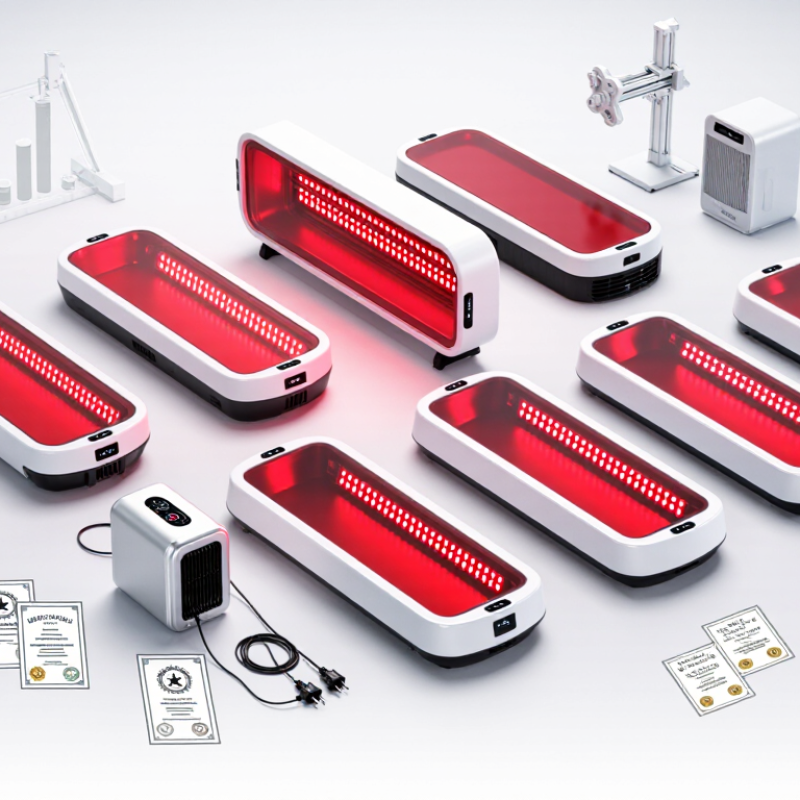
Red Light Therapy Beds are large panels fitted with red and near-infrared LEDs. They usually expose much of the body at once. Common wavelengths range from about 630–660 nanometers for red light and 810–850 nanometers for near-infrared light. These figures vary between devices.
The process is called photobiomodulation. Light energy may be absorbed by cellular structures, including mitochondria, and influence signaling, circulation, and inflammatory responses. Research suggests possible benefits for skin appearance, wound recovery, and muscle soreness. Results depend on wavelength, irradiance, treatment time, and regular use. More light is not automatically better.
Small details matter. A reliable evaluation should include measured output, clear safety instructions, eye protection guidance, and realistic clinical claims. Professional experience also shows that users often confuse warmth with effectiveness. They are not the same. Red light beds are generally non-invasive, but they can still cause eye discomfort, skin irritation, or overheating. People using photosensitizing medication, or managing a light-sensitive condition, should consult a qualified clinician before treatment. The science is promising, yet uneven. Some studies are small, and long-term evidence remains limited. That uncertainty deserves honest attention.
Red light therapy beds use arrays of LEDs to expose much of the body to red and near-infrared light. Common wavelengths include approximately 630–660 nm for visible red light and 810–850 nm for near-infrared light. The chart shows the photon energy associated with representative wavelengths, calculated using the relationship E ≈ 1240 ÷ wavelength (nm).
Photon energy is only one technical factor. Actual treatment outcomes also depend on irradiance, exposure time, treatment distance, coverage, and the resulting dose. These values vary by device and should be verified from independent measurements rather than inferred from wavelength alone.
Evaluating Chinese red light therapy bed manufacturers requires more than comparing prices. Grand View Research reported that the global LED light therapy market was valued at about USD 1.1 billion in 2023. Its projected growth makes supplier quality increasingly important. Buyers should request independent tests for wavelength accuracy, irradiance, treatment uniformity, heat output, and electrical safety. A strong supplier provides dated laboratory reports, not only factory screenshots.
Check whether the manufacturer operates under ISO 13485 quality procedures. For electrical products, review evidence related to IEC 60601-1 and IEC 60601-1-2, where applicable to the intended market. Ask for production records, component traceability, calibration certificates, and failure-rate data. The European Commission’s 2023 medical-device reporting emphasizes stronger evidence and post-market surveillance, so after-sales support deserves equal attention. Confirm spare-part availability, warranty terms, technician training, and response times before signing.
Test a physical sample under realistic conditions. Measure light levels at the bed surface, sides, and user position. Uneven exposure is easy to miss. A glossy compliance label proves little without a verifiable certificate number. Factory size can also mislead; a smaller producer may control assembly better than a large trading company. This remains a judgment call. I would score documented testing, engineering experience, export history, and transparent communication above marketing claims. Claims about medical outcomes should be checked against peer-reviewed evidence, because many commercial promises exceed current research.
China’s top ten red light therapy bed manufacturers are often evaluated through more than product appearance. Reliable factories show production records, trained technicians, and consistent quality checks. Their beds commonly combine red wavelengths around 630–660 nanometers with near-infrared light around 810–850 nanometers. Actual output matters more than colorful marketing.
A professional supplier should provide irradiance data, testing reports, user manuals, and clear warranty terms. Factory audits can reveal practical details, such as LED placement, cooling design, cable protection, and cleaning access. Look for documented electrical safety and photobiological testing. Export experience also helps, but it does not guarantee dependable performance. Some manufacturers have strong engineering teams but weak after-sales support. That gap can become expensive.
The strongest candidates among China’s top ten usually offer sample testing before large orders. Buyers should measure light intensity at the treatment surface, not only trust laboratory brochures. Ask how each bed performs after repeated operation.
Heat buildup is easy to overlook. A quiet cooling fan and stable frame improve daily use. Compliance requirements differ by market, so technical files must match the destination country. No ranking is flawless. A polished factory tour can still hide inconsistent assembly. Careful verification remains necessary, especially when product claims sound too perfect.
When evaluating China’s top red light therapy bed manufacturers, product details matter more than polished catalogs. Professional buyers should check wavelength ranges, measured irradiance, treatment timers, cooling systems, and LED lifespan. A useful bed should deliver even light across the body, not create bright and weak zones. Emergency stops, eye protection guidance, quiet ventilation, and stable electrical controls also deserve close attention.
Certifications require careful verification. ISO 9001 may indicate quality management, while ISO 13485 relates to medical-device manufacturing systems. CE documentation may support access to certain markets, but its scope must match the actual product. Ask for electrical safety reports, electromagnetic compatibility testing, factory audit records, and serial-number traceability. A certificate alone is not enough. I would request current copies and confirm the issuing organization.
Customization services can include wavelength combinations, panel layouts, bed dimensions, voltage options, control interfaces, branding, packaging, and user manuals. Strong manufacturers usually provide drawings, prototypes, sample testing, and clear production timelines. Buyers should compare the promised irradiance with independent measurements from a delivered sample. This step can reveal uneven output or uncomfortable heat. Some specifications may change during production, and that risk is easy to overlook. Reliable communication, spare-part availability, installation guidance, and warranty terms help reduce operational problems.
Choosing among China’s top 10 red light therapy bed manufacturers requires more than comparing catalogue prices. Start with your intended use, treatment space, and local compliance requirements. A dependable manufacturer should provide clear irradiance data, wavelength ranges, electrical safety documents, and photobiological safety test reports. Do not accept vague claims such as “maximum power” without measurement conditions.
Request a working sample before placing a large order. Check the light coverage across the bed, timer accuracy, cooling noise, and emergency shutoff. Ask how the factory controls LED consistency between production batches. An experienced supplier should explain testing procedures without avoiding technical questions. Factory photographs help, but an independent audit offers stronger evidence. Small details matter, including cable quality, hinge strength, ventilation openings, and cleaning instructions.
Review warranty terms carefully. Confirm replacement parts, response times, installation support, and shipping responsibilities in writing. Ask for references from businesses with similar operating conditions. Their feedback may reveal problems that sales materials hide. I once focused too heavily on output figures and overlooked service access; that was a costly lesson. High specifications mean little if repairs require weeks of international shipping. Compare total ownership costs, not only the purchase price. A manufacturer that welcomes third-party inspection usually demonstrates greater accountability. Still, no supplier is perfect, so record every promise and verify it before payment.
„Thanks to the LUVIR technology, the solder resist process could be switched directly from the previously used mask exposure to direct exposure. As an outstanding digital solution on the market, this technology has been able to demonstrate fast process times and superior quality on our certified conventional ink in production. This allowed us to fully digitize the solder mask process at low cost – without process or ink adjustments. An excellent benefit to our production in Rot am See.“
Ralf Göhringer (Head of Production WE Rot am See)
I would definitely recommend the Limata machine and team for a future company purchase
Michael Greenaway
Compunetics Inc.
“The Limata ldi has been amazing!! Best thing we did was buy this machine”
Richard Brady
GM
Circuitlabs
“Since 2019, we have been running the Limata X1000 LDI system (including LUVIR for solder mask imaging) in daily production as an addition to our current process with film. The machine was capable of properly exposing Taiyo PSR-4000 BN (DI) solder mask types on normal to high-copper boards using a new and unique direct imaging process. The machine operating interface is very user friendly which allowed for a quick technical training curve. The pre-registration processing reduced several seconds of production time at every print. Limata support and service staff is incomparable. They supported our team every step of the way at basically any time of the day or night, with literally, an immediate response time, customizing the software interface to best fit our Operations and needs.
We have exposed more than 8,000 prints since end of October, on various solder mask colors and some resist film panels. Limata, has proven to be very capable and innovative. They are a strong contender in the industry.
We have very much enjoyed this project, and working with the team!
Thank you Limata for the continued support and being a part of our growth.”
Bill Sezate
Vice President, GM
Summit Interconnect
As a replacement to our current contact exposure process with film, the LIMATA X2000 system including LUVIR-Technology was capable of properly exposing non-LDI solder mask types using a direct imaging process. The machine offers cutting edge software with a very intuitive operating interface which allowed for quick technician training curve. The dual drawer system combined with pre-registration processing reduced several seconds of production time at every machine cycle. Limata support and service staff is world class. They added software patches to keep production running at shortest possible response times, customized the software interface to best fit our in-house Operations system, and even wrote a step-by-step machine processing manual. As a result of the project, we have exposed more than 16,000 times on various product types and solder mask brands/colors. Limata, in a very short timeframe as a company, has definitely shown they are truly innovative and will be challenging the industry of direct imaging for the top spot.
Kevin Beattie
Process Engineer
TTM Technologies
Forest Grove Division
