In the fast-evolving world of cable management, selecting the right Cable Marking Machine can feel daunting. According to a recent industry report by Technavio, the global market for cable marking machines is projected to grow by 5% annually from 2023 to 2028. This growth underscores the increasing importance of effective wire identification and organization in various sectors, such as telecommunications and manufacturing.
Industry expert Dr. John Blackwell, who has over 20 years of experience in cable management technologies, emphasizes, “Choosing the correct marking system impacts both efficiency and compliance.” His insights highlight the necessity of evaluating hardware features, software compatibility, and the specific needs of your operation.
Attention to detail plays a crucial role in this decision-making process. While there are many options available, not all machines are created equal. The nuances between printing methods, materials, and maintenance requirements should be thoroughly explored. Ultimately, a well-informed choice can enhance your operational effectiveness and reduce costly errors.
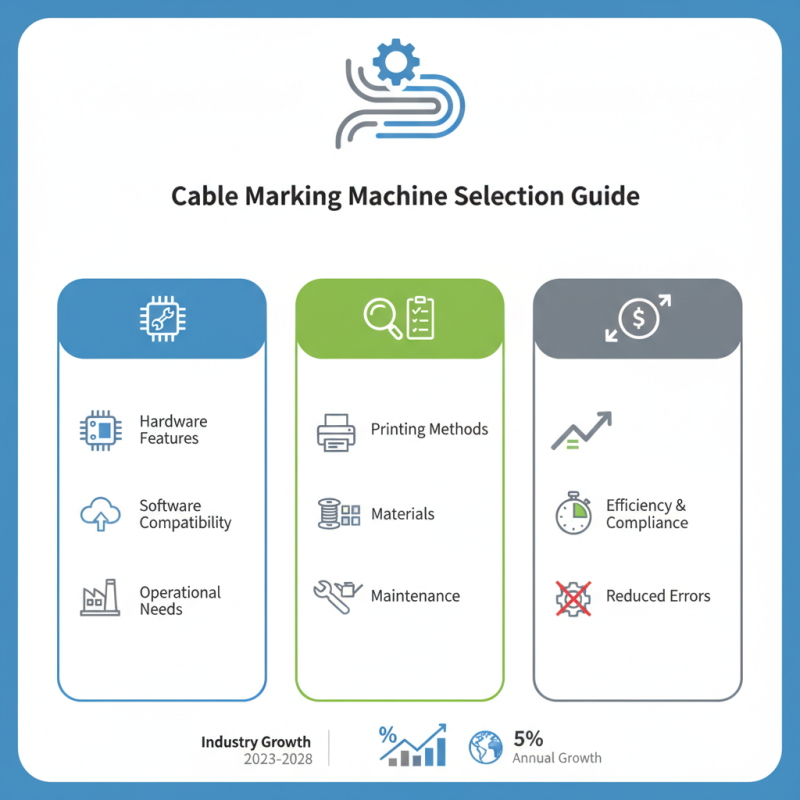
When selecting a cable marking machine, several factors are crucial. Consider the types of cables you will mark. Different machines handle various materials and sizes. Some machines excel in flexibility while others offer precision for specific applications. Evaluate your current and future needs. A machine that meets your current application might be inadequate as your business grows.
Speed and efficiency are also vital elements. A machine that operates slowly can delay your workflow. Think about your production volume. If you have high demands, opting for a faster machine could save you time. However, don’t overlook maintenance costs. A speedy device often requires more upkeep, which can add to your overall budget.
Lastly, user-friendliness is key. Complex machines can lead to errors. Your team should be able to operate the machine efficiently. Training may be necessary, which adds to your costs. A balance between ease of use and functionality is essential. Choosing the right cable marking machine involves weighing these factors carefully.
When selecting a cable marking machine, understanding the available technologies is crucial. The market features several prominent cable marking techniques, including thermal transfer printing, laser marking, and inkjet printing. According to industry reports, thermal transfer printing is popular due to its durability, making it suitable for outdoor applications. Laser marking provides precision and longevity, often utilized for complex labeling requirements.
Each technology has its strengths. Thermal transfer printers produce high-quality labels quickly. They are efficient, catering to high-volume production needs. On the other hand, laser markers offer an environmentally friendly option, reducing waste. Inkjet printers excel in flexibility but may struggle with durability in harsh environments.
For effective decisions, consider specific applications and environments. Assess the materials you're working with. Ensure compatibility for optimal results. Research shows that organizations that select machines aligning with their specific needs significantly improve operational efficiency.
Tip: Analyze your production volume before investing. Higher volumes may justify more advanced equipment. Take time to reflect on maintenance and potential operational challenges. Balancing initial costs with long-term reliability is essential for making the right choice in cable marking technology.
When choosing a cable marking machine, evaluating printing speed and efficiency is crucial. A machine that can print quickly reduces production time. It also increases overall efficiency. Look for machines that offer adjustable printing speeds to match your workflow. This flexibility can accommodate different printing needs.
Consider the types of materials the machine can handle. Some machines perform better with specific cable types. Performance may vary based on the surface, size, or flexibility of the cables. Test flexibility in various settings. It’s essential to assess whether the machine’s efficiency aligns with your production demands.
Sometimes, users find that the fastest machine isn't always the most efficient. A slower machine may utilize ink better, leading to clearer prints. Consider maintenance aspects too. Machines that require frequent calibration can disrupt workflow. Evaluating these factors can help ensure your chosen machine meets your specific needs effectively.
When selecting a cable marking machine, understanding label durability and resistance standards is crucial. Cables often face harsh environments, making the choice of labeling materials essential. According to industry data, approximately 30% of cable failures are due to labeling issues. Labels that fade or peel can lead to misidentification and costly mistakes.
Durability ratings commonly include resistance to chemicals, UV exposure, and extreme temperatures. For example, labels designed for outdoor use should ideally be UV resistant. A report from a leading industrial standards organization notes that labels should survive at least five years in such conditions. This duration should be a benchmark when assessing your cable marking needs.
Different applications require distinct labeling solutions. In environments prone to moisture, labels should have a waterproof rating, while those exposed to chemicals need chemical resistance. Neglecting these factors can undermine safety and compliance. Investing in quality labels, backed by relevant industry standards, ensures reliability and performance over the cable’s lifespan. This emphasis on durability and standards can reduce long-term costs and operational risks significantly.
When evaluating the cost-benefit of cable marking machines, several factors come into play. A recent survey by the Electrical Contractors Association found that proper cable labeling can reduce installation errors by up to 30%. This error reduction can lead to substantial savings, making a case for investing in quality marking equipment.
Analyzing initial costs versus long-term efficiency is crucial. High-end cable marking machines may have a higher upfront cost but often yield lower operational expenses over time. Reports indicate that businesses can save approximately 15-20% on labor costs with automated marking solutions. These machines not only provide accurate labels but also minimize manual handling, reducing wear and tear on staff.
However, not all businesses require advanced features. Smaller projects may not justify the expense of top-tier equipment. A balance must be struck between cost and functionality. Consider the scale of your operations and your specific labeling needs. This reflection can often lead to better decision-making. Investing in the right technology requires careful thought, but the potential returns can’t be ignored.
„Thanks to the LUVIR technology, the solder resist process could be switched directly from the previously used mask exposure to direct exposure. As an outstanding digital solution on the market, this technology has been able to demonstrate fast process times and superior quality on our certified conventional ink in production. This allowed us to fully digitize the solder mask process at low cost – without process or ink adjustments. An excellent benefit to our production in Rot am See.“
Ralf Göhringer (Head of Production WE Rot am See)
I would definitely recommend the Limata machine and team for a future company purchase
Michael Greenaway
Compunetics Inc.
“The Limata ldi has been amazing!! Best thing we did was buy this machine”
Richard Brady
GM
Circuitlabs
“Since 2019, we have been running the Limata X1000 LDI system (including LUVIR for solder mask imaging) in daily production as an addition to our current process with film. The machine was capable of properly exposing Taiyo PSR-4000 BN (DI) solder mask types on normal to high-copper boards using a new and unique direct imaging process. The machine operating interface is very user friendly which allowed for a quick technical training curve. The pre-registration processing reduced several seconds of production time at every print. Limata support and service staff is incomparable. They supported our team every step of the way at basically any time of the day or night, with literally, an immediate response time, customizing the software interface to best fit our Operations and needs.
We have exposed more than 8,000 prints since end of October, on various solder mask colors and some resist film panels. Limata, has proven to be very capable and innovative. They are a strong contender in the industry.
We have very much enjoyed this project, and working with the team!
Thank you Limata for the continued support and being a part of our growth.”
Bill Sezate
Vice President, GM
Summit Interconnect
As a replacement to our current contact exposure process with film, the LIMATA X2000 system including LUVIR-Technology was capable of properly exposing non-LDI solder mask types using a direct imaging process. The machine offers cutting edge software with a very intuitive operating interface which allowed for quick technician training curve. The dual drawer system combined with pre-registration processing reduced several seconds of production time at every machine cycle. Limata support and service staff is world class. They added software patches to keep production running at shortest possible response times, customized the software interface to best fit our in-house Operations system, and even wrote a step-by-step machine processing manual. As a result of the project, we have exposed more than 16,000 times on various product types and solder mask brands/colors. Limata, in a very short timeframe as a company, has definitely shown they are truly innovative and will be challenging the industry of direct imaging for the top spot.
Kevin Beattie
Process Engineer
TTM Technologies
Forest Grove Division
