Choosing the right Dc Car Fridge can be a daunting task. With many options available, knowing what suits your needs is essential. A DC car fridge is not just about keeping drinks cold; it’s about enhancing your travel experience.
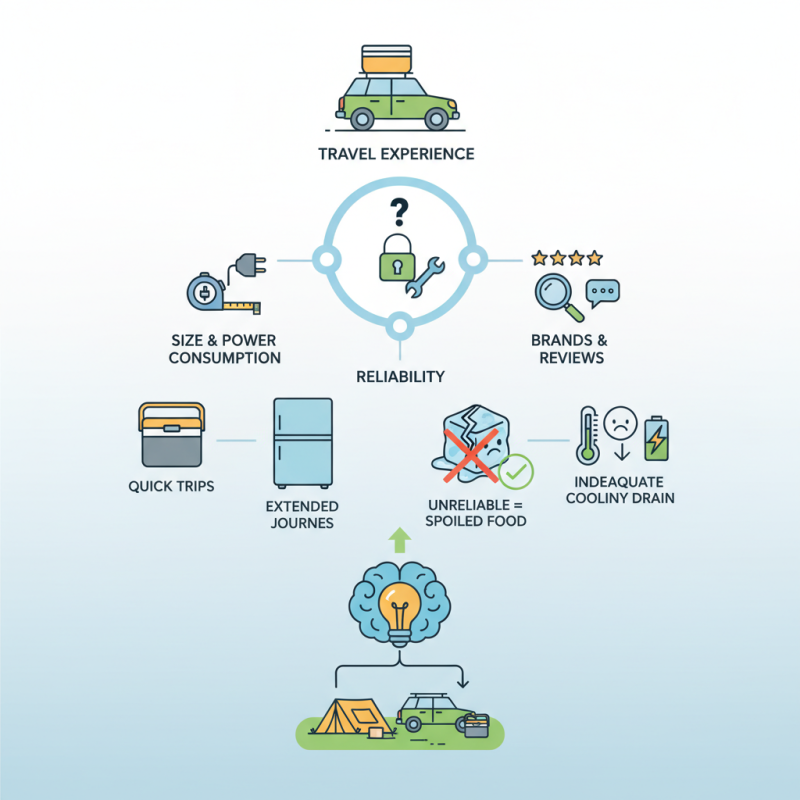
When selecting a DC car fridge, consider size and power consumption. You might need a compact model for quick trips or a larger one for extended journeys. Look beyond the surface features. Reliability is key, especially during long road trips. An unreliable fridge could spoil your food or drinks, leading to frustration.
Evaluate brands that have a reputation for quality. Reading reviews can provide valuable insights. It’s important to acknowledge that not all fridges meet user expectations. Some may lack adequate cooling, while others might drain your car battery faster than anticipated. Reflecting on these aspects will help you make an informed choice.
When selecting a DC car fridge, understanding the various types available is crucial. Common options include thermoelectric coolers, compressor fridges, and absorption refrigerators. Thermoelectric coolers are lightweight and energy-efficient. They work well for short trips and can cool items effectively. However, their performance may dip in extremely hot weather, which is something to consider.
Compressor fridges, in contrast, offer superior cooling capabilities. They maintain lower temperatures consistently, making them suitable for long journeys or camping trips. The downside is they tend to be heavier and consume more power. Lastly, absorption refrigerators utilize heat sources for cooling. They are versatile but usually more expensive. Users might find them less portable and slower to cool down. Evaluating these features against your needs is essential. Reflecting on your travel habits will help you identify what type best fits your lifestyle.
| Type | Cooling Capacity (Liters) | Power Consumption (W) | Weight (kg) | Special Features |
|---|---|---|---|---|
| Portable Compressor Fridge | 30 | 50 | 15 | Dual zone, digital thermostat |
| Thermoelectric Fridge | 20 | 40 | 10 | Lightweight, quiet operation |
| Absorption Fridge | 40 | 70 | 20 | Gas/electric operation, no moving parts |
| Mini Fridge | 15 | 30 | 5 | Compact design, easy to carry |
When selecting a DC car fridge, energy efficiency is crucial. High energy ratings indicate that the fridge consumes less power over time. This can be especially important during long road trips. If your fridge uses too much energy, it may drain your car battery. Choosing a model with better efficiency can save you money in the long run.
Consider the fridge's insulation and cooling technology. A well-insulated unit will maintain low temperatures without using excessive energy. Look for fridges that offer different cooling settings. This allows you to adjust performance based on your needs. Low power consumption can also mean a quieter operation, which enhances your travel experience.
Some users may find high-efficiency models to be pricier at first glance. However, the savings over time often justify the initial investment. Reflecting on the energy ratings ensures you choose wisely. A fridge that lasts longer and works efficiently is always worth considering.
When choosing a DC car fridge, size and capacity are essential factors. A typical car fridge ranges from 20 to 60 liters. Smaller models, around 20-30 liters, are ideal for short trips or snacks. However, for longer journeys or families, a larger capacity is crucial. Research highlights that about 68% of travelers prefer fridges that can store a week’s worth of food. Thus, considering your travel habits is necessary.
It’s also important to think about how much space is available in your vehicle. Some fridges fit well in compact cars, while others require more room. Ensure the unit doesn't obstruct your view or take up too much cargo space. A well-designed fridge can maximize utility without overwhelming the interior. The layout matters; some models offer flexible compartments that allow for better organization.
Another point of reflection is energy efficiency. DC fridges generally consume between 30-70 watts of power. Using energy-efficient models prolongs battery life, especially during off-grid excursions. Yet, some consumers overlook this, leading to dead batteries on trips. Therefore, a careful evaluation of both size and energy requirements can greatly enhance your travel experience.
When it comes to choosing a DC car fridge, understanding the cooling technology is vital. Compressor systems are popular for their efficiency and ability to reach low temperatures quickly. They operate similarly to household refrigerators, making them ideal for long trips. However, they can be noisy and may require more power.
On the other hand, thermoelectric coolers work differently. They utilize a simple Peltier effect, which means they're quieter and lighter. This makes them suitable for short outings or camping scenarios. However, their cooling power is limited. They might not keep items icy cold in hot weather.
Assessing your needs is essential. Consider how often you will use the fridge and for how long. Do you frequently travel in high temperatures? A compressor fridge could be more beneficial. If you need something portable for occasional outings, thermoelectric models might suffice. Reflection on these factors can lead to a more informed decision.
When budgeting for a DC car fridge, understanding the price ranges is paramount. Basic models can start as low as $50. However, mid-range options typically cost between $100 to $300. For high-end models, prices can escalate from $300 to over $800. These variations reflect different capacities, cooling efficiencies, and additional features like dual-zone functionality. As per industry reports, features often justify a higher price. Investing in a fridge with better insulation or energy efficiency may save money in the long run through reduced power consumption.
Assessing long-term value requires considering several factors. A fridge with higher upfront costs might offer longevity and reliability. Some high-quality products boast warranties extending to three years or more, indicating manufacturers’ confidence. Moreover, energy-efficient models could cut power consumption by up to 50%, according to recent studies. While the initial investment is higher, savings in electricity bills can be substantial over time. Reflect on how frequently you travel and your storage needs. Choosing a cheaper model might be tempting, but reliability and efficiency should guide your decision. Always weigh immediate savings against future expenses.
„Thanks to the LUVIR technology, the solder resist process could be switched directly from the previously used mask exposure to direct exposure. As an outstanding digital solution on the market, this technology has been able to demonstrate fast process times and superior quality on our certified conventional ink in production. This allowed us to fully digitize the solder mask process at low cost – without process or ink adjustments. An excellent benefit to our production in Rot am See.“
Ralf Göhringer (Head of Production WE Rot am See)
I would definitely recommend the Limata machine and team for a future company purchase
Michael Greenaway
Compunetics Inc.
“The Limata ldi has been amazing!! Best thing we did was buy this machine”
Richard Brady
GM
Circuitlabs
“Since 2019, we have been running the Limata X1000 LDI system (including LUVIR for solder mask imaging) in daily production as an addition to our current process with film. The machine was capable of properly exposing Taiyo PSR-4000 BN (DI) solder mask types on normal to high-copper boards using a new and unique direct imaging process. The machine operating interface is very user friendly which allowed for a quick technical training curve. The pre-registration processing reduced several seconds of production time at every print. Limata support and service staff is incomparable. They supported our team every step of the way at basically any time of the day or night, with literally, an immediate response time, customizing the software interface to best fit our Operations and needs.
We have exposed more than 8,000 prints since end of October, on various solder mask colors and some resist film panels. Limata, has proven to be very capable and innovative. They are a strong contender in the industry.
We have very much enjoyed this project, and working with the team!
Thank you Limata for the continued support and being a part of our growth.”
Bill Sezate
Vice President, GM
Summit Interconnect
As a replacement to our current contact exposure process with film, the LIMATA X2000 system including LUVIR-Technology was capable of properly exposing non-LDI solder mask types using a direct imaging process. The machine offers cutting edge software with a very intuitive operating interface which allowed for quick technician training curve. The dual drawer system combined with pre-registration processing reduced several seconds of production time at every machine cycle. Limata support and service staff is world class. They added software patches to keep production running at shortest possible response times, customized the software interface to best fit our in-house Operations system, and even wrote a step-by-step machine processing manual. As a result of the project, we have exposed more than 16,000 times on various product types and solder mask brands/colors. Limata, in a very short timeframe as a company, has definitely shown they are truly innovative and will be challenging the industry of direct imaging for the top spot.
Kevin Beattie
Process Engineer
TTM Technologies
Forest Grove Division
