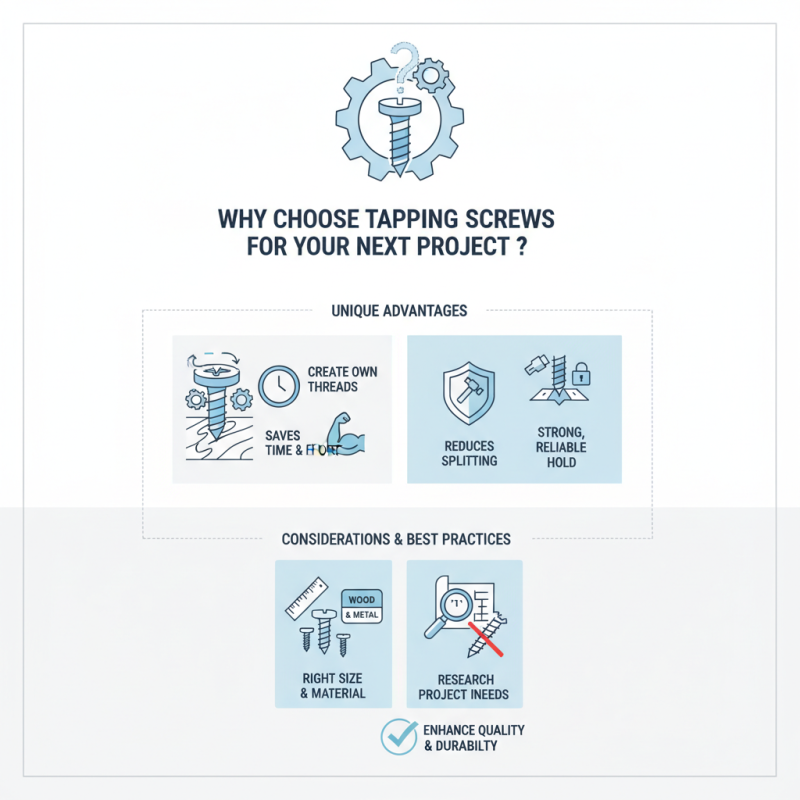
When planning a project, choosing the right fasteners can be crucial. Tapping Screws offer unique advantages that many overlook. These specialized screws create their own threads in materials, making them versatile for various applications. This capability can save both time and effort during assembly.
Many professionals prefer tapping screws for wood and metal projects. Their design reduces the likelihood of splitting and ensures a strong hold. This reliability can lead to fewer unexpected repairs in the future. However, one must consider the right size and material to avoid issues during installation.
Tapping screws can be an excellent choice, but they aren’t perfect for every situation. The wrong screw can lead to stripped threads or inadequate grip. Researching and understanding the project requirements is essential. In the end, the careful use of tapping screws can enhance the quality and durability of your project.
Tapping screws, often overlooked, are essential fasteners in various projects. They create their own mating threads when driven into materials, providing a strong hold. This feature sets them apart from traditional screws. They are ideal for use in metals, plastics, and wood. Understanding their types can help in choosing the right one for your task.
There are various types of tapping screws. Sheet metal screws are popular for metal applications. They have sharp threads that cut through metal easily. Then there are the composite screws designed explicitly for plastic materials. Their unique thread design reduces cracking. Each type has specific applications, making it crucial to select the right one. A common mistake is assuming all screws are interchangeable, leading to potential failures.
In practice, some tapping screws can strip or fail if not properly installed. Incorrect angles or excessive force can compromise their effectiveness. One must carefully consider the material thickness and type when using tapping screws. Misjudgments can lead to structural weaknesses. Planning and understanding the environment of use can enhance the longevity of your projects.
Tapping screws are increasingly favored in various projects due to their unique advantages across different materials. These screws feature a sharp tip that allows them to cut threads into materials like plastic, metal, and wood. According to a report by the Fastener Quality Act, over 30% of manufacturers prefer tapping screws for their speed and ease of use. This makes them ideal for time-sensitive projects.
In addition to their efficiency, tapping screws provide strong holding power. A study from the Institute of Industrial Engineers noted that tapping screws can sustain a torque of up to 40% more than standard screws. This strength is particularly beneficial when working with softer materials. However, care must be taken to avoid over-tightening, as this can lead to stripping. Also, not every tapping screw is suitable for all materials; understanding the specific requirements is crucial.
When choosing tapping screws, consider the material thickness and the necessary load-bearing capacity. Some engineers note challenges when using tapping screws in very thin materials. Misjudgment in screw size or type can affect project integrity. With careful planning and consideration, tapping screws can be a reliable choice for enhancing durability and efficiency in various applications.
| Material | Advantages of Tapping Screws | Common Applications |
|---|---|---|
| Wood | Self-tapping action suitable for wood density variability | Furniture assembly, cabinetry |
| Plastic | Prevents splitting and allows for secure fastening | Electronics, automotive components |
| Metal | Creates strong connections with minimal surface preparation | Machinery, structural applications |
| Composite | Ideal for mixed material applications | Aerospace, construction |
| Concrete | Effective in providing secure fastening without pre-drilling | Building facades, structural integration |
Tapping screws are an excellent choice for various projects. Their design allows for direct installation into materials without pre-drilling. This can save time and money on labor. Additionally, they create a strong hold in a range of substrates.
When using tapping screws, prepare your materials properly. Ensure the surface is clean to avoid any hindrance during installation. Align the screw perpendicular to the material for the best grip. Applying consistent pressure while driving the screw in ensures it cuts threads properly and secures tightly. If you encounter resistance, stop and check for any debris. Over-tightening can strip the screw hole.
Always choose the right size for your application. Using an undersized screw may result in failure, while an oversized one could weaken the material. It’s vital to assess the type of material you’re working with. Sometimes, experimenting with different screw sizes may lead to better results. Keep in mind that proper installation practices can significantly affect the outcome of your project.
Tapping screws are widely used in construction for various applications. These versatile fasteners can create their own threads in materials. This feature makes them ideal for securing metal, wood, and plastic components. In residential projects, they often attach drywall to metal studs. In commercial settings, they can fasten equipment to floor structures.
One common application is attaching roofing materials. Tapping screws ensure a tight seal against moisture. They prevent leaks that could lead to costly damage. Be sure to select the right screw length for your project. This choice can avoid stripping and enhance durability.
Tips for choosing tapping screws: verify the material compatibility. Using the wrong type could weaken the connection. Inspect the screw’s coating; corrosion can lead to failure. For heavy-duty tasks, consider pilot holes. They can help guide screws and improve installation precision. Remember, each project is unique. Reflect on your methods and adapt where necessary.
When selecting tapping screws for your project, consider several key factors. The material of the screw is crucial. It influences strength and corrosion resistance. For outdoor projects, choose screws made from stainless steel. For indoor uses, carbon steel can be the right option.
The size of the screw matters too. Ensure the diameter and length match your project requirements. A screw that's too long can damage materials. A screw that's too short will not hold securely. Always check the threaded portion. It should fit snugly without stripping the materials.
Tip: Always test a screw on a sample piece. This helps avoid issues later on. Also, don’t forget about the screw head style. It affects your project’s final appearance. Consider whether a flat, pan, or hex head looks best for your need.
Lastly, remember that installation method counts. Using a drill for tapping screws speeds up the process. However, over-drilling can lead to material failure. Finding the right balance is important; practice makes perfect here.
„Thanks to the LUVIR technology, the solder resist process could be switched directly from the previously used mask exposure to direct exposure. As an outstanding digital solution on the market, this technology has been able to demonstrate fast process times and superior quality on our certified conventional ink in production. This allowed us to fully digitize the solder mask process at low cost – without process or ink adjustments. An excellent benefit to our production in Rot am See.“
Ralf Göhringer (Head of Production WE Rot am See)
I would definitely recommend the Limata machine and team for a future company purchase
Michael Greenaway
Compunetics Inc.
“The Limata ldi has been amazing!! Best thing we did was buy this machine”
Richard Brady
GM
Circuitlabs
“Since 2019, we have been running the Limata X1000 LDI system (including LUVIR for solder mask imaging) in daily production as an addition to our current process with film. The machine was capable of properly exposing Taiyo PSR-4000 BN (DI) solder mask types on normal to high-copper boards using a new and unique direct imaging process. The machine operating interface is very user friendly which allowed for a quick technical training curve. The pre-registration processing reduced several seconds of production time at every print. Limata support and service staff is incomparable. They supported our team every step of the way at basically any time of the day or night, with literally, an immediate response time, customizing the software interface to best fit our Operations and needs.
We have exposed more than 8,000 prints since end of October, on various solder mask colors and some resist film panels. Limata, has proven to be very capable and innovative. They are a strong contender in the industry.
We have very much enjoyed this project, and working with the team!
Thank you Limata for the continued support and being a part of our growth.”
Bill Sezate
Vice President, GM
Summit Interconnect
As a replacement to our current contact exposure process with film, the LIMATA X2000 system including LUVIR-Technology was capable of properly exposing non-LDI solder mask types using a direct imaging process. The machine offers cutting edge software with a very intuitive operating interface which allowed for quick technician training curve. The dual drawer system combined with pre-registration processing reduced several seconds of production time at every machine cycle. Limata support and service staff is world class. They added software patches to keep production running at shortest possible response times, customized the software interface to best fit our in-house Operations system, and even wrote a step-by-step machine processing manual. As a result of the project, we have exposed more than 16,000 times on various product types and solder mask brands/colors. Limata, in a very short timeframe as a company, has definitely shown they are truly innovative and will be challenging the industry of direct imaging for the top spot.
Kevin Beattie
Process Engineer
TTM Technologies
Forest Grove Division
