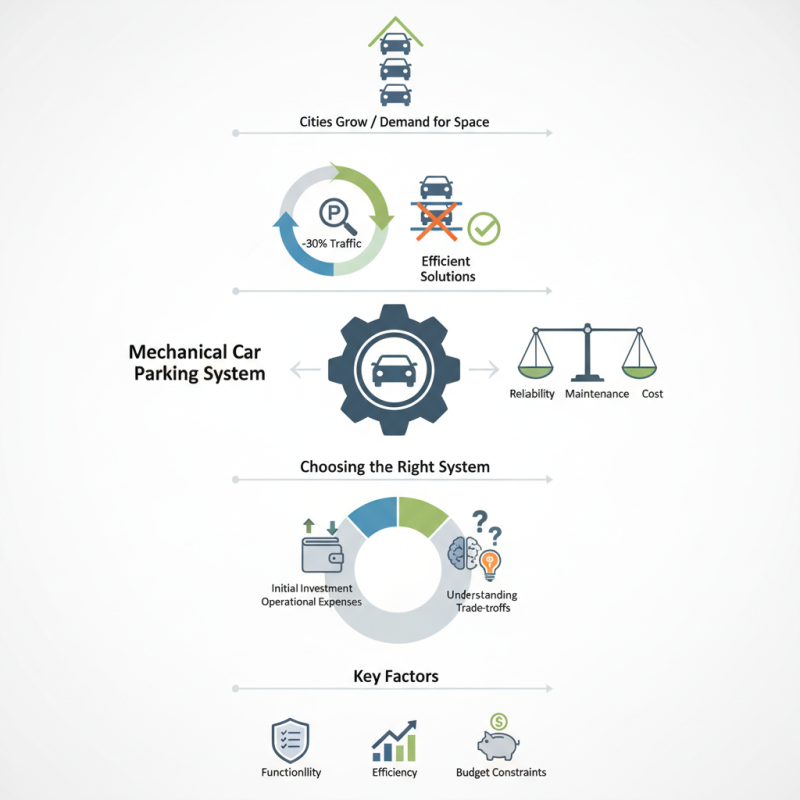
As cities grow, parking has become a significant challenge. The demand for space is increasing in urban areas. According to a recent report by the International Parking Institute, as much as 30% of traffic in urban centers is caused by drivers searching for parking. This highlights the need for efficient solutions. A Mechanical Car Parking System offers an innovative approach.
These systems use automated technology to maximize the available space. They can reduce the land required for parking by 60% compared to traditional methods. However, choosing the right system involves careful consideration. Not all Mechanical Car Parking Systems are created equal. Factors such as reliability, maintenance requirements, and cost impact performance and user satisfaction.
Many buyers overlook the long-term costs associated with these systems. While the initial investment may seem high, operational expenses can vary greatly. Understanding the trade-offs involved is crucial. Evaluating different options with attention to detail can lead to more informed decisions. It’s essential to balance functionality, efficiency, and budget constraints when selecting a Mechanical Car Parking System.
When considering different types of mechanical car parking systems, it's essential to understand their unique features. One common type is the automated parking system. This system uses lifts and conveyors to park cars. It offers high density and saves space. These systems are ideal for urban areas where parking is limited. They often require specific designs and may not fit all building layouts.
Another option is the stacker parking system. This mechanical system stacks vehicles vertically. It's suitable for locations with ample vertical space but limited horizontal space. Drivers park on the entry level, and the system automatically moves the vehicle to its designated spot. However, stacker systems are less flexible and might not access all types of vehicles easily.
Pallet-based systems are also popular. This type uses platforms that shift to retrieve vehicles. Pallet systems can accommodate various vehicle sizes. Maintenance is critical for these systems to ensure they operate efficiently. Regular checks can help prevent more significant issues later. Understanding these systems allows for better choices based on individual needs and building specifications.
When selecting a mechanical car parking system, several key factors come into play. It's crucial to assess the available space. Some systems save room effectively. Others need more area, influencing your choice.
Consider the type of vehicle. Different systems accommodate various sizes. A compact solution may not suit larger cars. Be mindful of the weight limit, as some models are not designed for heavier vehicles.
Tips: Research the maintenance needs. Systems with lower upkeep can save time and expense. Think about user accessibility too. Design matters for ease of operation.
Don't ignore safety features. A reliable system should have emergency protocols. Look for safety certifications that ensure quality. Weigh your options carefully. Each choice carries potential drawbacks. The right system for one might not be the best for another.
When choosing a mechanical car parking system, evaluating space and site requirements is crucial. Begin by assessing the available area. Measure height, width, and length accurately. Consider any nearby obstacles, like trees or buildings, that may impact installation. Different systems have varying spatial requirements, so narrowing down options early helps streamline your choice.
Tips: Always leave room for accessibility. Ensure service personnel can access the system for maintenance. Overlooked space can lead to problems down the road.
Next, examine the ground conditions. A stable surface is necessary for installation. If the ground is uneven or unstable, you may require additional groundwork, which adds costs. Be wary of hidden utilities below. A thorough site survey can prevent unexpected complications.
Tips: Consult professionals when assessing site conditions. They can identify potential issues that may not be obvious.
Remember that not every parking solution fits every location. Think about local climate factors too. Heavy rain or snow can affect the performance of certain systems. Reflect on these aspects carefully before making a decision.
| Criteria | Description | Dimensions (L x W x H) | Capacity | Installation Space Required | Power Supply |
|---|---|---|---|---|---|
| Stack Parking System | Utilizes vertical space to stack vehicles | 15 x 10 x 15 ft | Up to 10 vehicles | 20 x 15 ft | 240V, 30A |
| Puzzle Parking System | Compact design allowing cars to move in a puzzle-like fashion | 20 x 12 x 12 ft | Up to 8 vehicles | 25 x 20 ft | 220V, 20A |
| Automated Valet Parking | Automated system where drivers leave their car, and the system parks it | 18 x 14 x 10 ft | Up to 6 vehicles | 30 x 25 ft | 480V, 50A |
| Horizontal Carousel Parking | Circular system that rotates to bring the car to the driver | 20 x 20 x 8 ft | Up to 12 vehicles | 30 x 30 ft | 220V, 40A |
When selecting a mechanical car parking system, maintenance and cost are paramount. Understanding these aspects can help in making an informed decision. Regular maintenance is often needed to ensure smooth operation. Ignoring maintenance can lead to higher costs in the long run. Experts recommend setting aside a budget for ongoing service to avoid unexpected expenses.
Tips for maintenance include scheduling regular inspections. These checks can catch minor issues before they develop into major problems. Simple tasks like lubricating moving parts also extend the system’s life. Keep an eye on performance, as unexpected changes may signal the need for service.
Cost considerations should factor in installation, maintenance, and potential repairs. Initially, a system might seem affordable, but maintenance costs add up. Some systems require specialized technicians, which can increase expenses significantly. Before committing, assess the long-term financial implications. Calculating total cost can help in understanding its overall value.
When choosing a mechanical car parking system, user accessibility is paramount. Ease of use should be a primary consideration in your decision-making process. For instance, systems with intuitive control panels encourage user confidence. Ensure that the buttons and interfaces are clearly labeled. Also, assess whether the system accommodates individuals with disabilities. Integrating features like voice control can create a more inclusive environment.
Safety features also play a critical role. Look for systems that include emergency stop buttons or automatic shut-off mechanisms. These features provide peace of mind to users. Additionally, consider the structural design. A well-ventilated and spacious environment reduces the risk of accidents during vehicle retrieval.
However, potential drawbacks can arise. Some systems may have complicated user manuals. This can lead to confusion, especially during high-pressure situations. It’s essential to weigh accessibility against complexity. Regular assessments of user feedback can help refine these systems over time. Continuous improvement ensures that user experience remains a priority.
„Thanks to the LUVIR technology, the solder resist process could be switched directly from the previously used mask exposure to direct exposure. As an outstanding digital solution on the market, this technology has been able to demonstrate fast process times and superior quality on our certified conventional ink in production. This allowed us to fully digitize the solder mask process at low cost – without process or ink adjustments. An excellent benefit to our production in Rot am See.“
Ralf Göhringer (Head of Production WE Rot am See)
I would definitely recommend the Limata machine and team for a future company purchase
Michael Greenaway
Compunetics Inc.
“The Limata ldi has been amazing!! Best thing we did was buy this machine”
Richard Brady
GM
Circuitlabs
“Since 2019, we have been running the Limata X1000 LDI system (including LUVIR for solder mask imaging) in daily production as an addition to our current process with film. The machine was capable of properly exposing Taiyo PSR-4000 BN (DI) solder mask types on normal to high-copper boards using a new and unique direct imaging process. The machine operating interface is very user friendly which allowed for a quick technical training curve. The pre-registration processing reduced several seconds of production time at every print. Limata support and service staff is incomparable. They supported our team every step of the way at basically any time of the day or night, with literally, an immediate response time, customizing the software interface to best fit our Operations and needs.
We have exposed more than 8,000 prints since end of October, on various solder mask colors and some resist film panels. Limata, has proven to be very capable and innovative. They are a strong contender in the industry.
We have very much enjoyed this project, and working with the team!
Thank you Limata for the continued support and being a part of our growth.”
Bill Sezate
Vice President, GM
Summit Interconnect
As a replacement to our current contact exposure process with film, the LIMATA X2000 system including LUVIR-Technology was capable of properly exposing non-LDI solder mask types using a direct imaging process. The machine offers cutting edge software with a very intuitive operating interface which allowed for quick technician training curve. The dual drawer system combined with pre-registration processing reduced several seconds of production time at every machine cycle. Limata support and service staff is world class. They added software patches to keep production running at shortest possible response times, customized the software interface to best fit our in-house Operations system, and even wrote a step-by-step machine processing manual. As a result of the project, we have exposed more than 16,000 times on various product types and solder mask brands/colors. Limata, in a very short timeframe as a company, has definitely shown they are truly innovative and will be challenging the industry of direct imaging for the top spot.
Kevin Beattie
Process Engineer
TTM Technologies
Forest Grove Division
