Choosing the right Walking Tractor can significantly impact your farming efficiency. According to Dr. Alex Thompson, an expert in agricultural machinery, “Selecting the right walking tractor can enhance productivity, but understanding your specific needs is crucial.” His insights emphasize the importance of aligning your choice with your farming tasks.
Walking tractors come in various models, each designed for different applications. From small vegetable plots to larger fields, the variety can be overwhelming. It’s essential to consider factors such as horsepower, attachments, and terrain compatibility. A well-chosen walking tractor can lead to better yields and less physical strain.
However, many farmers struggle with these choices. They often select a model based on trends rather than their unique requirements. This can lead to inefficiencies in operation and maintenance. Reflecting on your farming practices and considering expert advice can help ensure you make an informed decision about your walking tractor.
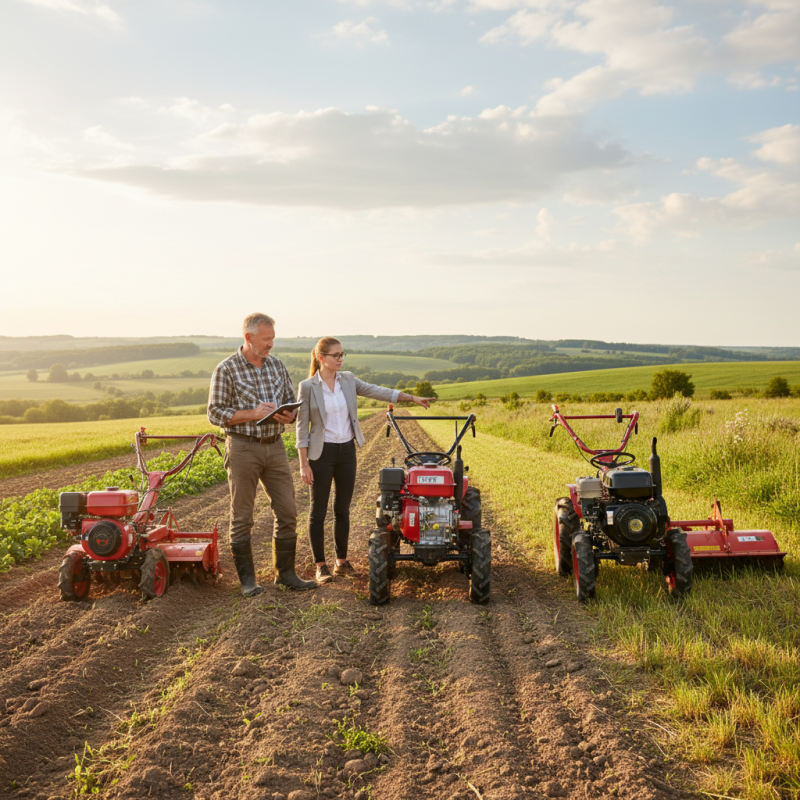
When considering the purpose of a walking tractor, it's important to identify your specific tasks. These machines excel in various agricultural activities, such as plowing, tilling, and planting. They are ideal for small to medium-sized farms. Their versatility allows for attachments like seeders and cultivators, enhancing their utility. However, complexity can arise with different models offering varied features.
Think about the terrain where you will use the walking tractor. Uneven or rocky ground may require a more robust machine. Assess your physical strength too; some models are heavier or more challenging to maneuver. A lighter model might be suitable for smaller fields, but it may lack power for tougher jobs.
Understanding your soil type is crucial as well. Sandy or clay-heavy soils may affect how you use the tractor. You may need to adjust your expectations accordingly. Reflect on your long-term goals too. Will this tractor meet your needs for years to come? Owning a walking tractor should align with your evolving farming practices. This consideration can help you make a more informed decision.
When choosing a walking tractor, one of the main considerations is power and performance. It's essential to assess the terrain where you plan to use it. Flat fields require less power, while hilly or uneven ground demands a robust engine. The weight of the tractor also plays a role; heavier models often provide better traction.
Another critical factor is the engine size. A powerful engine enables quicker work but can consume more fuel. Determine how much fuel efficiency matters to your operation. Will you be using it for long hours or on small tasks? Think about your daily needs rather than just the immediate task at hand.
Performance isn't just about power. Consider attachments and versatility as well. A tractor that supports different implements can increase productivity. Reflect on what tools you might need later. It’s essential to strike a balance between power and practicality. A powerful machine can be overwhelming for small tasks, leading to inefficiency. Choosing the right power level requires careful thought about the specific uses and conditions you’ll encounter.
When choosing a walking tractor, it's essential to evaluate its features carefully. Start by considering engine power. A powerful engine can handle tough terrains easily. If you have hilly land, prioritize horsepower. Smaller engines may struggle. Understand your land conditions; it can save you hassle later.
Another key feature is the transmission system. Walking tractors typically use gear-driven or hydrostatic systems. Gear-driven types offer more durability. Hydrostatic models provide smoother operation, especially in tight spaces. Think about your tasks: are you plowing fields or moving soil? Each task may favor a different system.
Tips: Always test drive. This helps you understand comfort and handling. Pay attention to the weight. A heavier tractor may provide better traction on uneven ground. Also, consider the availability of parts. Reliable support can save you time and money in maintenance. Choose wisely to fit your unique needs.
Walking tractors come in various types, each designed to meet specific needs. When comparing models, consider your terrain. Some tractors excel on flat ground, while others are designed for hilly or uneven surfaces. The engine power is another crucial factor. More powerful engines can handle tougher tasks, but they may also consume more fuel and require more maintenance.
Another aspect to evaluate is the type of attachments available. Many walking tractors can be outfitted with different implements, such as plows, seeders, or cultivators. Ensure the model you choose supports attachments that suit your gardening or farming tasks. User reviews often reveal common issues with various models. Some users report problems with ease of use or mechanical reliability. This can affect long-term satisfaction.
Finally, take into account the weight and size. A heavier tractor may provide more stability but can be challenging to maneuver. Check how comfortable it is to operate over extended periods. Your specific needs may evolve, so consider versatility and adaptability when making a choice. Each model has its strengths and challenges; understanding them is key to making the right decision.
| Type | Power (HP) | Weight (kg) | Best For | Price Range ($) |
|---|---|---|---|---|
| Two-Wheel Tractor | 5-12 | 80-120 | Small Farms, Gardens | 600-1500 |
| Four-Wheel Tractor | 15-30 | 300-600 | Medium to Large Farms | 2500-8000 |
| Mini Walking Tractor | 3-6 | 40-90 | Home Use, Small Projects | 400-1200 |
| Electric Walking Tractor | 5-15 | 100-200 | Eco-friendly Farming | 800-3000 |
When it comes to purchasing a walking tractor, budget is a key factor. Many buyers often underestimate the total cost. A recent industry report reveals that most users spend between $1,500 and $4,000. However, this figure can fluctuate based on features and specifications. Understanding what you need is crucial. Higher-end models may offer advanced capabilities but can strain your finances.
Before making a decision, evaluate your requirements. Will you primarily use it for small plots or larger fields? A basic model may suffice for small-scale tasks, while extensive farming might warrant a more powerful engine. It's important to note that maintenance costs also add up. According to research, roughly 15% of the initial investment goes towards upkeep.
Consider future expenses like repairs and fuel efficiency, which can alter your budget significantly. Sometimes, a cheaper model leads to higher maintenance costs down the road. It’s essential to reflect on your options. Opting for a well-rounded machine might prove more economical in the long run. Balancing immediate affordability with long-term costs can guide you to a suitable choice.
„Thanks to the LUVIR technology, the solder resist process could be switched directly from the previously used mask exposure to direct exposure. As an outstanding digital solution on the market, this technology has been able to demonstrate fast process times and superior quality on our certified conventional ink in production. This allowed us to fully digitize the solder mask process at low cost – without process or ink adjustments. An excellent benefit to our production in Rot am See.“
Ralf Göhringer (Head of Production WE Rot am See)
I would definitely recommend the Limata machine and team for a future company purchase
Michael Greenaway
Compunetics Inc.
“The Limata ldi has been amazing!! Best thing we did was buy this machine”
Richard Brady
GM
Circuitlabs
“Since 2019, we have been running the Limata X1000 LDI system (including LUVIR for solder mask imaging) in daily production as an addition to our current process with film. The machine was capable of properly exposing Taiyo PSR-4000 BN (DI) solder mask types on normal to high-copper boards using a new and unique direct imaging process. The machine operating interface is very user friendly which allowed for a quick technical training curve. The pre-registration processing reduced several seconds of production time at every print. Limata support and service staff is incomparable. They supported our team every step of the way at basically any time of the day or night, with literally, an immediate response time, customizing the software interface to best fit our Operations and needs.
We have exposed more than 8,000 prints since end of October, on various solder mask colors and some resist film panels. Limata, has proven to be very capable and innovative. They are a strong contender in the industry.
We have very much enjoyed this project, and working with the team!
Thank you Limata for the continued support and being a part of our growth.”
Bill Sezate
Vice President, GM
Summit Interconnect
As a replacement to our current contact exposure process with film, the LIMATA X2000 system including LUVIR-Technology was capable of properly exposing non-LDI solder mask types using a direct imaging process. The machine offers cutting edge software with a very intuitive operating interface which allowed for quick technician training curve. The dual drawer system combined with pre-registration processing reduced several seconds of production time at every machine cycle. Limata support and service staff is world class. They added software patches to keep production running at shortest possible response times, customized the software interface to best fit our in-house Operations system, and even wrote a step-by-step machine processing manual. As a result of the project, we have exposed more than 16,000 times on various product types and solder mask brands/colors. Limata, in a very short timeframe as a company, has definitely shown they are truly innovative and will be challenging the industry of direct imaging for the top spot.
Kevin Beattie
Process Engineer
TTM Technologies
Forest Grove Division
