What Are Hotel Dnd Signs and How Do They Work?
Hotel DND Signs, meaning “Do Not Disturb” signs, give guests a simple way to request privacy. Most signs hang from the exterior door handle. One side may read “Do Not Disturb,” while the other requests housekeeping service. Some modern hotels use digital room panels, mobile applications, or touch-screen controls instead.
The process looks simple. A guest places the sign outside the door before sleeping, working, or taking a private call. Housekeeping staff then notice the message during their service rounds. They usually skip the room and record the missed service for later follow-up. Policies can differ between properties, especially for extended DND periods.
Small details matter. A sign can prevent a knock, a ringing bell, or an unexpected interruption. However, it cannot guarantee complete privacy. Hotel staff may still need to respond to safety concerns, maintenance problems, or emergency procedures. Guests should check the property’s written policy rather than assume every hotel works identically.
Horst Schulze, a former Ritz-Carlton executive and respected hospitality expert, expressed the service principle clearly: “The customer is not an interruption of our work; he is the purpose of it.” Hotel DND Signs support that principle by making guest preferences visible. Yet, they are not flawless. A missing sign, unclear wording, or inattentive staff member can create confusion. That weakness deserves attention. Good hotel operations combine visible signs, trained employees, respectful communication, and sensible follow-up procedures.
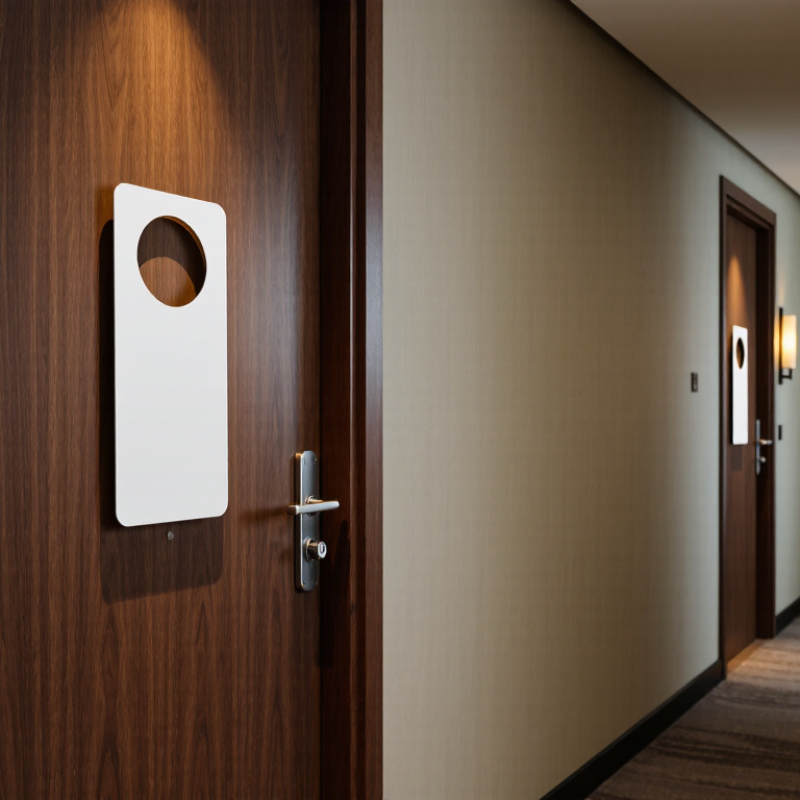
A hotel DND sign is a request for privacy, not merely a decoration on the door handle. “Do Not Disturb” tells housekeeping and other staff to pause routine visits. A small card. In practice, a housekeeper may see it while pushing a cart down the corridor and skip that room during the current round.
The sign also sets a boundary for guests. Staff should respect the request, avoid knocking for ordinary service, and follow the hotel’s procedures before attempting contact another way. Guests who need fresh towels or room cleaning can remove the sign or contact the front desk. A quick call is often clearer than leaving the request uncertain.
DND does not always mean that staff will never approach the room. A hotel may have safety procedures for unusual situations, and practices can vary by property. If a sign remains up for a long time, staff may follow their established check-in process rather than assume everything is fine. That can feel intrusive, even when the intention is care. The system is not perfect. Guests can ask at check-in how privacy requests are handled, especially if they need uninterrupted rest or have a specific concern.
| Situation or Sign | What It Usually Means | Typical Staff Response | Guest Consideration |
|---|---|---|---|
| “Do Not Disturb” (DND) displayed | The guest is asking to avoid routine room visits, calls, or interruptions. | Housekeeping and other staff generally postpone non-urgent entry or service and follow the property’s procedures. | Remove the sign or contact the front desk when service is wanted. |
| “Please Make Up Room” displayed | The guest is requesting housekeeping service, subject to staffing and service hours. | How DND Signs Work: Door Hangers, Magnetic Cards, and Digital AlertsA hotel DND sign is a guest’s request for privacy, but the message can travel in different ways. A door hanger is the simplest: guests place it outside, and staff check it while moving along the corridor. It needs no power or training. Yet it can fall, face the wrong way, or be missed during a busy shift. Small details matter. Magnetic cards work similarly, but attach directly to a metal door. They are easy to reposition and less likely to slip off a handle. They still rely on staff seeing them during room checks. Digital alerts send the request to a staff device or housekeeping system, where teams can record the time and status. These systems may help coordinate work, but only if devices stay connected and staff update them. Technology can fail, too. The staffing context makes clear communication especially useful. The American Hotel & Lodging Association’s 2024 survey of U.S. hotels found that 76% reported staffing shortages; housekeeping was the most commonly cited staffing need, at 49%. Those figures do not prove that digital alerts improve service. They do show why a clear, visible DND status can help teams prioritize limited time. A practical setup should give guests an obvious choice and staff a reliable way to notice it. There is a trade-off: digital records offer visibility, while a simple hanger may be easier for every guest to understand. 24-Hour DND Policies: Housekeeping Logs and Guest Welfare ChecksWhat Are Hotel DND Signs and How Do They Work?A “Do Not Disturb” sign tells staff that a guest prefers privacy. It does not always mean housekeeping can skip the room indefinitely. Under a 24-hour DND policy, staff record when the sign was first noticed and any later checks. A log might note the room number, time, attempted contact, and staff member’s initials. Clear records help the next shift understand what happened, rather than treating the door as a fresh mystery. Guest welfare checks should follow the hotel’s written procedure, not an improvised schedule. Staff may call the room or knock and announce themselves before escalating concerns to a supervisor. The details matter: a quiet hallway, a full tray, or a sign left up for many hours can prompt attention, but none alone proves a guest needs help. The American Hotel & Lodging Association’s 2024 industry survey reported that 76% of hotels faced staffing shortages. That makes consistent handovers especially important, though speed should not replace sound judgment. Policies can still feel awkward at the door. Tips: Log each observation with a time, use neutral wording, and brief incoming staff. If the policy sets a welfare-check threshold, follow it consistently and document any exception. Never promise guests uninterrupted privacy beyond the stated policy. AHLA Safety Guidance: Staff Response to Extended Do-Not-Disturb RequestsA Do Not Disturb sign protects a guest’s privacy, but an extended request also calls for a consistent staff response. AHLA’s January 2024 hotel survey found that 67% of responding properties reported staffing shortages, and 12% described them as severe. In busy operations, a clear procedure helps prevent a missed welfare concern. AHLA guidance should not be read as one universal room-entry deadline: properties need to follow their own safety procedures and local requirements. Staff can record when the sign was first observed, notify a supervisor, and make discreet contact through the approved channel. A quiet hallway is not proof that everything is fine. Tips: Set a written escalation threshold for prolonged DND requests. Have a supervisor review the room status, check for prior guest contact, and coordinate with housekeeping or security. If a welfare concern remains, use the property’s authorized check-in procedure; do not enter alone or improvise. Document times and actions factually. Keep the guest’s privacy in view. A knock, a brief pause, then a calm announcement can feel far less intrusive than sudden entry. Teams may need to revisit these steps after a near miss; procedures can look clear on paper and still fail during a shift change. NFPA 101 and Local Codes: Emergency Access Beyond the DND SignA hotel DND sign is a request for privacy, not a promise that nobody will enter. NFPA 101 addresses life safety in buildings, while local fire and building codes may add requirements for emergency access. The exact rules depend on the property, its layout, and the authority having jurisdiction. During a fire, medical emergency, or other urgent threat, staff or responders may need to check a room despite the sign. Safety comes first. FAQS What does a hotel DND sign mean? It asks staff to pause routine visits and respect your privacy. A small card sets a clear boundary. Will housekeeping enter while the sign is displayed? Staff should avoid entering for ordinary service and follow the property’s procedures. If you need towels, call the front desk or remove the sign. Does DND guarantee that nobody will approach my room? No. Extended requests or safety concerns may lead to an approved check-in. That can feel intrusive, even when staff intend to help. What might staff do if a DND sign stays up for a long time? They may note when they saw it, alert a supervisor, and make discreet contact through an approved channel. A quiet hallway proves little. Can staff enter during an emergency? Trained staff or responders may need to check a room during an urgent threat. A sign does not override emergency procedures. How can I get fresh towels without an unexpected visit? Call the front desk with a clear request. A quick call is often better than leaving the sign’s status uncertain. How should hotel staff handle prolonged DND requests? Follow written procedures, coordinate with a supervisor, and record actions factually. Shift changes can still cause mistakes, so teams should review near misses. What should I ask about privacy at check-in? Ask how prolonged DND requests and emergency access are handled. Local requirements and property procedures can differ. ConclusionHotel Dnd Signs let guests request privacy and help set clear boundaries for housekeeping and other staff. They may be displayed as door hangers or magnetic cards, or sent through a hotel’s digital system. Whatever the format, the sign communicates a preference rather than an absolute promise that staff will never approach the room. Hotels may record extended requests and follow their own procedures for checking on guest welfare. Article Source: |
„Thanks to the LUVIR technology, the solder resist process could be switched directly from the previously used mask exposure to direct exposure. As an outstanding digital solution on the market, this technology has been able to demonstrate fast process times and superior quality on our certified conventional ink in production. This allowed us to fully digitize the solder mask process at low cost – without process or ink adjustments. An excellent benefit to our production in Rot am See.“
Ralf Göhringer (Head of Production WE Rot am See)
I would definitely recommend the Limata machine and team for a future company purchase
Michael Greenaway
Compunetics Inc.
“The Limata ldi has been amazing!! Best thing we did was buy this machine”
Richard Brady
GM
Circuitlabs
“Since 2019, we have been running the Limata X1000 LDI system (including LUVIR for solder mask imaging) in daily production as an addition to our current process with film. The machine was capable of properly exposing Taiyo PSR-4000 BN (DI) solder mask types on normal to high-copper boards using a new and unique direct imaging process. The machine operating interface is very user friendly which allowed for a quick technical training curve. The pre-registration processing reduced several seconds of production time at every print. Limata support and service staff is incomparable. They supported our team every step of the way at basically any time of the day or night, with literally, an immediate response time, customizing the software interface to best fit our Operations and needs.
We have exposed more than 8,000 prints since end of October, on various solder mask colors and some resist film panels. Limata, has proven to be very capable and innovative. They are a strong contender in the industry.
We have very much enjoyed this project, and working with the team!
Thank you Limata for the continued support and being a part of our growth.”
Bill Sezate
Vice President, GM
Summit Interconnect
As a replacement to our current contact exposure process with film, the LIMATA X2000 system including LUVIR-Technology was capable of properly exposing non-LDI solder mask types using a direct imaging process. The machine offers cutting edge software with a very intuitive operating interface which allowed for quick technician training curve. The dual drawer system combined with pre-registration processing reduced several seconds of production time at every machine cycle. Limata support and service staff is world class. They added software patches to keep production running at shortest possible response times, customized the software interface to best fit our in-house Operations system, and even wrote a step-by-step machine processing manual. As a result of the project, we have exposed more than 16,000 times on various product types and solder mask brands/colors. Limata, in a very short timeframe as a company, has definitely shown they are truly innovative and will be challenging the industry of direct imaging for the top spot.
Kevin Beattie
Process Engineer
TTM Technologies
Forest Grove Division
