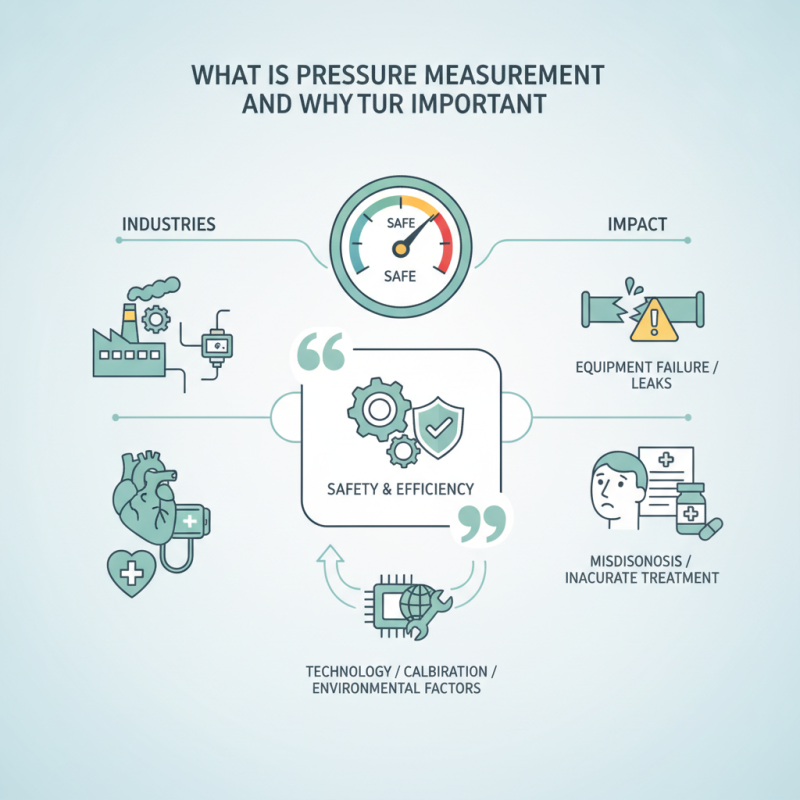
Pressure measurement is a critical aspect of various industries, including manufacturing and healthcare. As Dr. Emily Tran, a leading expert in fluid dynamics, noted, "Accurate pressure measurement is the backbone of safety and efficiency." This statement underscores the importance of precision in pressure measurement systems.
In practical applications, even slight discrepancies in pressure readings can lead to serious consequences. For instance, in chemical processing, incorrect pressure could result in equipment failure or hazardous leaks. In healthcare, inaccuracies in blood pressure measurement can lead to misdiagnosis and inappropriate treatments. These scenarios illustrate the vital need for reliable pressure measurement tools.
Despite advancements in technology, challenges remain in achieving consistent accuracy. Calibration issues and environmental factors can impact measurement reliability. Professionals in this field must continuously adapt and seek improvements to uphold safety standards. Pressure measurement is not just a technical challenge; it is about ensuring human safety and operational integrity in every application.
Pressure measurement is a vital aspect of many industries, from healthcare to manufacturing. It involves quantifying the force applied by a fluid (liquid or gas) per unit area. Accurate pressure readings ensure the safety and efficiency of systems. According to a report by the International Society of Automation, improper pressure monitoring can lead to 20% more energy usage in industrial processes.
Understanding the principles of pressure measurement requires knowledge of various techniques. Common methods include piezometers and manometers. These tools convert physical force into measurable data. Inaccurate readings can have significant repercussions. For instance, in the medical field, a slight error in blood pressure readings can impact patient care. The reliability of these measurements is crucial for appropriate treatment protocols.
In the energy sector, maintaining proper pressure levels enhances system reliability. The U.S. Department of Energy reports that pressure control can save up to 15% in operational costs. However, many facilities overlook calibration and maintenance of pressure sensors. This oversight can lead to malfunctioning devices and untimely failures. Continuous education on the significance of precise pressure measurements can mitigate such issues and enhance overall performance in various applications.
| Parameter | Measurement Unit | Importance |
|---|---|---|
| Atmospheric Pressure | hPa (hectopascal) | Crucial for weather forecasting and studies on climate change. |
| Gauge Pressure | psi (pounds per square inch) | Important for monitoring pressure levels in tanks and pipelines. |
| Absolute Pressure | bar | Essential for scientific research and various industrial applications. |
| Differential Pressure | Pa (pascal) | Used in filtration and Flow measurement applications. |
| Vacuums | Torr | Vital in various laboratory settings and manufacturing processes. |
Pressure measurement is a critical aspect in various industries. It helps ensure safety, efficiency, and product quality. Sensors and transducers are integral to this process. They enable accurate readings and allow for real-time monitoring.
Sensors are devices that convert pressure into an electrical signal. There are many types of pressure sensors, including piezoelectric and resistive sensors. Each has its advantages. Piezoelectric sensors are known for their robustness. In contrast, resistive sensors provide high accuracy in low-pressure applications. Understanding these differences is essential for selecting the right sensor.
Transducers play a vital role in converting signals. They take the electrical output from a pressure sensor and transform it into a usable form. This can be a voltage or current signal. While many transducers are reliable, some may drift over time. This can lead to inaccurate measurements. Regular calibration is crucial, yet often overlooked. Without it, the data may be misleading, leading to potential operational failures.
Pressure measurement plays a crucial role in various industries, ensuring safety and efficiency. In manufacturing, precise pressure control can enhance product consistency. For example, in the oil and gas sector, maintaining optimal pressure levels in pipelines minimizes risks of leaks and explosions. Reports indicate that ineffective pressure management has cost the industry millions in fines and damages.
In the food and beverage industry, pressure measurement ensures sterile environments. High-pressure processing can extend shelf life significantly. According to industry data, this method has gained popularity, with about 20% of food manufacturers adopting pressure technologies. However, a lack of expertise in proper equipment calibration can lead to contamination risks.
Tips: When measuring pressure, always verify equipment calibration regularly. This can help avoid costly errors. Additionally, ensure staff receives adequate training on pressure equipment. This may reduce workplace accidents and enhance operational efficiency.
Accurate pressure measurement plays a crucial role in ensuring safety and quality control across various industries. According to a report by the International Society of Automation (ISA), over 90% of industrial accidents can be traced back to improper pressure management. This alarming statistic highlights the necessity for precise pressure monitoring in environments where safety is paramount, such as chemical plants and oil refineries.
In production settings, maintaining optimal pressure levels can significantly affect product quality. A study by the American Society for Quality (ASQ) suggests that 30% of quality defects in manufacturing processes result from pressure variations. These defects not only lead to increased waste but can also jeopardize customer satisfaction. Accurate pressure measurement instruments are essential for controlling processes and reducing variability, ensuring that products meet stringent specifications.
Moreover, the reliability of pressure measurement technologies can vary widely. While some instruments claim high accuracy, their performance can be influenced by environmental factors and calibration schedules. Organizations must regularly assess their measurement tools to avoid costly errors. Continuous training for personnel operating these devices is vital, as human error remains a significant factor in pressure-related incidents. The complexity of pressure measurement requires a commitment to ongoing education and adherence to best practices in safety and quality management.
Accurate pressure measurement is crucial across various industries to ensure safety and maintain quality standards. This chart illustrates the percentage of importance assigned to pressure measurement accuracy in different sectors.
Pressure measurement plays a crucial role across various industries. Recent advancements focus on improving accuracy, reliability, and efficiency. The integration of smart technologies is gaining traction. These innovations enhance data collection and analysis.
Wireless pressure sensors are becoming popular. They offer flexibility in installation and reduce wiring costs. Additionally, digital interfaces allow real-time monitoring. This means operators can respond swiftly to changes. However, challenges such as signal interference remain.
Another trend is the use of micro-electromechanical systems (MEMS). These tiny sensors provide high precision in compact designs. They are paving the way for new applications. Yet, the delicate nature of MEMS can lead to reliability issues in demanding environments. Overall, these trends reflect a significant shift towards smarter and more efficient pressure measurement solutions.
„Thanks to the LUVIR technology, the solder resist process could be switched directly from the previously used mask exposure to direct exposure. As an outstanding digital solution on the market, this technology has been able to demonstrate fast process times and superior quality on our certified conventional ink in production. This allowed us to fully digitize the solder mask process at low cost – without process or ink adjustments. An excellent benefit to our production in Rot am See.“
Ralf Göhringer (Head of Production WE Rot am See)
I would definitely recommend the Limata machine and team for a future company purchase
Michael Greenaway
Compunetics Inc.
“The Limata ldi has been amazing!! Best thing we did was buy this machine”
Richard Brady
GM
Circuitlabs
“Since 2019, we have been running the Limata X1000 LDI system (including LUVIR for solder mask imaging) in daily production as an addition to our current process with film. The machine was capable of properly exposing Taiyo PSR-4000 BN (DI) solder mask types on normal to high-copper boards using a new and unique direct imaging process. The machine operating interface is very user friendly which allowed for a quick technical training curve. The pre-registration processing reduced several seconds of production time at every print. Limata support and service staff is incomparable. They supported our team every step of the way at basically any time of the day or night, with literally, an immediate response time, customizing the software interface to best fit our Operations and needs.
We have exposed more than 8,000 prints since end of October, on various solder mask colors and some resist film panels. Limata, has proven to be very capable and innovative. They are a strong contender in the industry.
We have very much enjoyed this project, and working with the team!
Thank you Limata for the continued support and being a part of our growth.”
Bill Sezate
Vice President, GM
Summit Interconnect
As a replacement to our current contact exposure process with film, the LIMATA X2000 system including LUVIR-Technology was capable of properly exposing non-LDI solder mask types using a direct imaging process. The machine offers cutting edge software with a very intuitive operating interface which allowed for quick technician training curve. The dual drawer system combined with pre-registration processing reduced several seconds of production time at every machine cycle. Limata support and service staff is world class. They added software patches to keep production running at shortest possible response times, customized the software interface to best fit our in-house Operations system, and even wrote a step-by-step machine processing manual. As a result of the project, we have exposed more than 16,000 times on various product types and solder mask brands/colors. Limata, in a very short timeframe as a company, has definitely shown they are truly innovative and will be challenging the industry of direct imaging for the top spot.
Kevin Beattie
Process Engineer
TTM Technologies
Forest Grove Division
