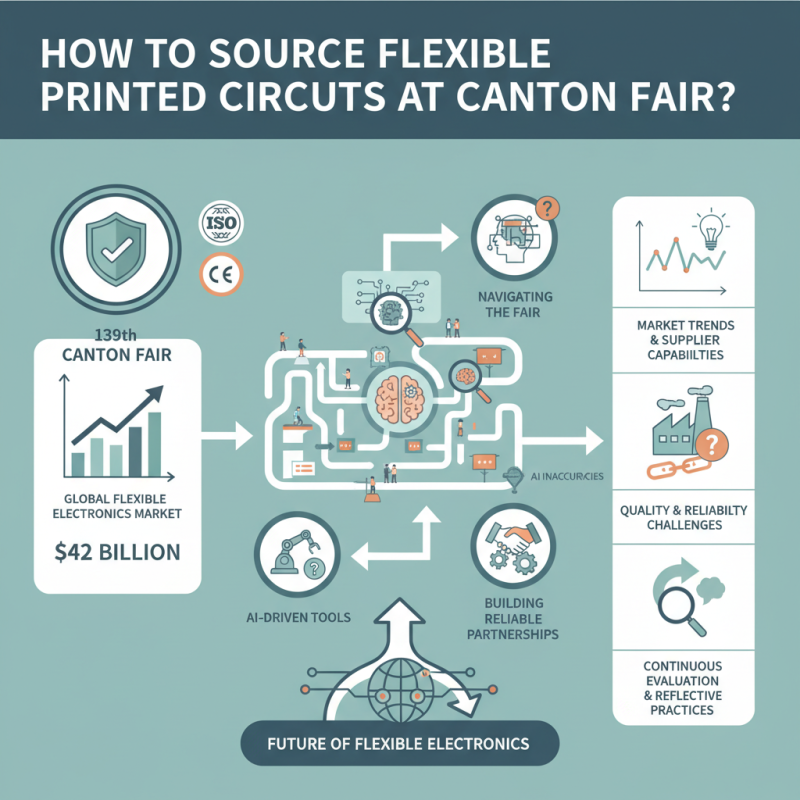
The 139th Canton Fair presents a strategic opportunity for sourcing Flexible Printed Circuits (FPCs). As industries increasingly rely on advanced manufacturing techniques, the demand for FPCs has surged. According to a recent market analysis, the global flexible electronics market is projected to reach $42 billion by 2026, growing at a CAGR of 20.5%. This growth underscores the necessity for suppliers to meet specific industry standards and certifications, such as ISO and CE.
Navigating the vast 1.55 million square meter exhibition space can be overwhelming. The introduction of AI-driven tools at the 2026 Canton Fair aims to enhance the sourcing experience. Buyers can filter suppliers quickly, yet some may find inaccuracies in AI recommendations. Effective sourcing involves not just finding suppliers, but also establishing reliable partnerships.
Flexibility in sourcing FPCs requires understanding market trends and supplier capabilities. While Canton Fair offers a platform, challenges such as product quality and supplier reliability persist. Continuous evaluation of sourcing strategies will be essential for success in this dynamic industry. The need for reflective practices in supplier evaluation cannot be overstated, as the future of flexible electronics is ever-evolving.
Flexible printed circuits (FPC) are essential in today's technology, connecting various electronic components. Their lightweight and compact design allows for greater efficiency. According to recent industry reports, the global flexible printed circuit market is projected to grow at a CAGR of 10.4% from 2021 to 2028. This acceleration highlights the increasing adoption of FPC across multiple sectors.
FPCs find applications in smartphones, wearables, automotive, and medical devices. For example, a typical smartphone may contain around ten different flexible circuits. This integration is vital for enhancing device functionality while minimizing space. However, sourcing high-quality FPCs at events like the Canton Fair can be challenging. Many suppliers may not meet strict quality standards or certification requirements.
Understanding key specifications before sourcing is crucial. Manufacturers must consider factors like material types, layer count, and thickness. The choice of substrate influences performance. Inadequate knowledge could lead to selecting inferior products. It's essential to evaluate multiple suppliers and conduct thorough quality checks. The stakes are high, as a subpar circuit could result in device failure.
Preparing for the Canton Fair requires careful planning and research. The fair is a unique event, attracting thousands of exhibitors and buyers. It's vital to know what to expect. Recent reports show that flexible printed circuit boards (FPCBs) are in high demand. The global FPCB market is projected to grow at a CAGR of 5.2% from 2021 to 2028. This indicates great opportunities for sourcing.
As you prepare for the fair, be aware of the different types of flexible printed circuits available. Some focus on high-frequency applications, while others are designed for low-power devices. Checking specifications is crucial. Bring a checklist to ensure you cover all necessary aspects, such as thickness, material, and application type. Not all suppliers will meet quality standards, so due diligence is essential.
Networking is another key aspect. The Canton Fair is a hub for industry professionals. Engage with potential suppliers, but don’t skip asking about their production capabilities. Reports indicate that 40% of buyers experience challenges with supplier reliability. Visiting exhibitors’ factories after the fair can also help confirm their production capacity before making commitments. Ensure you leverage every opportunity for successful sourcing.
When sourcing flexible printed circuits, finding reliable suppliers is crucial. Data from industry reports indicate the global flexible printed circuit market reached approximately $21 billion in 2022, with a projected growth rate of 10% annually. This underscores the rising demand for high-quality circuits in electronics, telecommunications, and automotive industries.
When you visit the Canton Fair, focus on the quality of materials used by potential suppliers. Ask about their manufacturing processes. Check if they adhere to international standards, like IPC-A-600. Many suppliers may claim high standards, but not all deliver. Look for certifications from independent bodies, as they provide credibility.
Networking is essential during the fair. Speak with other manufacturers. Gather feedback on suppliers’ performance and reliability. Some companies may share their struggles with delivery times or quality control. Reflecting on these experiences can save you from future headaches. Building relationships will allow you to understand the market better. Aim for suppliers who prioritize transparency and customer service. This can lead to long-term partnerships that benefit both parties.
When sourcing flexible printed circuits at the Canton Fair, evaluating quality standards is crucial. Look for manufacturers who meet international certifications like ISO and IPC. These certifications indicate adherence to quality management systems and industry standards. Don't hesitate to ask for proof of these certifications.
Inspect the materials used in the production of flexible printed circuits. Authentic materials ensure durability and performance. It's important to consider the thickness and flexibility aspects. They affect the circuit's performance. Pay close attention to the surface finish too, as it directly impacts solderability. A simple touch can tell you a lot about the product quality.
In discussions with suppliers, ask about their quality control processes. Some may have robust systems in place, while others might lack sufficient checks. This inconsistency can lead to quality issues down the line. Trust but verify—always request sample products before making larger commitments. This initial investment can save significant costs later. Know that not every claim can be taken at face value; you might find discrepancies that require further investigation.
Negotiating prices and terms with manufacturers at the Canton Fair can be challenging yet rewarding. Begin by researching the market trends for flexible printed circuits. Understand the typical price ranges. This knowledge serves as a solid foundation for negotiations.
When you engage in discussions with manufacturers, ask questions. What are their production capabilities? Inquire about lead times and minimum order quantities. Building a rapport is crucial. Remember, the relationship you create can influence the outcome. Don't hesitate to express your budget constraints.
Be prepared for some back and forth. Manufacturers may not meet your initial terms. It’s essential to remain flexible. Consider offering long-term cooperation in exchange for better pricing. Different styles of communication are important. Some manufacturers respond better to direct questions, while others appreciate a friendly conversation. Observing their reactions can help refine your negotiation strategy.
„Thanks to the LUVIR technology, the solder resist process could be switched directly from the previously used mask exposure to direct exposure. As an outstanding digital solution on the market, this technology has been able to demonstrate fast process times and superior quality on our certified conventional ink in production. This allowed us to fully digitize the solder mask process at low cost – without process or ink adjustments. An excellent benefit to our production in Rot am See.“
Ralf Göhringer (Head of Production WE Rot am See)
I would definitely recommend the Limata machine and team for a future company purchase
Michael Greenaway
Compunetics Inc.
“The Limata ldi has been amazing!! Best thing we did was buy this machine”
Richard Brady
GM
Circuitlabs
“Since 2019, we have been running the Limata X1000 LDI system (including LUVIR for solder mask imaging) in daily production as an addition to our current process with film. The machine was capable of properly exposing Taiyo PSR-4000 BN (DI) solder mask types on normal to high-copper boards using a new and unique direct imaging process. The machine operating interface is very user friendly which allowed for a quick technical training curve. The pre-registration processing reduced several seconds of production time at every print. Limata support and service staff is incomparable. They supported our team every step of the way at basically any time of the day or night, with literally, an immediate response time, customizing the software interface to best fit our Operations and needs.
We have exposed more than 8,000 prints since end of October, on various solder mask colors and some resist film panels. Limata, has proven to be very capable and innovative. They are a strong contender in the industry.
We have very much enjoyed this project, and working with the team!
Thank you Limata for the continued support and being a part of our growth.”
Bill Sezate
Vice President, GM
Summit Interconnect
As a replacement to our current contact exposure process with film, the LIMATA X2000 system including LUVIR-Technology was capable of properly exposing non-LDI solder mask types using a direct imaging process. The machine offers cutting edge software with a very intuitive operating interface which allowed for quick technician training curve. The dual drawer system combined with pre-registration processing reduced several seconds of production time at every machine cycle. Limata support and service staff is world class. They added software patches to keep production running at shortest possible response times, customized the software interface to best fit our in-house Operations system, and even wrote a step-by-step machine processing manual. As a result of the project, we have exposed more than 16,000 times on various product types and solder mask brands/colors. Limata, in a very short timeframe as a company, has definitely shown they are truly innovative and will be challenging the industry of direct imaging for the top spot.
Kevin Beattie
Process Engineer
TTM Technologies
Forest Grove Division
