Thrust Ball Bearings are a crucial component in many machines. They help support axial loads while allowing rotation. These bearings consist of a ball and two rings, one of which is stationary and the other rotates.
Understanding how Thrust Ball Bearings function is vital for various industries. They are commonly used in automotive applications and heavy machinery. The design allows them to handle high loads without much friction. However, improper installation can lead to failure.
Selecting the right Thrust Ball Bearing is essential for optimal performance. Consider the load capacity, speed, and environmental conditions. Mistakes in these areas can lead to inefficiencies. Despite their reliability, these bearings may still require regular maintenance to ensure longevity.
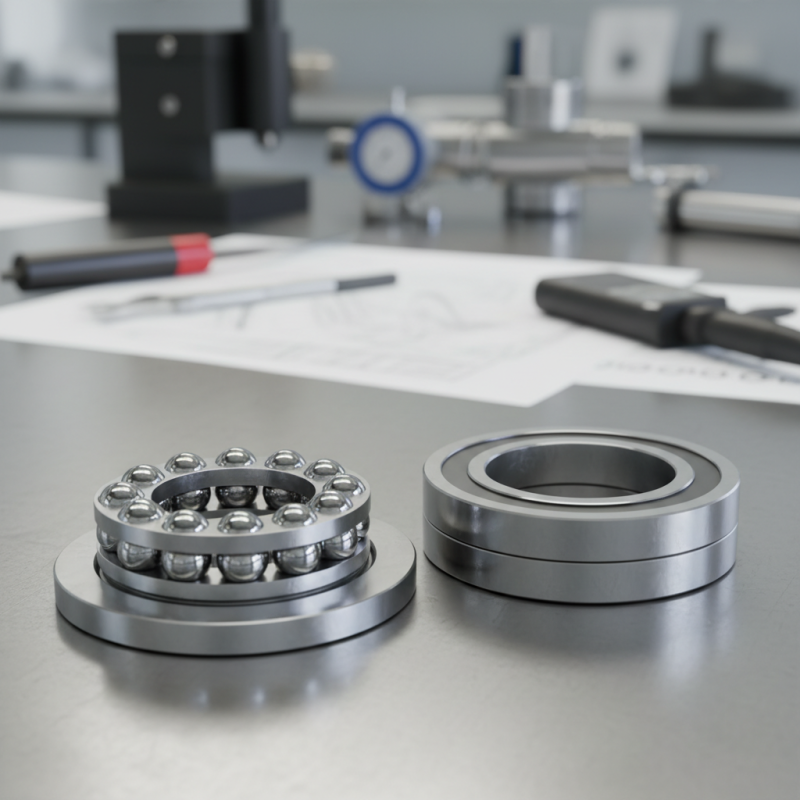
Thrust ball bearings are crucial components used in various machinery. They help support axial loads, which are forces pushing along the axis of a shaft. These bearings consist of two races and a ball. The races are surfaces where the balls roll. This simple design allows for efficient load distribution and smooth movement.
When loaded, thrust ball bearings rotate around a fixed axis. The balls roll between the races, and this rolling motion reduces friction. It enhances performance, especially in applications like automotive and industrial equipment. However, they have limitations. Thrust ball bearings can only handle axial loads, not radial loads. Thus, they often need to be used in conjunction with other types of bearings.
Installing thrust ball bearings correctly is crucial. Misalignment can lead to premature wear and failure. Regular maintenance checks are necessary to ensure their longevity. Even with proper care, these bearings may still require replacement. Observing changes in performance can help identify when they are failing. Regular attention to these details can improve overall machinery efficiency.
| Parameter | Description |
|---|---|
| Type | Thrust Ball Bearing |
| Design | Consists of balls situated between two rings |
| Load Direction | Handles axial loads only |
| Applications | Used in automotive, industrial, and high-speed applications |
| Material | Usually made of steel or ceramic |
| Advantages | Low friction, high load capacity, and reliable performance |
| Limitations | Cannot support radial loads |
| Maintenance | Requires periodic lubrication |
| Installation | Simple installation with proper alignment |
Thrust ball bearings are vital components in various machinery. They consist of several key parts that work together to support axial loads. Basic components include balls, inner and outer rings, and a cage. The balls provide the rolling element, and the rings offer the track for these balls. This design allows the bearing to handle high axial loads.
The inner ring is typically mounted on the rotating shaft, while the outer ring is fixed. The cage spaces the balls evenly, preventing wear and ensuring smooth operation. According to a recent industry report, thrust ball bearings can handle loads ranging from 1,000 to several tons, depending on size and material. The choice of materials affects performance and durability.
Effective lubrication is crucial for the bearing's operation. Insufficient lubrication can lead to premature failure. Data highlights that nearly 30% of bearing failures arise from inadequate lubrication. Understanding these components aids engineers in selecting the right thrust ball bearing for their applications. This knowledge is essential for enhancing performance and longevity in machines.
Thrust ball bearings are essential components in rotary machinery. They support axial loads and are crucial for applications needing high-speed rotation. These bearings consist of two grooved rings and a set of balls, allowing them to manage thrust loads effectively. According to a market analysis by ResearchAndMarkets, the thrust ball bearing market is predicted to reach $1.5 billion by 2025, highlighting their importance in various sectors.
In operation, these bearings allow for smooth movement by reducing friction. They rely on precision engineering to ensure proper alignment and balance. When friction is minimized, efficiency increases. This results in enhanced performance in mechanical systems such as automotive and aerospace applications. Yet, improper installation can lead to failures. Insufficient lubrication or misalignment can cause excessive wear.
The design of thrust ball bearings is relatively simple, but the underlying mechanics are complex. The balls must fit perfectly within the grooves. If they are too tight or too loose, operational issues may arise. Engineers must constantly evaluate the installations to avoid unforeseen problems. This subtle complexity highlights the importance of quality control during manufacturing processes.
Thrust ball bearings play a vital role in various applications. They are designed to handle axial loads in machinery. These bearings are commonly found in automotive parts and industrial machines. In electric motors, they reduce friction and improve efficiency. Their ability to handle high-speed applications makes them ideal for turbines and generators.
Machine tools also rely on thrust ball bearings for precision. They maintain proper alignment and ensure smooth operation. In aviation, these bearings help support propeller shafts. Their reliability is crucial for safety and performance in aircraft. Additionally, thrust ball bearings are used in marine applications, where they endure harsh conditions.
Despite their advantages, some challenges exist. Overloading can lead to failure, and regular maintenance is essential. Proper installation is also crucial to avoid misalignment. Addressing these issues can enhance the performance and longevity of thrust ball bearings in applications.
Thrust ball bearings are crucial components in various mechanical assemblies. They support axial loads primarily and facilitate smooth rotational motion. However, they come with distinct advantages and limitations that impact their application.
One advantage is their ability to handle high axial loads effectively. According to industry standards, thrust ball bearings can accommodate loads reaching up to 300,000 N in controlled environments. Moreover, they offer minimal friction, which enhances overall efficiency. Their simple design allows for easy installation and maintenance.
On the flip side, these bearings have limitations. They are not suitable for multi-directional loads, making them less versatile than other bearing types. Operating temperatures can also affect their performance. Data shows that exceeding recommended temperatures may lead to premature failure. Regular inspections are crucial to ensure their longevity.
Tip: Always monitor operating conditions to prevent overheating. Regular lubrication checks can enhance performance, especially in continuous use situations. Being proactive can mitigate some inherent limitations.
„Thanks to the LUVIR technology, the solder resist process could be switched directly from the previously used mask exposure to direct exposure. As an outstanding digital solution on the market, this technology has been able to demonstrate fast process times and superior quality on our certified conventional ink in production. This allowed us to fully digitize the solder mask process at low cost – without process or ink adjustments. An excellent benefit to our production in Rot am See.“
Ralf Göhringer (Head of Production WE Rot am See)
I would definitely recommend the Limata machine and team for a future company purchase
Michael Greenaway
Compunetics Inc.
“The Limata ldi has been amazing!! Best thing we did was buy this machine”
Richard Brady
GM
Circuitlabs
“Since 2019, we have been running the Limata X1000 LDI system (including LUVIR for solder mask imaging) in daily production as an addition to our current process with film. The machine was capable of properly exposing Taiyo PSR-4000 BN (DI) solder mask types on normal to high-copper boards using a new and unique direct imaging process. The machine operating interface is very user friendly which allowed for a quick technical training curve. The pre-registration processing reduced several seconds of production time at every print. Limata support and service staff is incomparable. They supported our team every step of the way at basically any time of the day or night, with literally, an immediate response time, customizing the software interface to best fit our Operations and needs.
We have exposed more than 8,000 prints since end of October, on various solder mask colors and some resist film panels. Limata, has proven to be very capable and innovative. They are a strong contender in the industry.
We have very much enjoyed this project, and working with the team!
Thank you Limata for the continued support and being a part of our growth.”
Bill Sezate
Vice President, GM
Summit Interconnect
As a replacement to our current contact exposure process with film, the LIMATA X2000 system including LUVIR-Technology was capable of properly exposing non-LDI solder mask types using a direct imaging process. The machine offers cutting edge software with a very intuitive operating interface which allowed for quick technician training curve. The dual drawer system combined with pre-registration processing reduced several seconds of production time at every machine cycle. Limata support and service staff is world class. They added software patches to keep production running at shortest possible response times, customized the software interface to best fit our in-house Operations system, and even wrote a step-by-step machine processing manual. As a result of the project, we have exposed more than 16,000 times on various product types and solder mask brands/colors. Limata, in a very short timeframe as a company, has definitely shown they are truly innovative and will be challenging the industry of direct imaging for the top spot.
Kevin Beattie
Process Engineer
TTM Technologies
Forest Grove Division
