Choosing the right Electric Cylinder for your application can be challenging. Industry expert Dr. Emily Carter emphasizes, "The correct cylinder can transform efficiency." This statement rings true as Electric Cylinders play a vital role in automation solutions today. Understanding their features is crucial for decision-making.
When selecting an Electric Cylinder, consider factors such as load capacity, stroke length, and compatibility with your control systems. Each application varies, and it's vital to know your machine's specific needs. Many users overlook the importance of these details, leading to suboptimal performance. Reliability is paramount.
Making informed choices about Electric Cylinders can enhance productivity significantly. Yet, some manufacturers fail to provide clear specifications. This can create confusion. Thorough research is necessary to avoid costly mistakes. Strive for a balance between quality and affordability when making your selection.
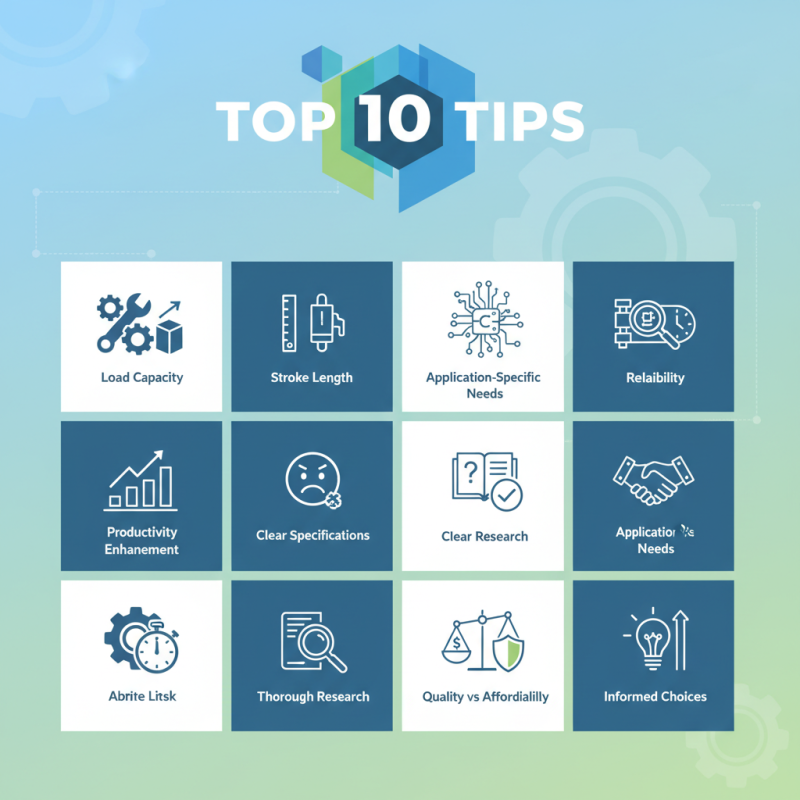
Electric cylinders play a crucial role in various applications. They provide linear motion with precision and efficiency. Understanding their key features can help you make an informed choice. Different types of electric cylinders exist, each tailored for specific tasks. Some are designed for heavy loads, while others excel in speed and accuracy.
When selecting an electric cylinder, consider the load capacity. This is vital for ensuring that the cylinder meets your operational needs. Pay attention to dimensions as well, since space constraints may limit your options. Another important aspect is the stroke length; it determines how far the cylinder can extend or retract.
Incorporating a few practical tips can ease the decision-making process. Always assess the speed and response time based on your application. Reliability is non-negotiable; look for components that are durable and well-constructed. Energy efficiency is another factor; it impacts operational costs.
There’s no perfect choice—each application presents unique challenges and requirements. Be ready to adapt and reassess your choices as necessary.
Choosing the right electric cylinder can significantly impact your project’s success. One critical factor is understanding load requirements. Evaluate how much weight the cylinder needs to move. This helps you identify the appropriate capacity. If you underestimate the load, it could lead to failures. Overestimating waste resources.
When assessing load, consider dynamic and static loads. Dynamic loads occur during movement, while static loads remain constant when stationary. To ensure performance, factor in safety margins. This guarantees that the cylinder handles unexpected surges in weight. Many users overlook this, which can lead to safety hazards.
An additional tip involves considering how frequently the cylinder will operate. Frequent use requires a higher capacity. Investigate the expected lifespan of the cylinder too. Quality materials and construction can enhance performance over time. Choosing wisely simplifies future replacements and reduces costs. Be thorough in your assessment to avoid future logistical issues.
Choosing the right electric cylinder can greatly impact your project's success. Evaluating speed and stroke length is crucial. Speed refers to how quickly the cylinder can extend and retract. Different applications require different speeds. For instance, industrial automation may need high-speed operation, while medical devices often prioritize precision over speed. Understand your application to determine the right balance.
Stroke length is another important factor. This measurement indicates how far the cylinder can extend. Inadequate stroke length can limit functionality, causing inefficiencies. Conversely, overly long strokes can lead to wasted space and energy. It’s essential to analyze the specific requirements of your system. Sometimes, manufacturers offer customizable options to optimize performance.
Consider the environmental factors as well. Ambient temperature and loading conditions can impact both speed and stroke capabilities. Always consult technical specifications and guidelines when making your choice. Testing different combinations may reveal inconsistencies. These insights will guide you in tailoring the electric cylinder to your unique needs.
When selecting an electric cylinder, environmental factors play a crucial role in ensuring durability and functionality. The International Electrotechnical Commission (IEC) indicates that exposure to extreme temperatures can significantly affect performance. A well-chosen electric cylinder should operate efficiently in a range of conditions, extending its lifespan and helping to maintain operational integrity.
In terms of humidity, research shows that over 60% of electric cylinder failures can be traced to moisture-related issues. Selecting materials resistant to corrosion and wear is essential. Many industries face challenges with humidity and contaminants. Implementing protective coatings can enhance the durability of electric cylinders. Consider choosing products rated for specific environmental conditions, as they are often designed to withstand various stresses.
Noise and vibration are also important to consider. According to recent industry reports, a significant proportion of failures occur due to excessive vibration. Opting for electric cylinders designed with integrated dampening technology can mitigate these issues. Talented engineers often reflect on cases where overlooking such factors led to operational disruptions. Always account for environmental variables in your decision-making process for optimal performance.
| Tip Number | Tip Description | Environmental Considerations | Durability Factors | Functionality Features |
|---|---|---|---|---|
| 1 | Assess your load requirements | Consider humidity and temperature ranges | Corrosion-resistant materials | Variable speed control for precise operations |
| 2 | Evaluate installation space | Dust and debris exposure | Rugged design for harsh conditions | Backward compatibility with existing systems |
| 3 | Choose the correct power supply | Voltage stability under environmental stress | Thermal management systems | Smooth operation across various loads |
| 4 | Look for energy efficiency ratings | Impact on surrounding environment | Built-in overload protection | Integration with automation systems |
| 5 | Consult with technical experts | Guidance on environmental impacts | Long lifespan components | Flexible control options |
| 6 | Review maintenance requirements | Impact of maintenance environment | Ease of access for repairs | Customizable programming features |
| 7 | Consider feedback and control systems | Response to environmental changes | Durable sensor technology | Real-time monitoring capabilities |
| 8 | Check for certification and compliance | Regulatory environmental standards | Certifications for safety | Standardization for ease of use |
| 9 | Analyze cost versus quality | Lifetime cost in various environments | Quality assurance processes | Performance guarantees |
| 10 | Prepare for future scalability | Avoid environmental constraints on growth | Adaptability in material usage | Expandable functionality |
When choosing an electric cylinder, the reputation of the manufacturer cannot be overlooked. A well-established company typically offers superior products. Their experience in the industry often translates into better technology and customer support. Consider researching online reviews to gauge the manufacturer's credibility. Look for testimonials that mention durability and performance. A trustworthy manufacturer will have a strong track record.
Warranty policies also play a crucial role in your decision. A good warranty reflects the manufacturer's confidence in their product. Some companies offer extensive warranties, covering parts and labor. This assurance can save you money on repairs or replacements. Always read the fine print. Some warranties may have conditions that can limit your coverage.
While you're considering these factors, don't forget the practical aspects of the electric cylinder itself. Evaluate its compatibility with your current equipment. Test the ease of installation and operation. Are the controls user-friendly? An electric cylinder should meet your specific needs without requiring constant adjustments. Take your time in this process; making an ill-informed choice can lead to costly consequences.
„Thanks to the LUVIR technology, the solder resist process could be switched directly from the previously used mask exposure to direct exposure. As an outstanding digital solution on the market, this technology has been able to demonstrate fast process times and superior quality on our certified conventional ink in production. This allowed us to fully digitize the solder mask process at low cost – without process or ink adjustments. An excellent benefit to our production in Rot am See.“
Ralf Göhringer (Head of Production WE Rot am See)
I would definitely recommend the Limata machine and team for a future company purchase
Michael Greenaway
Compunetics Inc.
“The Limata ldi has been amazing!! Best thing we did was buy this machine”
Richard Brady
GM
Circuitlabs
“Since 2019, we have been running the Limata X1000 LDI system (including LUVIR for solder mask imaging) in daily production as an addition to our current process with film. The machine was capable of properly exposing Taiyo PSR-4000 BN (DI) solder mask types on normal to high-copper boards using a new and unique direct imaging process. The machine operating interface is very user friendly which allowed for a quick technical training curve. The pre-registration processing reduced several seconds of production time at every print. Limata support and service staff is incomparable. They supported our team every step of the way at basically any time of the day or night, with literally, an immediate response time, customizing the software interface to best fit our Operations and needs.
We have exposed more than 8,000 prints since end of October, on various solder mask colors and some resist film panels. Limata, has proven to be very capable and innovative. They are a strong contender in the industry.
We have very much enjoyed this project, and working with the team!
Thank you Limata for the continued support and being a part of our growth.”
Bill Sezate
Vice President, GM
Summit Interconnect
As a replacement to our current contact exposure process with film, the LIMATA X2000 system including LUVIR-Technology was capable of properly exposing non-LDI solder mask types using a direct imaging process. The machine offers cutting edge software with a very intuitive operating interface which allowed for quick technician training curve. The dual drawer system combined with pre-registration processing reduced several seconds of production time at every machine cycle. Limata support and service staff is world class. They added software patches to keep production running at shortest possible response times, customized the software interface to best fit our in-house Operations system, and even wrote a step-by-step machine processing manual. As a result of the project, we have exposed more than 16,000 times on various product types and solder mask brands/colors. Limata, in a very short timeframe as a company, has definitely shown they are truly innovative and will be challenging the industry of direct imaging for the top spot.
Kevin Beattie
Process Engineer
TTM Technologies
Forest Grove Division
