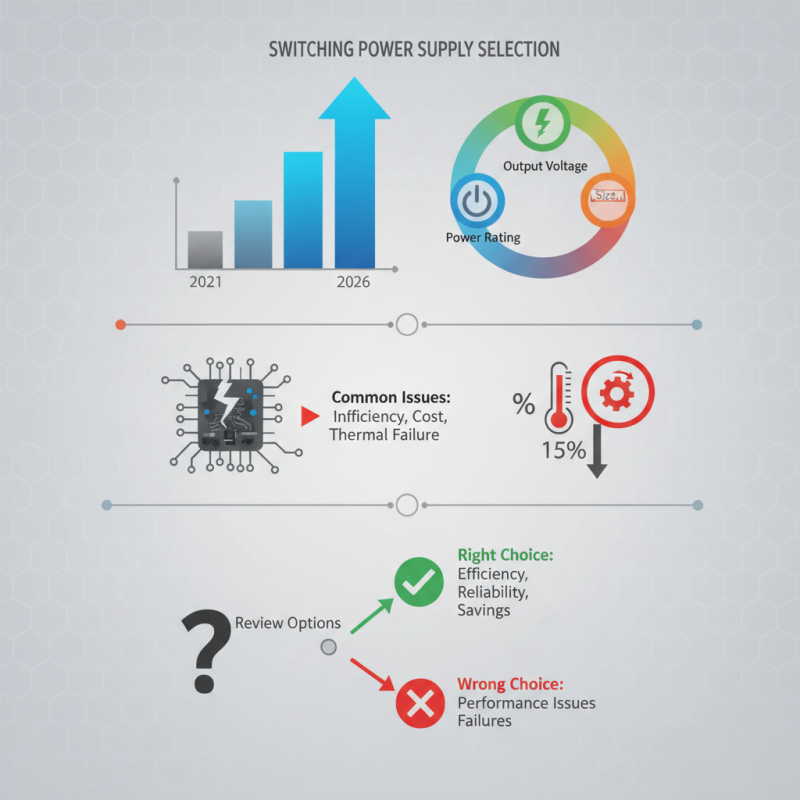
Choosing the right Switching Power Supply is crucial for any electronic project. Poorly selected supplies can lead to inefficiency and increased costs. According to a recent industry report by MarketsandMarkets, the global switching power supply market is projected to reach $30.8 billion by 2026, growing at a CAGR of 5.3% from 2021. This growth highlights the rising demand for efficient power solutions.
The variety in switching power supplies can be overwhelming. Factors like output voltage, power rating, and size play significant roles. A mismatch can cause performance issues. Moreover, improper thermal management can lead to failures. A study by ResearchAndMarkets suggests that up to 15% of power supplies fail due to thermal issues. Choosing wisely is essential not only for performance but reliability.
Reviewing available options is a key step. Look for components that suit your specific application. Not every supply fits every need. Research helps identify the most suitable type. In an era where efficiency matters, the right Switching Power Supply can save energy and money. Investing time in selection is always worth it.
Switching power supplies (SPS) are integral to modern electronics. They convert electrical energy efficiently, making them ideal for various applications. Understanding the basics is vital for effective utilization. Recent studies show that SPS can achieve efficiencies above 90%. This efficiency not only saves energy but also reduces heat generation. However, high efficiency isn’t the only consideration.
Different parameters can affect performance. Output ripple voltage, voltage regulation, and load transient response are crucial. A poor choice can lead to device malfunction. For example, high ripple voltage can interfere with sensitive circuits. Many reports indicate that improper selection has led to failures in 30% of cases analyzed. That's a significant number that highlights the need for careful evaluation.
Noise margins in switching power supplies can also be problematic. Attention is needed when evaluating specifications. Reports suggest that around 25% of power supply failures stem from inadequate noise suppression. Users should reflect on their requirements. It’s essential to prioritize reliability over sheer power output. An informed decision saves time and resources in the long run. Assessing both technical data and real-world performance is key to making the right choice.
| Parameter | Description | Importance | Recommended Value |
|---|---|---|---|
| Input Voltage | The voltage level that the power supply needs to operate at. | High | Depends on application, typically 100-240V AC |
| Output Voltage | The voltage that the power supply outputs to the load. | High | 5V, 12V, 24V common values |
| Output Current | The maximum current the power supply can deliver. | Medium | Based on application (e.g., 1A, 5A) |
| Efficiency | How effectively the power supply converts input to output power. | High | 80% or higher is preferred |
| Size | Physical dimensions of the power supply unit. | Medium | Compact designs preferred for space-limited applications |
| Protection Features | Built-in features to protect against overload, short circuit, etc. | High | Look for multiple protections |
When selecting a switching power supply, several key specifications must be considered. Efficiency is critical; a power supply with an efficiency rating above 85% can reduce energy waste. Recent industry reports indicate that choosing efficient supplies can cut energy costs by nearly 20% for enterprises.
Voltage output is equally important. It must match your device requirements. A mismatch can lead to performance issues or even damage. For example, an output voltage too high may heat components excessively, leading to failure. It’s worth noting that variations in load need to be accounted for. Using supplies with adjustable outputs enables better stability.
Tips: Always check for load regulation specifications. A power supply with poor load regulation may cause irregular performance. Look for supplies with low ripple voltages, as high ripple can degrade circuit longevity. Ensure proper thermal management features. Overheating is a common issue that can lead to efficiency drop-off. Reflect on these aspects to make informed decisions when choosing your power supply.
When evaluating efficiency ratings in switching power supplies, it's crucial to understand their implications. Efficiency ratings indicate how much input power is converted to output power. According to the U.S. Department of Energy, a power supply with 80% efficiency wastes 20% of energy as heat. This loss not only increases energy costs but can also impact system reliability. A high-efficiency unit minimizes energy waste, reducing the thermal load on other components.
However, achieving high efficiency is not always straightforward. Some designs prioritize cost over efficiency, potentially leading to short-term savings but long-term issues. A report from the International Energy Agency highlighted that power supplies account for up to 30% of total energy consumption in electronic devices. Thus, poor efficiency ratings can result in significant energy waste. It's worth considering these factors when choosing a power supply.
Another point to consider is the environment. A highly efficient power supply can lower greenhouse gas emissions. The Energy Star program estimates that increasing efficiency in power supplies could lead to a reduction of up to 60 million metric tons of carbon dioxide annually. In this context, efficiency ratings serve not just economic interests, but also ecological ones. Choosing wisely demands careful analysis and reflection.
When selecting a switching power supply, compatibility with your electronic devices is crucial. Different devices require specific voltage and current. A mismatch can lead to malfunction or damage. Check the input voltage range of your device. Confirm that the power supply can deliver sufficient current too.
Understanding connector types is another vital aspect. Many electronics come with unique connectors. Ensure you choose a power supply that fits your device’s connector. Some may need adapters, which can be inconvenient.
Consider the power supply's efficiency rating. Higher efficiency means less energy waste. However, efficiency ratings can be confusing. Rely on user reviews and trusted sources for clarity. Remember, not all power supplies are created equal. Research is essential to avoid mistakes that might happen later. Always keep these details in mind to avoid unnecessary headaches.
When selecting a switching power supply, safety features are non-negotiable. Look for built-in protections against overcurrent, overvoltage, and short circuits. These features can prevent potential disasters. For instance, an inadequate power supply can lead to equipment damage or even pose fire risks. Always prioritize units that include these essential protective circuits.
Compliance with industry standards is equally critical. Power supplies should meet regulations like IEC and UL certifications. These standards ensure products have been rigorously tested for safety. If a power supply lacks these certifications, it raises questions. It may not be reliable for critical applications. Ignoring these compliance aspects could lead to unforeseen consequences, both financially and operationally.
Every decision has impacts. Failing to choose a compliant and safe power supply can jeopardize projects. You might save costs initially, but risks accumulate. Poor decisions in power supply selection may haunt you later. Always reflect on the potential long-term implications before making a choice.
„Thanks to the LUVIR technology, the solder resist process could be switched directly from the previously used mask exposure to direct exposure. As an outstanding digital solution on the market, this technology has been able to demonstrate fast process times and superior quality on our certified conventional ink in production. This allowed us to fully digitize the solder mask process at low cost – without process or ink adjustments. An excellent benefit to our production in Rot am See.“
Ralf Göhringer (Head of Production WE Rot am See)
I would definitely recommend the Limata machine and team for a future company purchase
Michael Greenaway
Compunetics Inc.
“The Limata ldi has been amazing!! Best thing we did was buy this machine”
Richard Brady
GM
Circuitlabs
“Since 2019, we have been running the Limata X1000 LDI system (including LUVIR for solder mask imaging) in daily production as an addition to our current process with film. The machine was capable of properly exposing Taiyo PSR-4000 BN (DI) solder mask types on normal to high-copper boards using a new and unique direct imaging process. The machine operating interface is very user friendly which allowed for a quick technical training curve. The pre-registration processing reduced several seconds of production time at every print. Limata support and service staff is incomparable. They supported our team every step of the way at basically any time of the day or night, with literally, an immediate response time, customizing the software interface to best fit our Operations and needs.
We have exposed more than 8,000 prints since end of October, on various solder mask colors and some resist film panels. Limata, has proven to be very capable and innovative. They are a strong contender in the industry.
We have very much enjoyed this project, and working with the team!
Thank you Limata for the continued support and being a part of our growth.”
Bill Sezate
Vice President, GM
Summit Interconnect
As a replacement to our current contact exposure process with film, the LIMATA X2000 system including LUVIR-Technology was capable of properly exposing non-LDI solder mask types using a direct imaging process. The machine offers cutting edge software with a very intuitive operating interface which allowed for quick technician training curve. The dual drawer system combined with pre-registration processing reduced several seconds of production time at every machine cycle. Limata support and service staff is world class. They added software patches to keep production running at shortest possible response times, customized the software interface to best fit our in-house Operations system, and even wrote a step-by-step machine processing manual. As a result of the project, we have exposed more than 16,000 times on various product types and solder mask brands/colors. Limata, in a very short timeframe as a company, has definitely shown they are truly innovative and will be challenging the industry of direct imaging for the top spot.
Kevin Beattie
Process Engineer
TTM Technologies
Forest Grove Division
