Choosing a Balloon Blower is less about buying the loudest machine and more about matching its output to real work. A party decorator filling a few dozen latex balloons has different needs from a venue crew preparing several hundred arrangements before guests arrive. Speed matters. So do nozzle size, inflation consistency, motor heat, noise, portability, and the time required between jobs. These details become clear beside a crowded worktable, where tangled ribbons and half-inflated balloons can slow a team.
This guide introduces ten manufacturers in the balloon blower market and considers practical differences buyers may encounter. It looks at product range, build quality, operating controls, maintenance needs, available support, and suitability for occasional or frequent use. Manufacturer specifications are useful, but they do not tell the whole story. A machine’s performance can vary with balloon material, operator technique, and the pace of a job. No comparison is perfect.
For that reason, the list is a starting point rather than a universal verdict. Buyers should verify current model details, warranty terms, voltage, and service availability with each supplier before ordering. A compact unit may fit a small studio, while a heavier model could suit event teams that move equipment often. The right choice is one that works reliably, cleans up easily, and suits the balloons being used. Sometimes the overlooked detail is the most important one.
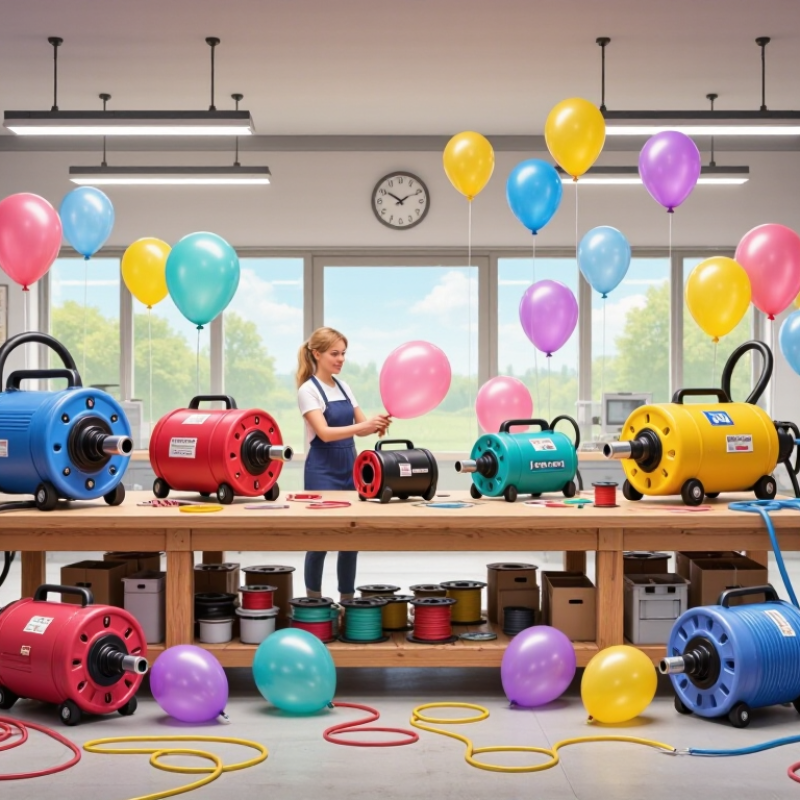
A balloon blower is a powered device that moves room air through a nozzle into an uninflated balloon. It is commonly used to prepare decorations, arches, columns, and table displays faster than hand inflation. Most units have one or two outlets and use a hand control or foot switch to start airflow. They fill balloons with air, not helium, so the balloons generally will not float freely.
During use, stretch the balloon opening over the nozzle, hold it securely, and inflate in short bursts. Stopping near the intended size helps reduce splitting and keeps a display more uniform. A sizing guide can improve consistency when preparing many balloons. Not every balloon behaves alike. Material, shape, and room temperature can affect how quickly each one expands.
For busy setups, a dual-nozzle model can save time, though its airflow and noise may not suit every workspace. Keep intake vents clear, place the unit on a stable surface, and follow the operating instructions. The blower reduces repetitive effort, but it does not replace careful handling or checking each balloon. That part is easy to rush. Dust and scraps near the air intake can also interfere with airflow.
Selecting the top balloon blower manufacturers requires more than comparing advertised speed. A useful shortlist weighs measured airflow, pressure stability, continuous operating time, energy use, noise, service access, and documented safety controls. Test units with the same balloon size and record inflation time across repeated cycles. Small differences matter on a busy packing line.
Market demand gives context, not a ranking. Fortune Business Insights’ Balloon Market report valued the global balloon market at US$8.56 billion in 2023 and projected US$12.56 billion by 2032. That growth suggests wider demand for dependable inflation equipment, but it does not prove which manufacturers make the best blowers. Buyers should check whether published performance figures come from repeatable tests, and whether warranties and replacement parts are available in their region.
Safety and durability deserve direct review. Ask for electrical protection details, thermal limits, and maintenance instructions; compare them with relevant machinery-safety guidance, such as ISO 12100. Numbers need context. A high airflow rating may describe a brief peak, not a full shift of operation. One weakness in many comparisons is limited independent testing, so rankings should disclose their test method and uncertainty rather than imply perfect precision.
A global view of balloon blower manufacturing reveals different strengths, not one universal formula. These ten profiles describe common supplier specialities; individual product performance still needs verification.
Small details count.
Specifications can look impressive on paper.
No supplier is perfect. For a practical comparison, request measured airflow, duty-cycle guidance, warranty terms, and sample units. A short test can reveal awkward controls or excessive heat that a catalogue photograph cannot.
A useful comparison of ten balloon manufacturers starts with what they actually make. Some focus on latex party balloons; others offer foil shapes, printed designs, or event-sized products. Product range matters, but so does consistency. Ask for material specifications, color samples, and documented quality checks. Small sample-to-order differences can become obvious across a large shipment.
Production capacity should be judged in practical terms, not just headline output. Check monthly volume, peak-season lead times, minimum order quantities, and whether custom printing slows dispatch. Global reach includes export experience, regional warehousing, sturdy packaging, and responsive support across time zones. A broad sales map alone proves little. Delivery records matter more.
Tips: Request a recent sample set and a written capacity estimate for your exact order. Compare like with like. Ask how defects are recorded and replacements handled. One caveat: published figures may be dated, and this comparison may miss local service differences. Verify current details directly before choosing.
Balloon blower manufacturing is moving toward tighter airflow control and more efficient motors. A steady stream helps inflate balloons evenly without stretching their necks too quickly. Small details matter. Nozzle shape, hose length, and valve response can all affect filling time and consistency.
Manufacturers are adding pressure sensors and simple digital controls to regulate output. These systems can reduce operator guesswork, especially when different balloon sizes are used on one line. Some production equipment also uses automated feeding and counting, while workers still inspect seams and nozzle fit. That human check remains useful. Sensors can miss defects.
Energy use is another design focus. Brushless motors and improved airflow paths may lower power demand, though results depend on operating conditions and maintenance. Noise reduction matters on busy production floors, too. Still, automation is not automatically better: added controls can make repairs harder when parts or technical support are scarce. Practical designs need accessible components, clear service instructions, and repeatable quality checks. A small leak can waste air all day.
„Thanks to the LUVIR technology, the solder resist process could be switched directly from the previously used mask exposure to direct exposure. As an outstanding digital solution on the market, this technology has been able to demonstrate fast process times and superior quality on our certified conventional ink in production. This allowed us to fully digitize the solder mask process at low cost – without process or ink adjustments. An excellent benefit to our production in Rot am See.“
Ralf Göhringer (Head of Production WE Rot am See)
I would definitely recommend the Limata machine and team for a future company purchase
Michael Greenaway
Compunetics Inc.
“The Limata ldi has been amazing!! Best thing we did was buy this machine”
Richard Brady
GM
Circuitlabs
“Since 2019, we have been running the Limata X1000 LDI system (including LUVIR for solder mask imaging) in daily production as an addition to our current process with film. The machine was capable of properly exposing Taiyo PSR-4000 BN (DI) solder mask types on normal to high-copper boards using a new and unique direct imaging process. The machine operating interface is very user friendly which allowed for a quick technical training curve. The pre-registration processing reduced several seconds of production time at every print. Limata support and service staff is incomparable. They supported our team every step of the way at basically any time of the day or night, with literally, an immediate response time, customizing the software interface to best fit our Operations and needs.
We have exposed more than 8,000 prints since end of October, on various solder mask colors and some resist film panels. Limata, has proven to be very capable and innovative. They are a strong contender in the industry.
We have very much enjoyed this project, and working with the team!
Thank you Limata for the continued support and being a part of our growth.”
Bill Sezate
Vice President, GM
Summit Interconnect
As a replacement to our current contact exposure process with film, the LIMATA X2000 system including LUVIR-Technology was capable of properly exposing non-LDI solder mask types using a direct imaging process. The machine offers cutting edge software with a very intuitive operating interface which allowed for quick technician training curve. The dual drawer system combined with pre-registration processing reduced several seconds of production time at every machine cycle. Limata support and service staff is world class. They added software patches to keep production running at shortest possible response times, customized the software interface to best fit our in-house Operations system, and even wrote a step-by-step machine processing manual. As a result of the project, we have exposed more than 16,000 times on various product types and solder mask brands/colors. Limata, in a very short timeframe as a company, has definitely shown they are truly innovative and will be challenging the industry of direct imaging for the top spot.
Kevin Beattie
Process Engineer
TTM Technologies
Forest Grove Division
