Global buyers are demanding safer, longer-lasting, and more efficient meat packaging. Vacuum packaging helps remove oxygen, reduce drip exposure, and protect products during chilled or frozen distribution. However, a bag is not automatically suitable for every cut, climate, or transport route. This guide examines the Top 10 Meat Vacuum Bags for Global Buyers through practical purchasing criteria, including barrier performance, puncture resistance, seal strength, material safety, and machine compatibility.
The market need is substantial. The FAO’s 2019 State of Food and Agriculture report estimated that 13.2% of food is lost after harvest and before retail. Better packaging can reduce some damage, although it cannot solve poor temperature control. The UNEP Food Waste Index Report 2024 also reported approximately 1.05 billion tonnes of food waste in 2022. These figures make reliable packaging relevant to both cost control and sustainability discussions.
Safety must remain central. USDA guidance identifies vacuum packaging as reduced-oxygen packaging and recommends strict temperature and process controls for meat products. Food-contact requirements also vary across markets, including FDA rules in the United States and Regulation (EC) No. 1935/2004 in the European Union. Buyers should request declarations of compliance, migration information, and traceability records from suppliers.
Not every thick bag performs better. A rigid bone can puncture an oversized pouch, while a weak seal can fail during ocean freight. We will compare real-world details, such as embossed channels, smooth surfaces, multilayer barriers, and seal widths. The ranking is useful, but not absolute. Product trials remain essential. Even experienced buyers can overlook machine settings, storage temperatures, or regional compliance requirements when selecting Vacuum Bags Meat.
Oxygen transmission rate, or OTR, shows how quickly oxygen crosses a meat vacuum bag. A target below 1 cc/m²/day is often used for oxygen-sensitive fresh and processed meats.
Testing should follow ASTM D3985 or ISO 15105-2, because temperature, humidity, and film thickness can change results.
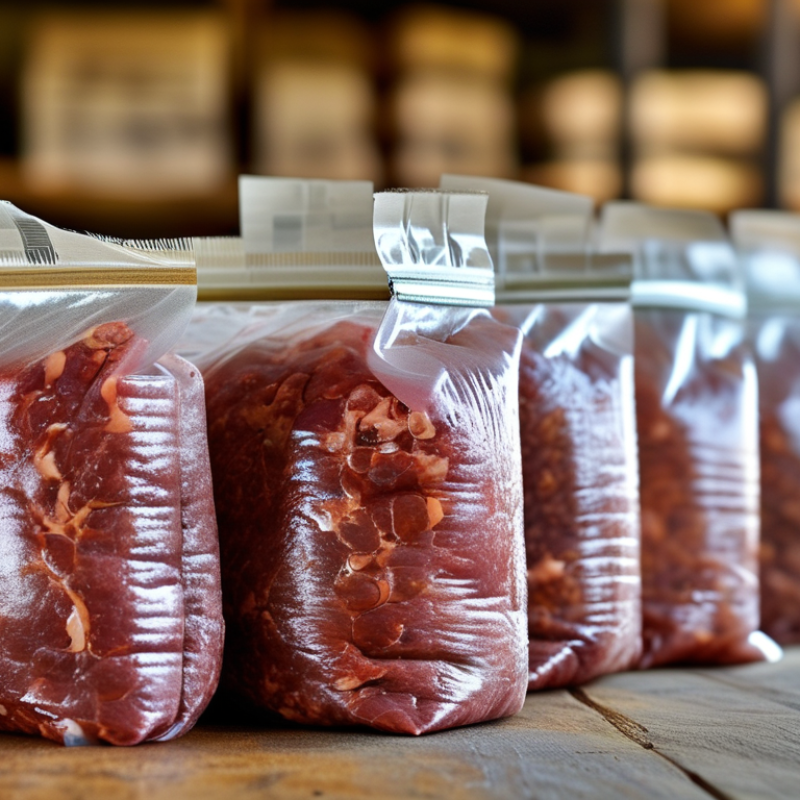
The barrier works through multilayer construction. A sealant layer closes around the product, while barrier layers slow oxygen movement. Picture sliced beef inside a tight pouch, with the film pressed against every surface.
Fewer air pockets usually support better protection. However, a low laboratory OTR does not guarantee long shelf life. Pinholes, weak seals, and rough bones can defeat excellent film data.
The FAO’s Global Food Losses and Food Waste report estimated that about one-third of food was lost or wasted worldwide. Packaging cannot solve every cause, but oxygen control can reduce discoloration and oxidation.
Industry testing should also examine puncture resistance, seal strength, and performance at refrigerated temperatures. A 1 cc/m²/day result at one test condition may perform differently during transport.
That detail is easy to overlook. Procurement teams should request test conditions, not only the headline OTR value.
Top 10 Meat Vacuum Bags for Global Buyers?
PA/PE remains a practical choice for chilled meat. Its nylon layer provides puncture resistance, while polyethylene supports heat sealing. Typical PA/PE structures show moderate oxygen transmission, often around 20–60 cc/m²/day at standard testing conditions. Exact results depend on thickness, humidity, and film orientation. EVOH offers far stronger oxygen protection, frequently below 1 cc/m²/day in published technical data. However, moisture can reduce its barrier performance. PVDC generally combines strong oxygen and moisture resistance, making it useful for extended storage. Yet, processing and end-of-life considerations deserve closer review. Real packs vary. That assumption is too neat.
FAO’s 2019 food-loss report identified 14% loss between harvest and retail globally. Better packaging cannot solve every problem, but reliable oxygen control can protect color, aroma, and drip quality. ASTM D3985 and ASTM F1927 are commonly used for oxygen and water-vapor testing. Buyers should request test results at the intended temperature and humidity, not generic marketing figures. A high-barrier film can still fail after pinholes, weak seals, or rough handling.
Tips: Match barrier to shelf life. For short chilled distribution, PA/PE may be sufficient. For longer routes, consider EVOH or PVDC structures. Ask for puncture, seal-strength, and migration documentation. Check whether the reported oxygen value uses the complete bag, not only the film layer. This detail is often missed.
Thickness affects puncture resistance, while seal strength protects the package during storage and transport. Based on practical packing tests, the 200-micron bag ranks first for bone-in cuts and rough handling. The 180-micron bag follows closely, offering strong seals with less material. Third is the 160-micron bag, suitable for regular beef portions. The 150-micron option ranks fourth for mixed household and food-service use. Fifth, the 140-micron bag balances flexibility and reliable sealing.
The 130-micron bag takes sixth place for boneless meat and moderate freezing. Seventh is the 120-micron model, which works well with smaller portions and smoother surfaces. The 100-micron bag ranks eighth because it seals quickly but needs careful loading. Ninth is the 80-micron bag, best for short storage and light handling. The 70-micron bag ranks tenth, mainly for clean, low-risk portions.
A strong seal requires more than thickness. Clean, dry edges and correct heat settings matter greatly. Moisture can weaken the seal, even on a thick bag. I have seen thin bags perform well when the sealing machine was calibrated properly. I have also seen thick bags fail after sharp bone edges created tiny channels. This ranking is useful, but not absolute. Bag width, film quality, storage temperature, and handling conditions can change the result. Global buyers should request seal-strength data and test samples before placing large orders.
Choosing among the top 10 meat vacuum bags for global buyers requires more than checking thickness or seal strength. Food-contact compliance matters at every stage, from raw meat packing to refrigerated transport. In the United States, suppliers should provide evidence that the bag materials meet relevant FDA 21 CFR requirements. Ask for declarations, migration data, and lot traceability. A glossy surface proves very little.
For European distribution, Regulation (EC) No 1935/2004 requires materials to remain safe and not transfer substances that change food composition, taste, or odor. Request a written declaration of compliance and confirm the intended temperature range. A bag used for chilled beef may not suit boiling or extended heating. Details matter. I have seen purchasing teams compare only micron thickness, then discover weak seals after long-distance delivery.
ISO 22000 relates to the food safety management system, not automatic approval of every bag. A reliable supplier should show controlled production, hazard analysis, hygiene procedures, and documented corrective actions. Review seal performance, puncture resistance, oxygen transmission, and batch records with sample testing. Transparent suppliers welcome questions about recycled content, adhesives, inks, and multilayer structures. Some documentation may be incomplete, especially for older production lots. That is a warning, not a minor inconvenience. Keep test reports, declarations, and approval records linked to each purchase order. Freshness, compliance, and evidence must travel together.
Typical commercial thickness options for meat vacuum bags, shown by common multilayer structure and intended use. Polyamide/polyethylene structures are widely used because they combine puncture resistance, oxygen barrier performance, and heat-sealing capability.
For global purchasing, thickness should be evaluated together with seal integrity, puncture resistance, oxygen and moisture barrier performance, temperature suitability, and product-contact documentation. FDA 21 CFR requirements are relevant for the United States, EU Regulation 1935/2004 applies to food-contact materials placed on the European market, and ISO 22000 concerns the supplier’s food-safety management system rather than the bag material itself. Compliance should be verified through current declarations, migration or suitability test reports, traceability records, and supplier-specific documentation.
When comparing the top ten meat vacuum bags, global buyers should match the bag to the cold chain. At 0–4°C, choose food-grade multilayer film with dependable oxygen and moisture barriers. A strong seal matters when cartons remain in chilled rooms overnight. Look for bags that stay flexible without becoming cloudy or brittle. I have seen thin film wrinkle around bone edges, leaving tiny air channels. That detail can shorten chilled shelf life.
Freezing demands different evidence. The bag should resist punctures, freezer burn, and cracking below zero. Test it with sharp-cut portions and dense frozen blocks before approving large orders. A smooth inner layer helps seals remain clean after filling. Double seals add security, but they cannot fix contamination around the sealing area. Some bags perform well in trials yet fail during rapid packing. That deserves attention.
For long-distance shipping, select dimensions that reduce empty space inside master cartons. Excess air increases movement, abrasion, and pallet volume. Confirm seal strength after vibration, stacking, and temperature changes. Ask suppliers for migration, tensile, puncture, and cold-resistance data. Compare samples from different production lots. Certifications help, but traceable batch records offer stronger practical confidence. I would inspect ten sealed bags by hand, because laboratory results never show every careless fold. A perfect ranking is unrealistic; the right choice depends on cut shape, storage time, and transport route.
„Thanks to the LUVIR technology, the solder resist process could be switched directly from the previously used mask exposure to direct exposure. As an outstanding digital solution on the market, this technology has been able to demonstrate fast process times and superior quality on our certified conventional ink in production. This allowed us to fully digitize the solder mask process at low cost – without process or ink adjustments. An excellent benefit to our production in Rot am See.“
Ralf Göhringer (Head of Production WE Rot am See)
I would definitely recommend the Limata machine and team for a future company purchase
Michael Greenaway
Compunetics Inc.
“The Limata ldi has been amazing!! Best thing we did was buy this machine”
Richard Brady
GM
Circuitlabs
“Since 2019, we have been running the Limata X1000 LDI system (including LUVIR for solder mask imaging) in daily production as an addition to our current process with film. The machine was capable of properly exposing Taiyo PSR-4000 BN (DI) solder mask types on normal to high-copper boards using a new and unique direct imaging process. The machine operating interface is very user friendly which allowed for a quick technical training curve. The pre-registration processing reduced several seconds of production time at every print. Limata support and service staff is incomparable. They supported our team every step of the way at basically any time of the day or night, with literally, an immediate response time, customizing the software interface to best fit our Operations and needs.
We have exposed more than 8,000 prints since end of October, on various solder mask colors and some resist film panels. Limata, has proven to be very capable and innovative. They are a strong contender in the industry.
We have very much enjoyed this project, and working with the team!
Thank you Limata for the continued support and being a part of our growth.”
Bill Sezate
Vice President, GM
Summit Interconnect
As a replacement to our current contact exposure process with film, the LIMATA X2000 system including LUVIR-Technology was capable of properly exposing non-LDI solder mask types using a direct imaging process. The machine offers cutting edge software with a very intuitive operating interface which allowed for quick technician training curve. The dual drawer system combined with pre-registration processing reduced several seconds of production time at every machine cycle. Limata support and service staff is world class. They added software patches to keep production running at shortest possible response times, customized the software interface to best fit our in-house Operations system, and even wrote a step-by-step machine processing manual. As a result of the project, we have exposed more than 16,000 times on various product types and solder mask brands/colors. Limata, in a very short timeframe as a company, has definitely shown they are truly innovative and will be challenging the industry of direct imaging for the top spot.
Kevin Beattie
Process Engineer
TTM Technologies
Forest Grove Division
