The manufacturing landscape in China is undergoing rapid evolution, driven by the demand for precision machining. Carbide Burrs play a crucial role in this sector, offering durability and high efficiency. According to a recent market report, the carbide tools industry in China is projected to grow at a CAGR of 7.8% from 2021 to 2026. Such growth reflects a growing emphasis on precision tooling.
Carbide burrs are essential for various applications, including metal shaping and woodworking. Their unique properties allow for superior material removal rates. Industries invest heavily in quality burrs to enhance production efficiency. However, not all carbide burrs are created equal, and selecting the right one can be challenging. There’s a noticeable gap between low-quality and high-quality tools, which can affect final product precision.
Understanding the nuances of carbide burrs is crucial for manufacturers aiming for optimal output. This article explores the top 10 carbide burrs currently available in the Chinese market, emphasizing their unique features and benefits. Recognizing the right tools can lead to better machining outcomes, yet many still overlook this critical aspect in their operations. Thus, careful consideration is needed when choosing carbide burrs for specific applications.
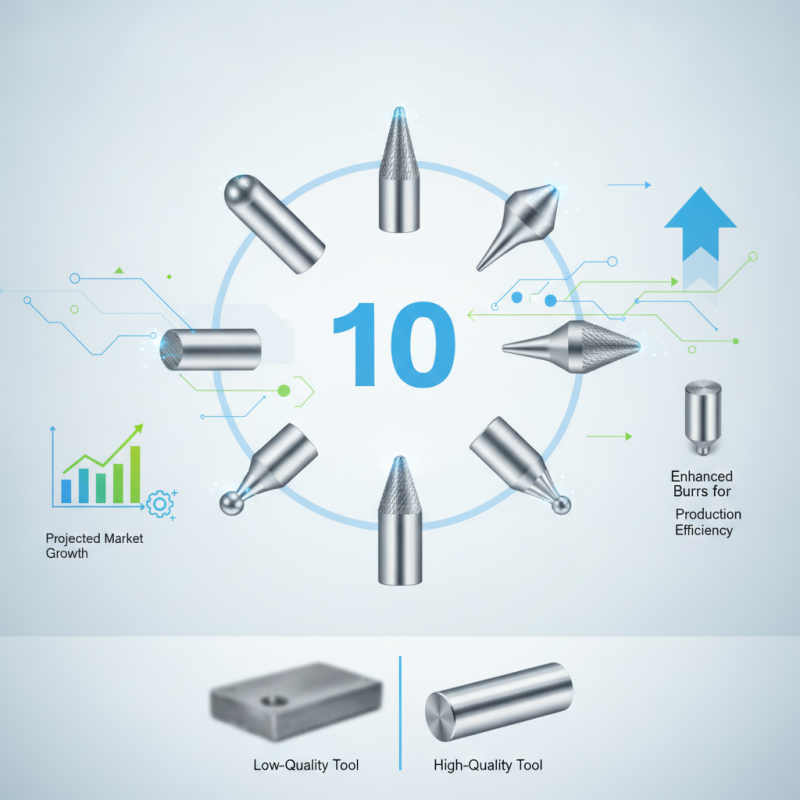
Carbide burrs are essential tools in precision machining. They are engineered for shaping, grinding, and finishing materials such as metal or wood. Carbide, a compound of carbon and tungsten, offers exceptional hardness and wear resistance. The performance of these burrs is vital in achieving detailed work with clean surfaces and precise dimensions.
In precision machining, carbide burrs play a crucial role. The global market for precision machining tools is projected to reach USD 20 billion by 2026, according to industry reports. With manufacturing demands increasing, the need for accurate cutting tools has surged. Carbide burrs contribute to this by enabling high-speed machining without overheating, increasing efficiency and productivity.
These tools come in various shapes and sizes for diverse applications. For example, flame-shaped burrs excel in contouring, while cylindrical burrs are ideal for smoothing edges. However, improper use can lead to tool wear or suboptimal results. Understanding the right burr for the job is crucial for engineers. Regular training and knowledge updates in this field remain essential, as many professionals still overlook the importance of tool selection.
Carbide burrs are essential tools in precision machining. They come in various shapes and sizes, each designed for specific tasks. In China, some popular types include flame burrs, tree burrs, and cylindrical burrs. Flame burrs are favored for their versatility in carving and finishing. They excel at creating intricate designs and detailed work on materials like metal and wood.
Tree burrs are particularly useful for accessing tight spaces. Their tapered design allows for deeper cuts and detailed engraving. This makes them ideal for sculpting small components. Cylindrical burrs, on the other hand, are great for shaping and smoothing surfaces. These are commonly used for deburring edges and achieving a polished finish.
Choosing the right type of burr is crucial. A mismatch can lead to inefficiency and poor workmanship. Mistakes in selecting burrs may slow down projects. Operators should evaluate their specific requirements carefully. Having a good selection can enhance productivity and precision in machining tasks. Understanding these nuances is vital for anyone involved in the manufacturing process.
When selecting carbide burrs for precision machining, several factors demand attention. The diameter of the burr can significantly influence its performance. Industry reports indicate that burrs with a 1/4” diameter provide a balanced approach for various applications. However, smaller diameters may offer enhanced precision for intricate tasks.
Material hardness is another critical factor. Carbide burrs are typically rated for specific hardness levels. A burr rated for steel may falter when used on titanium. Statistics show that using an inappropriate burr can reduce cutting efficiency by as much as 30%. Moreover, the burr's shape plays a substantial role in defining its application. A cylindrical shape is excellent for contouring, while a ball shape is preferable for finishing work.
End user feedback is invaluable. Experienced machinists often prioritize burrs that exhibit minimal wear and maintain sharpness longer. Reports suggest that maintaining a burr's cutting edge can extend service life significantly, often by 25% or more. Despite the growing range of options, many machinists express confusion over the selection process. This indicates an ongoing need for better guidance in the industry.
When it comes to precision machining, carbide burrs are essential tools in various industries across China. The right choice of burr can enhance both efficiency and accuracy. Reports suggest that over 60% of machining companies see a direct impact from using high-quality burrs. It's important to differentiate between types, like spherical, cylindrical, or tree-shaped, as each serves unique functions.
Leading experts in the machining field note that the material quality of carbide burrs greatly influences performance. High-grade carbide can increase tool life by 30% or more. Companies often focus on burrs with specific coatings, as these can further enhance durability. Such details matter in high-precision work, where even small deviations can lead to significant quality issues.
While there are many brands, not all meet the industry standards. A blend of innovation and traditional practices sets apart the most reliable manufacturers. The average investment in burr quality can vary, but many professionals agree it’s worth it. Precision machining relies heavily on these tools, and discerning users must often reflect on their choices.
Carbide burrs are essential tools in precision machining, particularly in industries such as aerospace and automotive. These tools efficiently remove material from various substrates, providing a smooth finish. High-quality carbide burrs enhance performance and ensure better results across different applications.
When using carbide burrs, operators benefit from increased durability. These tools can withstand high temperatures and prolonged use without losing sharpness. Additionally, they reduce the chances of tool breakage during complex machining operations. The precision they offer allows for intricate designs and fine detailing, which is crucial in high-stakes industries.
However, selecting the right burr can be challenging. Users must consider factors like size, shape, and grain type. This process may require trial and error, leading to potential waste. Still, investing time in understanding these tools pays off. The efficiency gained through careful selection results in higher productivity and quality outputs.
| Rank | Type of Burr | Diameter (mm) | Length (mm) | Application | Benefit |
|---|---|---|---|---|---|
| 1 | Conical Burr | 3.0 | 25 | Metal shaping | Precision shaping and detailing |
| 2 | Cylinder Burr | 4.0 | 35 | Welding seams | Efficient weld preparation |
| 3 | Ball Nose Burr | 6.0 | 30 | Surface finishing | Enhanced surface quality |
| 4 | Tapered Burr | 5.0 | 28 | Deburring | Effective edge smoothing |
| 5 | Flame Burr | 4.5 | 32 | Material removal | Quick removal of material |
| 6 | Sphere Burr | 7.0 | 45 | Piping | Consistent shaping |
| 7 | Cross-Cut Burr | 5.0 | 20 | General machining | Versatile use |
| 8 | Straight Burr | 8.0 | 50 | Bore finishing | Improved bore accuracy |
| 9 | Rasp Burr | 4.5 | 40 | Wood carving | Precision in woodworking |
| 10 | Diamond Burr | 3.5 | 22 | Glass smoothing | Fine surface finish |
„Thanks to the LUVIR technology, the solder resist process could be switched directly from the previously used mask exposure to direct exposure. As an outstanding digital solution on the market, this technology has been able to demonstrate fast process times and superior quality on our certified conventional ink in production. This allowed us to fully digitize the solder mask process at low cost – without process or ink adjustments. An excellent benefit to our production in Rot am See.“
Ralf Göhringer (Head of Production WE Rot am See)
I would definitely recommend the Limata machine and team for a future company purchase
Michael Greenaway
Compunetics Inc.
“The Limata ldi has been amazing!! Best thing we did was buy this machine”
Richard Brady
GM
Circuitlabs
“Since 2019, we have been running the Limata X1000 LDI system (including LUVIR for solder mask imaging) in daily production as an addition to our current process with film. The machine was capable of properly exposing Taiyo PSR-4000 BN (DI) solder mask types on normal to high-copper boards using a new and unique direct imaging process. The machine operating interface is very user friendly which allowed for a quick technical training curve. The pre-registration processing reduced several seconds of production time at every print. Limata support and service staff is incomparable. They supported our team every step of the way at basically any time of the day or night, with literally, an immediate response time, customizing the software interface to best fit our Operations and needs.
We have exposed more than 8,000 prints since end of October, on various solder mask colors and some resist film panels. Limata, has proven to be very capable and innovative. They are a strong contender in the industry.
We have very much enjoyed this project, and working with the team!
Thank you Limata for the continued support and being a part of our growth.”
Bill Sezate
Vice President, GM
Summit Interconnect
As a replacement to our current contact exposure process with film, the LIMATA X2000 system including LUVIR-Technology was capable of properly exposing non-LDI solder mask types using a direct imaging process. The machine offers cutting edge software with a very intuitive operating interface which allowed for quick technician training curve. The dual drawer system combined with pre-registration processing reduced several seconds of production time at every machine cycle. Limata support and service staff is world class. They added software patches to keep production running at shortest possible response times, customized the software interface to best fit our in-house Operations system, and even wrote a step-by-step machine processing manual. As a result of the project, we have exposed more than 16,000 times on various product types and solder mask brands/colors. Limata, in a very short timeframe as a company, has definitely shown they are truly innovative and will be challenging the industry of direct imaging for the top spot.
Kevin Beattie
Process Engineer
TTM Technologies
Forest Grove Division
