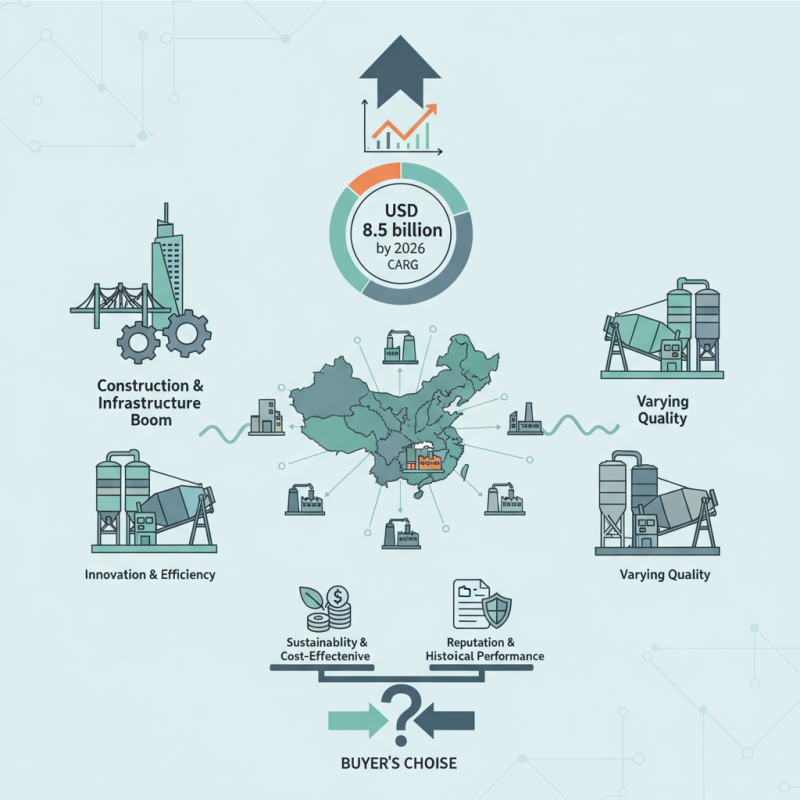
The demand for Concrete Batching Plants in the global market has surged in recent years. According to a report by MarketsandMarkets, the concrete batching plant market is projected to reach USD 8.5 billion by 2026, growing at a CAGR of 4.5%. This growth is driven by the booming construction and infrastructure sectors. China plays a pivotal role in this industry, with numerous manufacturers offering advanced solutions.
Among the top players, several Chinese companies stand out for their innovation and efficiency. Their plants integrate cutting-edge technology and robust designs, catering to the diverse needs of contractors globally. However, not all manufacturers maintain consistent quality and reliability. It is essential for global buyers to identify which Concrete Batching Plants yield the best overall performance, especially considering local regulations and operational standards.
As the industry evolves, emphasizing sustainability and cost-effectiveness becomes crucial. Concrete Batching Plants must adapt to these changing market demands. Buyers should weigh their options carefully. Investigating each provider's reputation and historical performance can lead to smarter investments in equipment.
China is home to a booming concrete batching plant industry. As the country continues to urbanize, the demand for concrete has surged. According to a recent report by Statista, China's concrete production reached 2.1 billion cubic meters in 2022. This relentless growth has established a robust market for advanced batching technologies.
Concrete batching plants in China are increasingly adopting automation. Many facilities utilize computer-controlled systems to optimize efficiency and reduce waste. This shift is driven by the need for consistent quality and tighter project deadlines. For instance, recent studies highlighted that plants with automated controls reduce material discrepancies by up to 15%. However, not all plants have kept pace with these advancements.
Despite notable progress, challenges remain. Some smaller plants still rely on outdated machinery and processes. This can lead to inconsistencies in mix quality. Additionally, regulatory compliance can be a hurdle. Striking a balance between modernization and maintaining standards is essential for long-term success. Moving forward, embracing technology while addressing these issues will help shape the future of concrete batching in China.
| Plant Type | Production Capacity (m³/h) | Features | Applications | Location |
|---|---|---|---|---|
| Mobile Batching Plant | 25-50 | Compact design, easy transportation | Small projects, road construction | Various regions |
| Stationary Batching Plant | 60-120 | High efficiency, large capacity | Highway, dam projects | Centralized locations |
| Concrete Mixing Plant | 40-100 | Automated controls, precise mixing | Building construction | Urban areas |
| Wet Mix Batching Plant | 30-90 | Enhanced mixing quality | Construction, precast applications | Coastal regions |
| Ready Mix Plant | 50-120 | On-demand delivery, consistency | Residential, commercial projects | Metropolitan areas |
| High-Performance Batching Plant | 80-160 | Durability, high strength | Infrastructure projects | Industrial zones |
| Compact Batching Plant | 20-40 | Space-saving, user-friendly | Small site works | Restricted areas |
| Pavement Batching Plant | 70-150 | Specialized for pavement mixtures | Pavement construction | Road projects |
| Dry Mix Batching Plant | 30-75 | Cost-effective, easy to transport | Rapid construction tasks | Various construction sites |
| Asphalt Batching Plant | 60-120 | Asphalt production | Road paving, resurfacing | Construction zones |
When selecting the best concrete batching plants, global buyers should prioritize several critical criteria. Reliability in production is paramount. According to industry reports, a reliable plant can enhance output efficiency. Most high-quality plants report a production capacity of over 100 cubic meters per hour. This level of productivity is crucial for meeting project timelines.
Additionally, technological features play an essential role. Automation and advanced control systems can significantly improve batching accuracy. Many modern plants are equipped with state-of-the-art software that minimizes human error. It's essential to consider the adaptability of the plant to various materials. Not all projects use the same concrete mix, and plants capable of handling diverse ingredients tend to attract more buyers.
Cost-effectiveness shouldn't be overlooked. While high initial investment might seem daunting, energy-efficient plants can lead to lower operational costs in the long run. Industry analysis shows that plants with higher energy efficiency can reduce costs by up to 30%. However, buyers must also recognize potential downsides, such as maintenance needs and spare parts availability, which can influence long-term investments. Balancing these factors is vital for informed decision-making.
When considering concrete batching plants, it's crucial for global buyers to focus on reliable and high-quality suppliers. The concrete batching industry in China has shown tremendous growth. Reports indicate that the market is projected to grow at a compound annual growth rate (CAGR) of over 5% from 2021 to 2026. This surge highlights an increasing demand for construction materials.
Many buyers often overlook the importance of evaluating equipment performance. Optimizing material storage and mixing technology can greatly enhance operational efficiency. Detailed efficiency metrics from various studies suggest that advanced plants can reduce material waste by up to 15%. Additionally, plants equipped with automated systems improve consistency in production, a vital aspect for large construction projects.
Tips: Always check for certification and compliance with international standards. Ensure suppliers provide service support and spare parts availability. Regular maintenance can prevent costly downtimes, yet many plants neglect this aspect. Investing in a reliable supplier contributes significantly to a project's long-term success.
When exploring concrete batching plants in China, several key features stand out among the top contenders. One notable aspect is the efficiency of production. Many plants boast a high output capacity, ensuring rapid delivery of concrete mixtures. Advanced automation is another critical feature. This technology allows for precise measurements and consistency in the mixing process, delivering reliable results on site.
Material quality is essential as well. Leading plants often utilize advanced aggregate handling systems, ensuring that materials are mixed accurately. This precision reduces waste and enhances durability. Additionally, some facilities incorporate eco-friendly technologies. This includes recycling systems for water and aggregates, addressing environmental concerns and reducing operational costs.
However, there are challenges to consider. Some plants may focus heavily on technology, leading to complex operations that require specialized training. Additionally, varying levels of after-sales support can impact long-term reliability for global buyers. It’s crucial to balance technology with user-friendly interfaces. Potential buyers should reflect on these dynamics carefully to make informed decisions.
The concrete batching industry in China is evolving rapidly. This transformation is driven by advances in technology and the need for sustainable practices. Automation is becoming the standard. More plants are integrating smart technologies. These innovations help in optimizing production and reducing waste.
However, the industry's shift toward sustainability raises some challenges. Many batching plants still rely on traditional methods. This reliance can result in higher emissions. The transition to greener practices is not instantaneous. It requires investment and training. Not every plant has the resources for this change, leading to a gap in operational efficiency.
Regulatory pressures are also influencing future trends. The Chinese government emphasizes eco-friendly operations. Compliance with new regulations can be daunting. Smaller plants may struggle to adapt. Industry leaders often advocate for a collaborative approach to share best practices. By fostering teamwork, the entire sector may benefit from the transition. It’s a complex landscape, but one filled with potential for growth and improvement.
This chart displays the annual production capacity (in cubic meters) of the top concrete batching plants in China, showcasing the capabilities and future trends in the concrete batching industry.
„Thanks to the LUVIR technology, the solder resist process could be switched directly from the previously used mask exposure to direct exposure. As an outstanding digital solution on the market, this technology has been able to demonstrate fast process times and superior quality on our certified conventional ink in production. This allowed us to fully digitize the solder mask process at low cost – without process or ink adjustments. An excellent benefit to our production in Rot am See.“
Ralf Göhringer (Head of Production WE Rot am See)
I would definitely recommend the Limata machine and team for a future company purchase
Michael Greenaway
Compunetics Inc.
“The Limata ldi has been amazing!! Best thing we did was buy this machine”
Richard Brady
GM
Circuitlabs
“Since 2019, we have been running the Limata X1000 LDI system (including LUVIR for solder mask imaging) in daily production as an addition to our current process with film. The machine was capable of properly exposing Taiyo PSR-4000 BN (DI) solder mask types on normal to high-copper boards using a new and unique direct imaging process. The machine operating interface is very user friendly which allowed for a quick technical training curve. The pre-registration processing reduced several seconds of production time at every print. Limata support and service staff is incomparable. They supported our team every step of the way at basically any time of the day or night, with literally, an immediate response time, customizing the software interface to best fit our Operations and needs.
We have exposed more than 8,000 prints since end of October, on various solder mask colors and some resist film panels. Limata, has proven to be very capable and innovative. They are a strong contender in the industry.
We have very much enjoyed this project, and working with the team!
Thank you Limata for the continued support and being a part of our growth.”
Bill Sezate
Vice President, GM
Summit Interconnect
As a replacement to our current contact exposure process with film, the LIMATA X2000 system including LUVIR-Technology was capable of properly exposing non-LDI solder mask types using a direct imaging process. The machine offers cutting edge software with a very intuitive operating interface which allowed for quick technician training curve. The dual drawer system combined with pre-registration processing reduced several seconds of production time at every machine cycle. Limata support and service staff is world class. They added software patches to keep production running at shortest possible response times, customized the software interface to best fit our in-house Operations system, and even wrote a step-by-step machine processing manual. As a result of the project, we have exposed more than 16,000 times on various product types and solder mask brands/colors. Limata, in a very short timeframe as a company, has definitely shown they are truly innovative and will be challenging the industry of direct imaging for the top spot.
Kevin Beattie
Process Engineer
TTM Technologies
Forest Grove Division
