Introduction
In plastics manufacturing, improving processing efficiency and surface performance is a key challenge for polymer processors.
To address these issues, many manufacturers rely on silicone additives, which play a critical role in enhancing polymer processing and improving final product performance.
This article explains: what silicone additives are, how they improve plastic performance, where they are commonly used, and how to choose a reliable silicone additives manufacturer.
What Are Silicone Additives for Plastics?
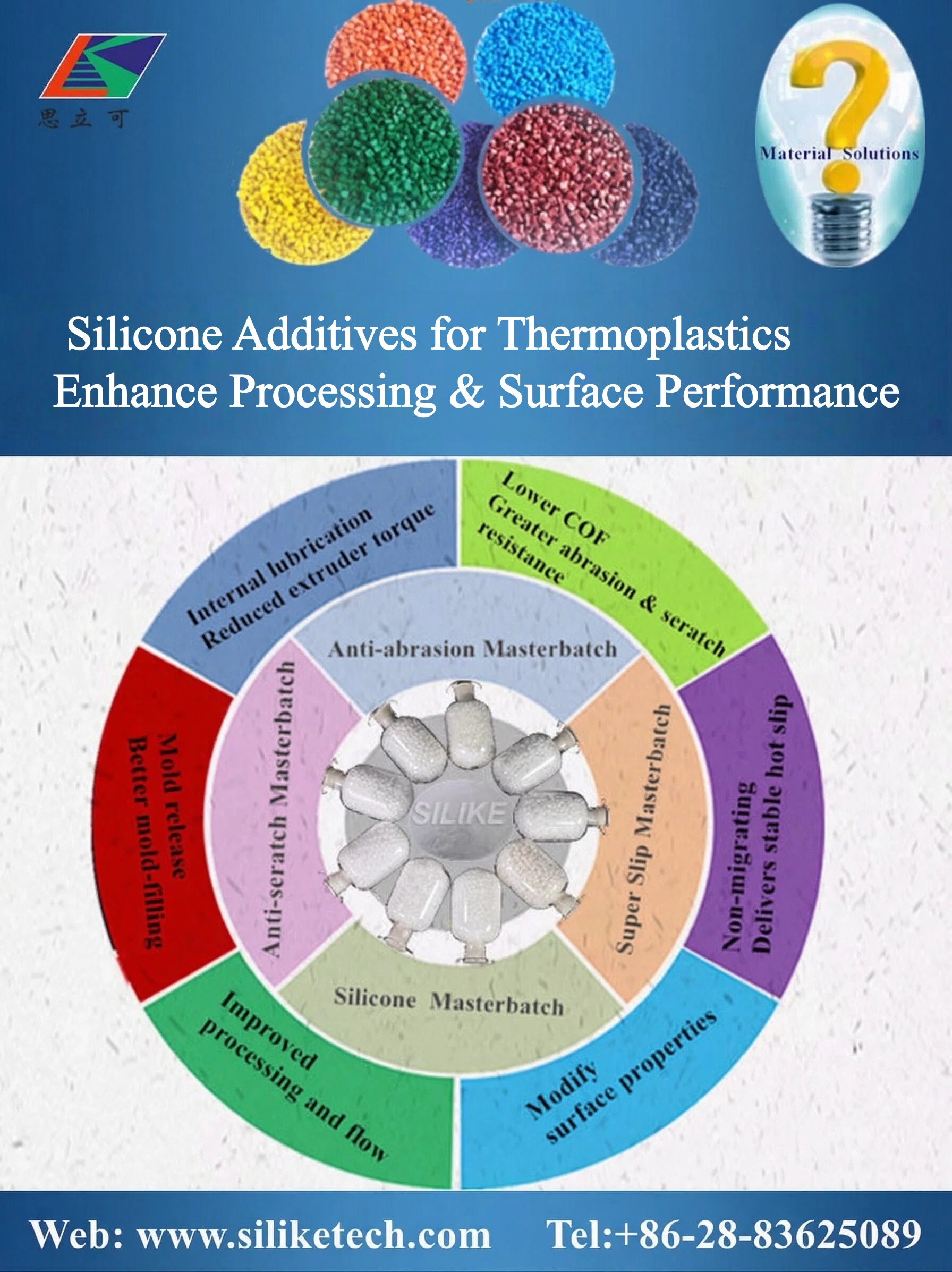
Silicone additives are polymer modifiers typically based on polysiloxane chemistry that are incorporated into thermoplastics to improve processing and surface properties.
The most widely used form in the plastics industry is silicone masterbatch, where ultra-high molecular weight silicone polymers are dispersed in thermoplastic carriers such as LDPE, EVA, TPEE, HDPE, ABS, PP, PA6, PET, TPU, HIPS, POM, LLDPE, PC, SAN, etc. These additives are pelletized to allow easy addition directly into thermoplastics during processing.
These plastic additives enhance polymer performance without significantly altering mechanical properties.
Common Processing Problems in Plastics Manufacturing
Many plastics processors encounter technical challenges during extrusion and injection molding.
Typical issues include:
• High melt viscosity
• Extrusion instability
• Die build-up
• Poor scratch resistance
• Squeaking noise in plastic components
These problems can reduce production efficiency and negatively affect product quality.
Engineering Root Causes of These Problems
From a polymer processing perspective, these problems are often caused by:
• High shear stress at the die wall
• Poor polymer flow behavior
• Insufficient lubrication during processing
• Friction between polymer melt and metal surfaces
These factors increase energy consumption and limit production speed.
How Silicone Additives Improve Polymer Processing
Silicone additives work by forming a lubricating molecular layer within the polymer matrix.
During processing:
1️⃣ Silicone molecules migrate toward the polymer surface
2️⃣ A lubricating interface forms between the melt and the equipment
3️⃣ Friction and shear stress are reduced
As a result, the polymer flows more smoothly through extrusion dies and molds.
Key Benefits of silicone-based plastic additives
Manufacturers use silicone additives to achieve several technical advantages:
• Reduced coefficient of friction (COF)
• Improved scratch resistance
• Enhanced abrasion resistance
• Improved mold release
• Reduced extrusion torque
• Better surface smoothness
These benefits help manufacturers produce higher quality plastic components with improved efficiency.
Chengdu SILIKE Technology manufactures and trades combo silicone additives (silicone masterbatch/powder) to improve processability and surface quality of thermoplastics in industries including textile, automotive interiors, cable and wire compounds, shoe soles, plastic pipes, and film.
Solutions for plastics
Processing properties: Improved melt flow, lower extruder torque, reduced die pressure & die drool, better mold filling, easier mold release, less energy consumption, and decreased cycle time.
Surface quality: Lower coefficient of friction, improved scratch and wear resistance, better surface slip, and improved hand feel.
Typical Applications of SILIKE Silicone Additives
1. Anti-wear agent for the footwear industries
• Reduce DIN value
• Improve abrasion resistance
2. Anti-scratch solutions for modified PP compounds & engineering plastics
• Good scratch resistance, Lower Delta L value
• Low odors, low VOC emissions
3. Silicone-based additives for cable compounds
• Improve processing ability
• Reduce die drool
• Increase line speed
4. Telecom pipe/PLB HDPE duct friction reduction solutions
• Reduce COF
• Smooth the inner wall
5. Matte finish, soft-touch & durable material solutions
• Matt effect
• Durable abrasion & scratch resistance
6. Non-migration slip & anti-block solutions for flexible packaging films
• Stable COF
• No migration, no precipitation
• No influence on haze, hot seal, or printing
7. Dispersion & lubrication solutions for WPC
• Efficient lubrication
• No migration
• Higher output
8. Hyperdispersants for masterbatches, fillers & flame retardants
• Good dispersion, prevents agglomeration
• Improves color strength and surface smoothness
9. PFAS-Free PPA & PTFE alternatives – sustainable polymer processing solutions
• Fluorine-free
• Less die drool
• Eliminates melt fracture
How to Choose a Reliable Silicone Additives Manufacturer
Key factors to evaluate:
• Manufacturing capability:
• Stable production capacity
• Strict quality control
• Batch consistency
• Technical expertise:
• Formulation support
• Polymer compatibility testing
• Application development assistance
SILIKE – A Trusted Silicone Additives Manufacturer
Chengdu Silike Technology Co., Ltd. is a leading manufacturer specializing in silicone-based plastic additives.
With more than 20 years of experience in silicone–polymer integration, SILIKE provides a full range of silicone-based additives for thermoplastics:
SILIKE Product Portfolio
Processing Additives
• Silicone Masterbatch (LYSI Series)
• Silicone Powder Processing Aids
• PFAS-Free Polymer Processing Aids
Surface Modification Additives
• Anti-Scratch Additives
• Anti-Wear Additives
• Super Slip & Anti-Blocking Masterbatches
• Matte Effect Masterbatch
Functional Additives
• Hyperdispersants
• Silicone Waxes
• Copolymeric Siloxane Modifiers
• Additives for Biodegradable Materials
Frequently Asked Questions
What are silicone additives used for?
Silicone additives improve polymer processing efficiency and enhance surface properties such as scratch resistance and slip.
What is silicone masterbatch?
Silicone masterbatch is a pelletized additive containing polysiloxane dispersed in thermoplastic resin carriers to improve processing and surface performance.
Do silicone additives affect mechanical properties?
At recommended dosages, silicone additives generally do not significantly affect mechanical strength or durability.
Can silicone additives replace fluoropolymer processing aids?
In some extrusion applications, silicone-based additives can reduce reliance on fluoropolymer processing aids and improve processing stability.
Conclusion
Silicone additives have become essential materials for improving polymer processing efficiency and product durability in modern plastics manufacturing.
By reducing friction, improving surface performance, and enhancing process stability, these additives enable manufacturers to produce high-quality plastic components more efficiently.
If you are looking for a reliable silicone additives manufacturer, the technical team at SILIKE can help evaluate your formulation and recommend suitable additive solutions. Contact Amy Wang via Email: sale@reytechmachine.com.
„Thanks to the LUVIR technology, the solder resist process could be switched directly from the previously used mask exposure to direct exposure. As an outstanding digital solution on the market, this technology has been able to demonstrate fast process times and superior quality on our certified conventional ink in production. This allowed us to fully digitize the solder mask process at low cost – without process or ink adjustments. An excellent benefit to our production in Rot am See.“
Ralf Göhringer (Head of Production WE Rot am See)
I would definitely recommend the Limata machine and team for a future company purchase
Michael Greenaway
Compunetics Inc.
“The Limata ldi has been amazing!! Best thing we did was buy this machine”
Richard Brady
GM
Circuitlabs
“Since 2019, we have been running the Limata X1000 LDI system (including LUVIR for solder mask imaging) in daily production as an addition to our current process with film. The machine was capable of properly exposing Taiyo PSR-4000 BN (DI) solder mask types on normal to high-copper boards using a new and unique direct imaging process. The machine operating interface is very user friendly which allowed for a quick technical training curve. The pre-registration processing reduced several seconds of production time at every print. Limata support and service staff is incomparable. They supported our team every step of the way at basically any time of the day or night, with literally, an immediate response time, customizing the software interface to best fit our Operations and needs.
We have exposed more than 8,000 prints since end of October, on various solder mask colors and some resist film panels. Limata, has proven to be very capable and innovative. They are a strong contender in the industry.
We have very much enjoyed this project, and working with the team!
Thank you Limata for the continued support and being a part of our growth.”
Bill Sezate
Vice President, GM
Summit Interconnect
As a replacement to our current contact exposure process with film, the LIMATA X2000 system including LUVIR-Technology was capable of properly exposing non-LDI solder mask types using a direct imaging process. The machine offers cutting edge software with a very intuitive operating interface which allowed for quick technician training curve. The dual drawer system combined with pre-registration processing reduced several seconds of production time at every machine cycle. Limata support and service staff is world class. They added software patches to keep production running at shortest possible response times, customized the software interface to best fit our in-house Operations system, and even wrote a step-by-step machine processing manual. As a result of the project, we have exposed more than 16,000 times on various product types and solder mask brands/colors. Limata, in a very short timeframe as a company, has definitely shown they are truly innovative and will be challenging the industry of direct imaging for the top spot.
Kevin Beattie
Process Engineer
TTM Technologies
Forest Grove Division
