Why choose Silicon Nitride for industrial applications? The answer begins with performance under pressure, heat, and repeated motion. Silicon Nitride combines low density, high hardness, strong thermal-shock resistance, and useful electrical insulation. These properties matter inside turbine components, semiconductor equipment, bearings, and molten-metal systems. A ceramic ball can rotate with less mass and reduced lubrication demand. That detail becomes important when equipment operates continuously.
Industry data supports this growing interest. Grand View Research’s 2024 advanced ceramics market analysis identifies energy, electronics, transportation, and medical manufacturing as major demand areas. MarketsandMarkets also reports continued growth in technical ceramics, driven by electrification, high-temperature processing, and semiconductor production. These reports do not isolate every Silicon Nitride application equally. However, they show a clear movement toward materials that extend service life and improve operating efficiency. The U.S. Department of Energy has also emphasized advanced materials as tools for improving industrial energy performance.
Silicon Nitride is not a universal solution. Its price, machining complexity, and sensitivity to processing quality require careful engineering review. Manufacturers must examine fracture toughness, surface finish, thermal gradients, joining methods, and standards compliance. ISO 26602, for example, addresses silicon nitride ceramic balls used in rolling bearings. Real-world selection should combine supplier test data with application trials. A failed component can resemble a material problem, but poor design or installation may be responsible. That distinction deserves attention. When correctly specified, Silicon Nitride can reduce wear, stabilize performance, and support longer maintenance intervals in demanding industrial environments.
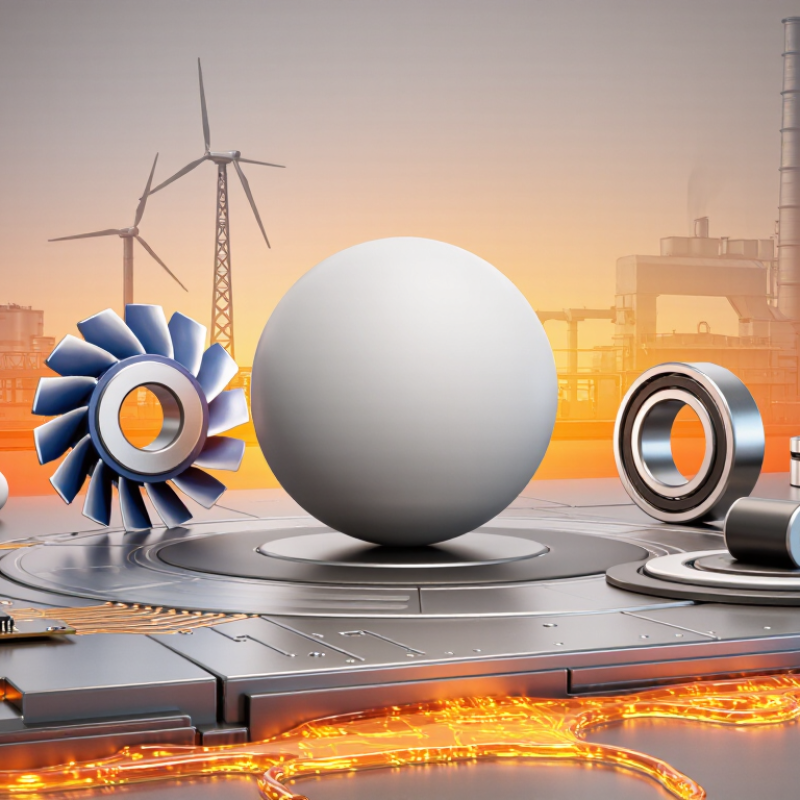
Silicon nitride, or Si3N4, is a ceramic made from silicon and nitrogen. Its atoms form strong covalent bonds in a compact crystal network. This structure explains much of its industrial value. It resists wear, corrosion, and high temperatures. It also remains electrically insulating in many demanding environments.
Silicon nitride commonly appears in alpha and beta crystal phases. Manufacturing conditions influence their ratio, grain growth, and final performance. A well-controlled microstructure can improve fracture toughness and thermal shock resistance.
The material is lighter than many traditional engineering ceramics, yet it offers high hardness and stiffness. Its low thermal expansion helps components survive repeated heating and cooling. However, performance is never guaranteed by composition alone. Poor processing can create pores, internal stresses, or weak grain boundaries. That detail is easy to underestimate.
Tips: Check density, phase composition, porosity, and surface finish before selecting a grade. Match the material to the real load, temperature, chemical exposure, and lubrication conditions. Test thermal cycling when failure would be costly. Silicon nitride can perform exceptionally well, but design assumptions still require verification.
Silicon nitride manufacturing begins with carefully selected ceramic powders. Their purity, particle size, and oxygen content strongly affect the final performance.
Technicians blend the powder with sintering aids and organic binders. The mixture must remain uniform.
Even slight segregation can create weak areas after firing.
Manufacturers shape the compound through pressing, injection molding, or slip casting. Each method suits different geometries and production volumes.
Pressing works well for simple components, while injection molding supports detailed shapes.
The green body is then dried and debound slowly. This stage removes organic materials without cracking the part.
It is not a flawless process. Hidden pores may remain, especially in thick sections.
Sintering usually occurs at high temperature in a controlled atmosphere. Pressure-assisted methods can improve density and reduce internal defects.
After sintering, engineers grind sealing surfaces, holes, and bearing tracks with diamond tools.
Silicon nitride is hard, so machining requires patience and stable cooling.
Dimensional inspection checks flatness, density, hardness, and fracture resistance.
Microscopic examination can reveal flaws that ordinary visual checks miss.
In demanding applications, traceable process records matter as much as the finished appearance.
A polished surface may look perfect, yet internal stress still deserves careful review.
In high-temperature industrial environments, material failure often begins quietly. A furnace fixture may warp, crack, or contaminate a finished part. Silicon nitride helps reduce these risks through strong thermal stability and low thermal expansion. It can tolerate repeated heating and cooling with less thermal shock than many conventional ceramics. This matters near burner zones, kiln interiors, and heat-treatment lines. The material also remains relatively lightweight, which can simplify handling and reduce mechanical load on moving equipment. Not every design benefits equally, though. Poor surface finishing or incorrect joint design can still cause early failure.
Its performance comes from more than heat resistance. Silicon nitride offers useful wear resistance, chemical stability, and electrical insulation at elevated temperatures. In bearings, supports, rollers, and protective components, these qualities can improve service consistency.
Engineers should examine atmosphere, load, temperature cycles, and contact pressure. A component rated for a high peak temperature may perform poorly under constant vibration. Real operating data matters more than a catalog number. Testing a small part under production-like conditions can reveal unexpected oxidation or edge chipping.
Tips: Keep temperature gradients gradual when possible. Check dimensional changes after thermal cycling. Use clean handling practices, because surface damage may grow during heating. Record failures with photos and operating data. This makes material selection more reliable, even when the first trial is not perfect.
Why Choose Silicon Nitride for Industrial Applications?
Silicon nitride is useful where heat, wear, and electrical isolation meet. Its density is about 3.2 g/cm³, roughly 40% lower than steel. This helps reduce rotating mass in bearings, rollers, and precision machinery. Its high fracture toughness, commonly near 6–10 MPa·m½, also improves resistance to sudden loading. In practice, ceramic rolling elements can run with less lubrication. They still require correct preload, surface finishing, and contamination control.
Electronics manufacturers use silicon nitride substrates, insulators, and protective layers. These parts manage heat while limiting unwanted current paths. The World Semiconductor Trade Statistics forecast global semiconductor sales at about 588 billion dollars in 2024. That growth increases demand for stable materials in power modules and high-frequency equipment. Energy systems create another opportunity. The International Energy Agency reported that renewable capacity additions reached about 510 GW in 2023. Inverters, turbines, and grid equipment face repeated thermal and mechanical stress. Silicon nitride can support longer service intervals, although cost and machining complexity remain real barriers. It is not a universal replacement.
Tips: Match the grade to the load, temperature, and atmosphere. Test thermal cycling before production approval. Inspect edges carefully. Small chips can become large failures. Design engineers should compare total lifecycle cost, not only purchase price. Field data matters more than attractive laboratory results. My practical concern is simple: many projects specify ceramic performance but underestimate installation quality. That gap deserves more attention.
Why Choose Silicon Nitride for Industrial Applications?
Silicon nitride suits components exposed to heat, wear, corrosion, and repeated mechanical loads. Selection should begin with operating temperature, applied force, speed, and chemical exposure. Its low density can reduce rotating mass, while its hardness supports long service in abrasive environments. However, hardness is not the whole story. Engineers must also assess fracture toughness, thermal shock resistance, surface finish, and dimensional tolerances. A complex shape may increase manufacturing cost and create stress concentrations. A perfect material does not exist.
Limitations deserve careful attention. Silicon nitride can fail from impact, edge damage, or poorly controlled thermal gradients. It may also require specialized machining and inspection. During equipment reviews, I would examine the full assembly, not only the ceramic part. Metal housings, seals, and fasteners can expand differently and create damaging contact pressure. Published data helps, but actual loads may differ from laboratory conditions. That assumption deserves a second look.
Tips: Keep edges protected during handling and installation. Use clean, compatible lubrication where required. Avoid sudden temperature changes, especially during startup and shutdown. Inspect for chips, hairline cracks, discoloration, and unusual vibration. Record operating hours and failure patterns. Replace damaged parts early; a small edge defect can grow under cyclic loading. Maintenance teams should verify alignment and mounting pressure during scheduled inspections, because even strong ceramics perform poorly under uneven support.
„Thanks to the LUVIR technology, the solder resist process could be switched directly from the previously used mask exposure to direct exposure. As an outstanding digital solution on the market, this technology has been able to demonstrate fast process times and superior quality on our certified conventional ink in production. This allowed us to fully digitize the solder mask process at low cost – without process or ink adjustments. An excellent benefit to our production in Rot am See.“
Ralf Göhringer (Head of Production WE Rot am See)
I would definitely recommend the Limata machine and team for a future company purchase
Michael Greenaway
Compunetics Inc.
“The Limata ldi has been amazing!! Best thing we did was buy this machine”
Richard Brady
GM
Circuitlabs
“Since 2019, we have been running the Limata X1000 LDI system (including LUVIR for solder mask imaging) in daily production as an addition to our current process with film. The machine was capable of properly exposing Taiyo PSR-4000 BN (DI) solder mask types on normal to high-copper boards using a new and unique direct imaging process. The machine operating interface is very user friendly which allowed for a quick technical training curve. The pre-registration processing reduced several seconds of production time at every print. Limata support and service staff is incomparable. They supported our team every step of the way at basically any time of the day or night, with literally, an immediate response time, customizing the software interface to best fit our Operations and needs.
We have exposed more than 8,000 prints since end of October, on various solder mask colors and some resist film panels. Limata, has proven to be very capable and innovative. They are a strong contender in the industry.
We have very much enjoyed this project, and working with the team!
Thank you Limata for the continued support and being a part of our growth.”
Bill Sezate
Vice President, GM
Summit Interconnect
As a replacement to our current contact exposure process with film, the LIMATA X2000 system including LUVIR-Technology was capable of properly exposing non-LDI solder mask types using a direct imaging process. The machine offers cutting edge software with a very intuitive operating interface which allowed for quick technician training curve. The dual drawer system combined with pre-registration processing reduced several seconds of production time at every machine cycle. Limata support and service staff is world class. They added software patches to keep production running at shortest possible response times, customized the software interface to best fit our in-house Operations system, and even wrote a step-by-step machine processing manual. As a result of the project, we have exposed more than 16,000 times on various product types and solder mask brands/colors. Limata, in a very short timeframe as a company, has definitely shown they are truly innovative and will be challenging the industry of direct imaging for the top spot.
Kevin Beattie
Process Engineer
TTM Technologies
Forest Grove Division
